
Did you know that 44% of advertisers say GA4’s default attribution setup isn’t enough to make real scaling decisions? That gap is exactly why default channel grouping is sabotaging your attribution model right now, quietly misfiling clicks, miscrediting conversions, and sending your budget in directions your data never actually supported.

Key Takeaways
- Default channel grouping lumps complex journeys into rigid buckets like “Organic Search” or “Paid Social,” hiding the real path a customer took.
- Last-click bias is still everywhere. 22% of organizations rely exclusively on last-click attribution, even though customers touch 6.5 touchpoints on average before converting.
- Data silos make it worse. 41% of marketers report their platforms don’t talk to each other, which breaks default groupings even further.
- Fixing it pays off. Companies that move to multi-touch attribution see a 22% increase in budget efficiency.
- Web analytics needs a human review layer. Dashboards can’t fix mislabeled channels on their own; someone has to audit the logic behind them.
- SEO consulting and attribution are connected. Organic and branded search often get miscredited when default rules can’t distinguish assisted visits from last-touch visits.
- Need a starting point? Our SEO and analytics services page breaks down exactly where we start untangling this.
What Default Channel Grouping Actually Does (And Why It Falls Short)
Default channel grouping is the out-of-the-box logic that analytics platforms use to sort your traffic into tidy categories. Organic Search. Direct. Referral. Paid Social. Email.
It sounds reasonable on the surface. But the rules behind those buckets are years old, rigid, and built for a much simpler web.
A visitor who clicks a paid ad, leaves, searches your brand name a week later, then converts from an email link gets flattened into a single, arbitrary category. That’s the moment default channel grouping is sabotaging your attribution model, and most marketers never even see it happen.
We built our whole digital web analytics approach around catching exactly this kind of blind spot.
Why Default Channel Grouping Is Sabotaging Your Attribution Model in GA4
GA4 changed the game when it replaced Universal Analytics, but its default channel rules still make assumptions your business may not fit.
Here’s where it breaks down most often:
- Cross-domain tracking gaps that split a single customer journey into two “different” sessions.
- UTM inconsistencies across campaigns that push traffic into “Unassigned” instead of its real source.
- Paid and organic social overlap, where boosted posts get grouped with organic ones.
- App-to-web handoffs that default logic simply wasn’t designed to follow.
None of this means GA4 is broken. It means the default settings were never meant to be the final word on your attribution model, only the starting point.


The Hidden Costs of Sabotaged Attribution Data
Bad channel grouping doesn’t just look messy in a dashboard. It costs real money.
Proper attribution reduces wasted ad spend by 27%. That’s budget currently going toward the wrong channel because your default groupings gave credit to the last click instead of the campaign that actually started the journey.
Think about what that means for your quarterly planning:
- Budget shifts toward channels that “look” like they convert, even when they’re just closing deals someone else opened.
- Underperforming-on-paper channels get cut, even when they’re doing the heavy lifting up top of the funnel.
- Leadership loses confidence in the numbers, and rightly so.
It’s no surprise only 31% of marketers say they’re very confident in their current attribution models. That confidence gap is a direct result of default logic nobody’s questioned in years.
How Data Silos Make Default Channel Grouping Even Worse
Default channel grouping struggles enough on its own. Add disconnected platforms, and it gets worse fast.
Your paid social platform reports one number. Your martech stack, GA4, and your CRM each tell a different story. None of them are lying, they’re just not talking to each other.
This is where data analysis becomes non-negotiable, not optional. Someone has to reconcile these sources before default groupings can be trusted at all.
Fixing Default Channel Grouping With Custom Data Analysis
We don’t believe in ripping out GA4 or starting from scratch. We believe in layering real data analysis on top of what’s already there.
Here’s what that typically looks like:
- Custom channel definitions built around your actual customer journey, not a generic template.
- Cross-platform reconciliation so your ad platform, your CRM, and your analytics dashboard agree on the story.
- Time series analysis to spot patterns default groupings flatten out entirely.
- Predictive modeling that tells you where the next conversion is likely coming from, not just where the last one landed.
Our data analysis service exists specifically for teams stuck staring at numbers they don’t trust anymore. We unlock your data instead of letting default settings decide what it means.

Web Analytics and the Multi-Touch Attribution Shift
The average customer interacts with 6.5 touchpoints before converting. Default channel grouping was never built to handle that kind of complexity.
Multi-touch attribution changes that. It’s why 74% of high-growth companies have already moved away from single-touch, default-style models.
And it pays off. Companies using attribution effectively see 15 to 30% higher marketing ROI compared to those still leaning on out-of-the-box defaults.
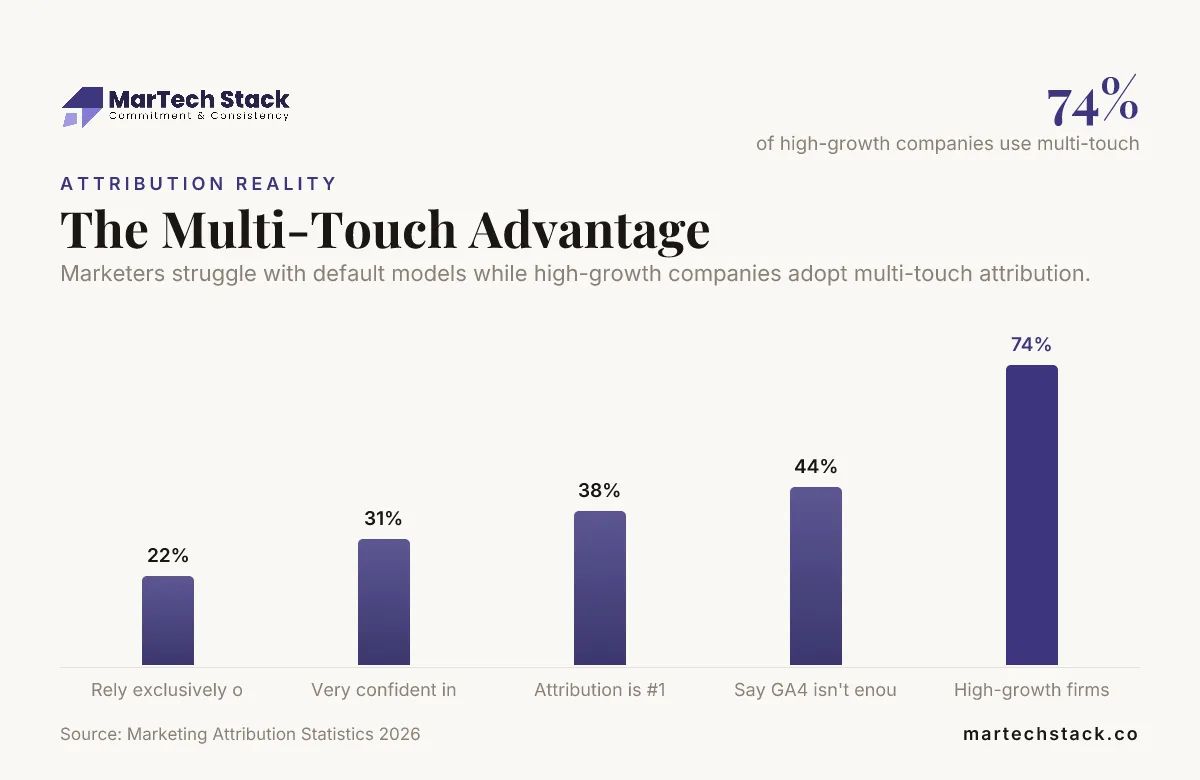
Marketers struggle with default models while high-growth companies adopt multi-touch attribution.
Web analytics dashboards, especially custom Looker Studio builds, make this visible in a way raw platform reports never can. That’s the core of our web analytics work: turning scattered data into a picture you can actually act on.
SEO Consulting and Attribution: Why Organic Visibility Gets Miscredited
Organic traffic is one of the biggest casualties of default channel grouping. A visitor discovers you through a helpful piece of content, leaves, comes back through a branded search, then converts.
Default logic often hands that entire conversion to “Direct” or “Branded Search,” erasing the organic discovery step that started everything.
This is where seo consulting and attribution modeling have to work together, not separately. Our SEO consulting team looks at the full journey, not just the last click, when we evaluate what content is actually driving pipeline.
Getting seo credit right matters more now than ever, because content discovery paths have gotten longer and messier, not shorter.
How AI, LLM Traffic, and AI SEO Are Breaking Default Channel Groupings Further
2026 has brought a new wrinkle nobody’s default settings were ready for: traffic coming from AI tools and llm-powered search experiences.
When someone gets a recommendation from an ai chat assistant and then visits your site directly, most default channel grouping logic files that as “Direct.” It has no category for “AI-influenced,” even though that influence is very real.
This is a fast-growing gap in ai seo strategy. Businesses tracking ai seo performance closely are already building custom channel definitions to catch this traffic before it disappears into a meaningless “Direct” bucket.
We’re watching this shift closely across every martech stack we work inside of, because it’s only going to grow through the rest of 2026 and beyond.

Our 3-Step Roadmap to Fix Your Attribution Model
Untangling a sabotaged attribution model doesn’t have to feel overwhelming. We approach it the same way every time.
- Audit. We map your actual customer journey against your current default channel groupings to find every mismatch.
- Rebuild. We design custom channel definitions and reconciliation rules tailored to how your customers really move.
- Monitor. We set up dashboards that keep the new model accurate as your marketing mix evolves.
Let’s start by having an honest conversation about your needs. With your personalized plan in hand, we dive in with a collaborative spirit, and our team of passionate people puts their heads together to make things happen.
We’re more than consultants. We’re partners invested in your triumph, and this roadmap is how we get there.
Conclusion
Default channel grouping isn’t a small technical detail buried in your analytics settings. It’s actively shaping the budget decisions your whole team makes, and it’s usually getting the story wrong.
Now you understand exactly why default channel grouping is sabotaging your attribution model, and what fixing it actually involves: custom definitions, cross-platform reconciliation, and a willingness to question what the defaults told you.
MarTech Stack isn’t just a company, it’s a partnership built on trust, innovation, and results. Together, we’ll navigate the digital landscape and steer your online success story back toward numbers you can actually trust.
Ready to see what your real attribution picture looks like? Reach out to our team and let’s get started.
Frequently Asked Questions
What does “default channel grouping” mean in Google Analytics?
Default channel grouping is the built-in logic GA4 and similar tools use to sort traffic into categories like Organic Search, Paid Social, or Direct. It relies on generic rules that often miscredit conversions, which is a core reason default channel grouping is sabotaging your attribution model for many businesses.
Is default channel grouping still reliable in 2026?
Not on its own. With AI-driven search, llm referrals, and longer multi-device journeys now common, default logic misses too much context to be trusted without custom adjustments.
How do I know if my attribution model is broken?
If your reported channel performance keeps contradicting what your sales team or CRM sees, that’s a strong sign. Falling confidence in your numbers, like the 69% of marketers who aren’t fully confident in their models, is another red flag.
Can fixing attribution actually save money?
Yes. Proper attribution reduces wasted ad spend by 27%, and companies using it effectively report 15 to 30% higher marketing ROI overall.
Do I need to replace GA4 to fix default channel grouping issues?
No. Most fixes involve layering custom channel definitions, better UTM discipline, and reconciled data analysis on top of GA4, not replacing the platform entirely.
How does seo consulting connect to attribution modeling?
Organic search often gets undercredited by default rules because visitors return through branded search or direct traffic later in their journey. Good seo consulting factors in that full path instead of only crediting the last click.
What role does ai seo play in attribution going forward?
As more customers discover businesses through ai tools and llm-powered assistants, attribution models need custom categories to capture that influence. Without it, ai seo-driven traffic gets buried under generic “Direct” labels and never gets proper credit.

Founder of MarTech Stack. SEO, analytics and marketing automation.
LinkedIn