

The modern B2B buyer journey now stretches across 272 days and 88 touchpoints, up from 211 days just two years ago. If your team is still crediting one channel for the entire sale, you’re not measuring reality. That’s exactly why attribution models in marketing have become the backbone of every serious growth journey we build alongside our clients.

Key Takeaways
| Model | Best For | Main Limitation |
|---|---|---|
| First-Touch | Awareness-stage reporting | Ignores everything after the first click |
| Last-Touch | Short sales cycles, direct response | Undervalues nurturing channels like email |
| Linear | Teams wanting a simple, fair baseline | Treats every touchpoint as equally important |
| Time-Decay | Longer B2B sales cycles | Can still undercredit early awareness work |
| Position-Based (U-Shaped) | Businesses that value both discovery and conversion | Middle-of-funnel touches still get shortchanged |
| Data-Driven | Enterprises with enough volume and clean data | Requires strong data analysis infrastructure to trust it |
A few quick answers to what B2B leaders ask us most:
- Which attribution model is most accurate? Data-driven attribution, when built on clean data, consistently outperforms rules-based models.
- Can I use more than one model? Yes, and most mature teams do, comparing models side by side before committing to one for budget decisions.
- Do attribution models replace marketing mix modeling? No, they answer different questions and work best as complementary tools.
- How often should we revisit our model? At minimum annually, or whenever your web analytics setup changes significantly.
- Is data-driven attribution worth the investment? For most companies with real conversion volume, yes. We’ll cover exactly when in this article.
What Are Attribution Models in Marketing, and Why They Matter in 2026
Attribution models in marketing are the rules you use to assign credit for a conversion across every touchpoint a buyer interacts with. That sounds simple. It isn’t.
Every channel, every email, every ad impression plays some role in the decision. The question is how much role, and that’s where most teams get it wrong.
Enterprise adoption of multi-touch attribution has reached 41%, but only 18% of those implementations are rated as highly accurate. That gap between adoption and actual accuracy is the whole reason this article exists.
We’ve built our practice on the belief that data-driven isn’t a buzzword, it’s a discipline. Getting attribution right means your budget goes where it actually works, not where the last click happened to land.
First-Touch Attribution: Crediting the Spark That Started the Journey
First-touch attribution gives 100% of the credit to the very first interaction a prospect had with your brand. Someone finds you through a blog post, a paid ad, or a referral, and that single moment gets all the glory.
This model is easy to set up and easy to explain to a boardroom. It’s genuinely useful when you’re evaluating pure awareness efforts and want to know what’s actually bringing new people into your funnel.
The problem is obvious once you say it out loud. Everything that happened after that first click, the nurture emails, the retargeting, the demo request, gets zero credit.
If your buyer journey is short and simple, first-touch can work as a directional signal. For anything more complex, it’s a starting point, not a strategy.

Last-Touch Attribution: Why the Default Model Falls Short
Last-touch is the model most tools default to because it’s the easiest to track. Whatever channel a buyer interacted with right before converting gets all the credit.
Here’s the uncomfortable truth: under last-touch models, email marketing receives only 8% of credit despite being involved in 28% of touchpoints. That’s not a small rounding error. That’s a systemic blind spot that leads teams to defund the exact channels doing the nurturing work.
Last-touch still has a place. If you’re running a direct-response campaign with a genuinely short path to purchase, it’s fine.
But if you’re a B2B company with a multi-month sales cycle, last-touch alone will actively mislead your budget decisions. We see it constantly in the data analysis work we do for clients.
Linear Attribution: Spreading Credit Evenly Across Every Touchpoint
Linear attribution splits credit equally across every touchpoint in the journey. If a buyer touched six channels before converting, each one gets roughly 16.7% of the credit.
This is a fair compromise, and it’s a genuine improvement over single-touch models. It acknowledges that the journey is a journey, not a single moment.
The trade-off: it assumes every touchpoint matters equally, which almost never reflects reality. A single retargeting ad clicked in passing shouldn’t count the same as a 45-minute demo call.
Still, linear is a solid transitional model for teams moving away from single-touch reporting for the first time. It’s honest, it’s easy to explain, and it forces stakeholders to acknowledge the full path.
Time-Decay Attribution: Giving Recent Touchpoints More Weight
Time-decay attribution assigns more credit to touchpoints that happened closer to the actual conversion. Early awareness touches still get something, but the weighting increases as the buyer moves closer to the decision.
This model tends to fit longer B2B sales cycles well. It reflects the reality that a case study a buyer read three days before signing probably influenced them more than an ad they scrolled past six months earlier.
Time-decay isn’t perfect either. It can still shortchange the awareness-stage content that got the buyer into the funnel in the first place, which matters when you’re trying to prove the value of top-of-funnel work.
We recommend time-decay for companies with sales cycles longer than 60 to 90 days who want more nuance than linear can offer without jumping straight into full data-driven modeling.

Position-Based (U-Shaped) Attribution: Balancing First and Last Touch
Position-based attribution, often called U-shaped, gives the bulk of credit to the first and last touchpoints, typically 40% each, with the remaining 20% spread across everything in between.
The logic here is straightforward. The first touch generated the lead, the last touch closed it, and both deserve real recognition.
This model works well for companies that want to protect budget for both top-of-funnel discovery content and bottom-of-funnel conversion tactics. It’s a favorite among teams running both content marketing and paid retargeting programs.
The weakness is the middle. Nurture sequences, webinars, and sales enablement content in the middle of the journey still get squeezed into that thin 20% slice, even when they did real work.
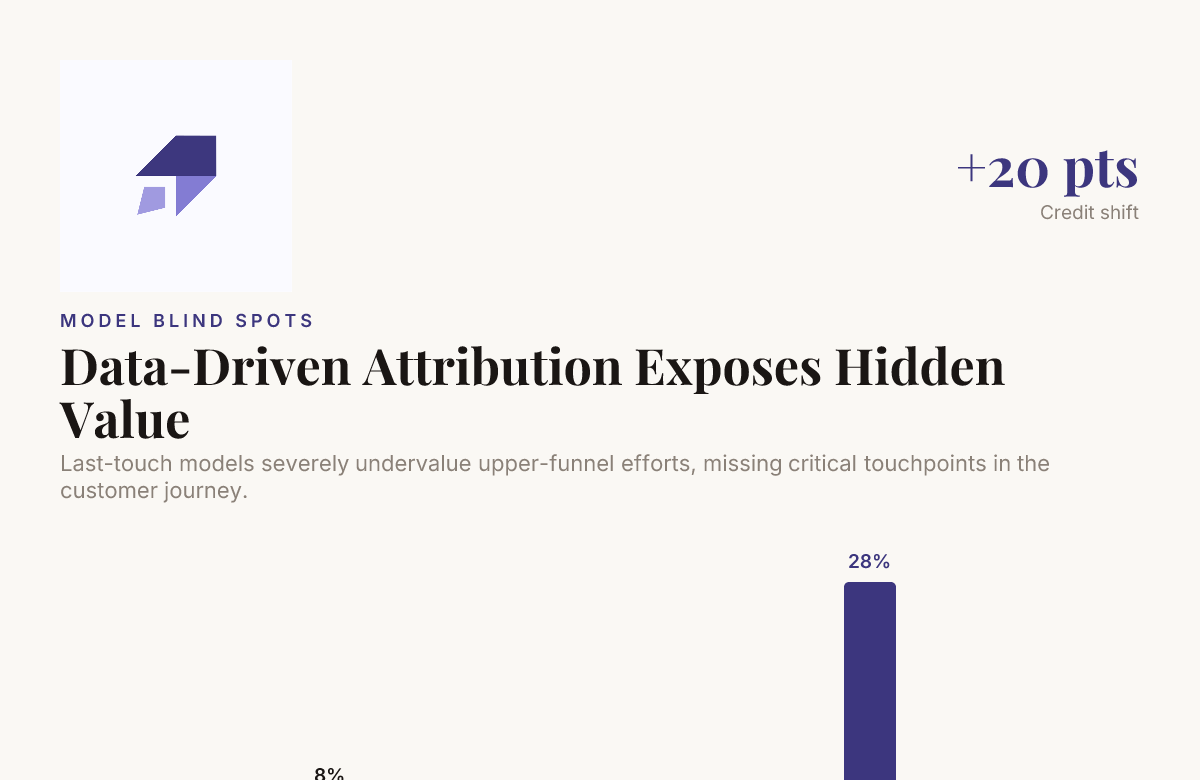
Last-touch models severely undervalue upper-funnel efforts, missing critical touchpoints in the customer journey.
Data-Driven Attribution: Where AI, Machine Learning, and Data Analysis Meet
Data-driven attribution uses statistical modeling and machine learning to assign credit based on actual patterns in your conversion data, not a fixed rule. It looks at thousands of converting and non-converting paths and calculates what each touchpoint genuinely contributed.
This is where AI stops being a buzzword and starts doing real work. The model learns from your specific customers, your specific channels, and your specific sales cycle, rather than applying a one-size-fits-all formula.
Companies using data-driven attribution grow revenue 1.7x faster than those relying on traditional rules-based models. That’s not a marginal edge. That’s a meaningfully different growth journey.
The catch: data-driven attribution needs volume. You need enough conversions flowing through your digital web analytics setup for the model to find real statistical patterns rather than noise.
It’s also worth being honest about adoption. Only 7% of marketers currently use data-driven algorithmic attribution, though that number is growing at 44% year-over-year. If your organization has the data foundation, now is a genuinely good time to make the move.
How to Choose Attribution Models in Marketing for Your Business
Choosing between attribution models in marketing isn’t about picking the “best” one in the abstract. It’s about matching the model to your sales cycle, your data maturity, and what decisions you actually need to make.
Here’s the roadmap we walk clients through:
- Map your actual buyer journey. Pull the real touchpoint data before assuming you know the path.
- Check your data volume. Data-driven models need meaningful conversion counts to be statistically trustworthy.
- Match the model to the sales cycle. Short cycles can lean on last-touch or linear; longer cycles need time-decay or data-driven.
- Test more than one model in parallel. Compare outputs before you make a single model your budget standard.
- Revisit the model regularly. Channels shift, buyer behavior shifts, and your model should shift with it.
Companies that switch from single-touch to multi-touch models see an average 22% increase in budget efficiency, which is exactly why this decision deserves real time and real analysis, not a default setting left on since 2019.

Attribution Models, Web Analytics, and Your Data Analysis Foundation
No attribution model is better than the data feeding it. We say this constantly, and it’s the reason our data analysis work always starts with the foundation, not the model.
Privacy regulations and browser changes have eliminated 30-40% of previously trackable conversion signals. That means the martech stack behind your attribution needs first-party data strategies now more than it ever did before.
This is where enhanced eCommerce tracking, clean tagging, and solid dashboard work matter more than the fancy algorithm sitting on top. We build data analysis workflows that give attribution models something real to learn from, because a brilliant model fed messy data still produces messy answers.
Proper attribution implementation lets marketing leaders reduce wasted ad spend by nearly 27%. That’s the kind of tangible success that gets budget conversations approved in a single meeting.
We also see clients ask whether attribution and SEO consulting should live in the same conversation. They should, because organic-driven touchpoints need to show up accurately in your model too, not get lumped into a vague “direct” bucket.
AI SEO tools and large language model-driven search are changing how people discover brands before they ever hit your site. Your attribution model needs to account for those earlier, harder-to-track influences, not pretend they don’t exist.
This is the kind of work we’re passionate about: connecting the visibility side of the business to the analysis side, so nothing falls through the cracks.
Conclusion
Picking the right attribution models in marketing isn’t a one-time decision you set and forget. It’s an ongoing part of your growth journey, one that should evolve as your buyer behavior, your channels, and your data maturity evolve alongside it.
Whether you’re starting with linear attribution as an honest baseline or moving into full data-driven modeling powered by machine learning, the goal is the same: real results you can see, and growth you can measure.
We’re not just here to hand you a report and walk away. We’re partners invested in your triumph, and we’d love to have an honest conversation about where your attribution setup stands today. Reach out and let’s talk through your specific data, or take a look at our full range of services to see where we can help first. You can also read more about who we are on our story page if you want to know the team behind the work.
Frequently Asked Questions
What is the most accurate attribution model in marketing?
Data-driven attribution is generally the most accurate because it uses machine learning to assign credit based on real conversion patterns rather than fixed rules. It does require enough data volume to be statistically reliable, so smaller companies may need to start with time-decay or position-based models first.
Which attribution model should a B2B company with a long sales cycle use?
Time-decay or data-driven attribution tend to work best for B2B companies, since buyer journeys now average 272 days and 88 touchpoints. Position-based (U-shaped) attribution is also a strong option if you want to protect credit for both awareness and closing activities.
Is last-touch attribution still worth using in 2026?
Last-touch attribution can still be useful for short, direct-response sales cycles, but it severely undervalues nurturing channels like email. For most B2B and multi-channel businesses, relying on last-touch alone leads to misallocated marketing budgets.
How is attribution modeling different from marketing mix modeling?
Attribution modeling tracks individual, touchpoint-level customer journeys, usually for digital channels, while marketing mix modeling looks at aggregate spend across channels over time, including offline media. They answer different questions and work best used together, not as substitutes for each other.
Do I need a lot of data to use data-driven attribution?
Yes, data-driven attribution needs a meaningful volume of conversions to find genuine statistical patterns rather than noise. Companies with lower conversion volume typically get more reliable results starting with time-decay or position-based models.
How often should a business review its attribution model?
We recommend reviewing your attribution model at least once a year, or any time your web analytics setup, sales cycle, or channel mix changes significantly. Buyer behavior shifts constantly, and your model needs to shift with it to stay useful.
Can AI and large language models affect how attribution models work?
Yes, AI-driven search and large language model tools are changing how people discover brands, often creating earlier touchpoints that are harder to track with traditional attribution setups. Businesses need to account for these AI SEO-influenced discovery moments when building or refining their attribution models.

Founder of MarTech Stack. SEO, analytics and marketing automation.
LinkedIn