
Did you know that 94% of B2B buyers used a generative AI tool during their most recent purchase process? That single number changes what a content strategy in SEO has to accomplish for data-driven B2B companies right now, in 2026.
Your buyers aren’t just Googling anymore. They’re asking AI tools, cross-referencing sources, and expecting your content to show up wherever they’re looking.

Key Takeaways
- A content strategy in SEO is a system, not a document. It connects topic clusters, buyer intent, and technical execution into one repeatable engine.
- Topic clusters compound. Each new piece of content strengthens the ones around it instead of starting from zero.
- Intent mapping matters more than keyword volume. B2B buyers move through research, comparison, and decision stages, and your content has to meet them at each one.
- Prioritization beats production speed. Publishing more content without a framework wastes budget and dilutes authority.
- Measurement has to include web analytics and data analysis, not just traffic. Pipeline influence and conversion quality tell the real story.
- AI and LLM visibility are now part of the job. Being cited by an AI answer is becoming as important as ranking on a results page.
- Want the full story on how we got here? Read more about our passion and approach to content and data.
What Is a Content Strategy in SEO for B2B Marketing Leaders?
Let’s define it plainly. A content strategy in SEO is the plan that decides what you publish, why you publish it, and how each piece supports the ones already live.
For B2B teams, that plan has to account for longer sales cycles, multiple stakeholders, and buying committees who research long before they ever fill out a form.
We’ve seen too many teams treat content and SEO as separate departments. That’s a mistake.
The strongest content and SEO programs we build treat them as one discipline: content built for humans, structured so machines and algorithms can understand it too.
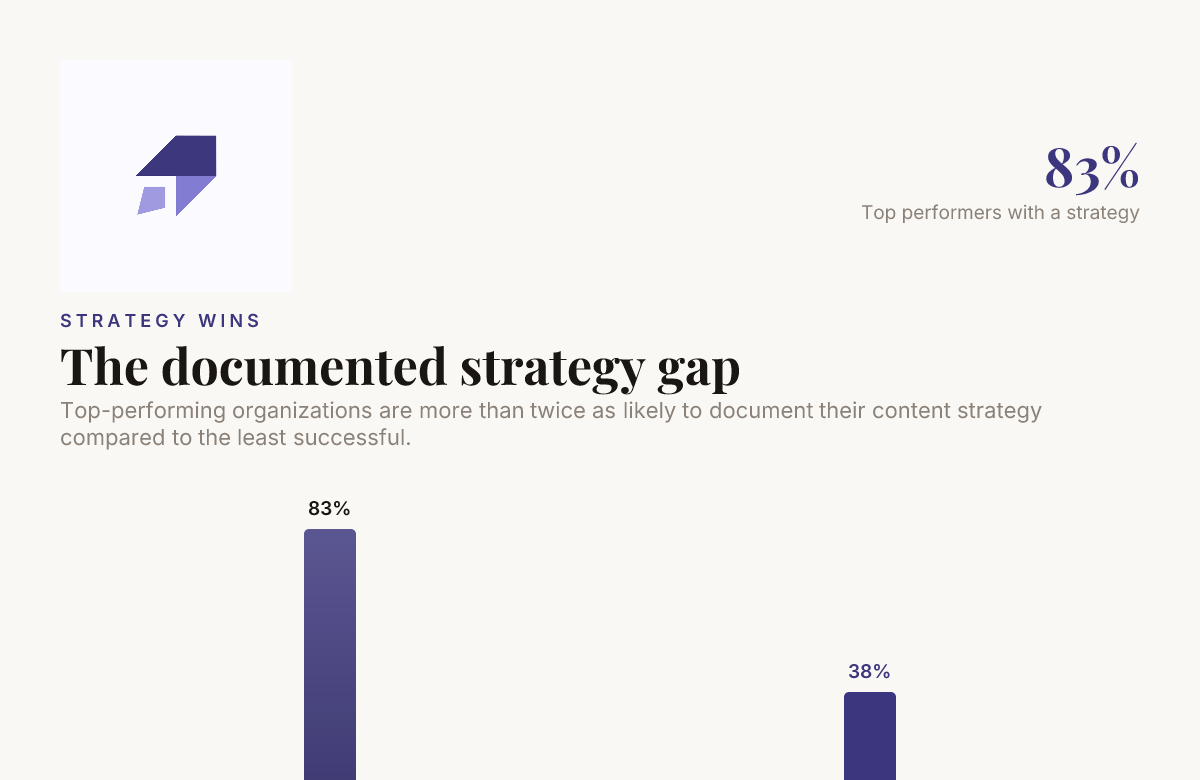
Top-performing organizations are more than twice as likely to document their content strategy compared to the least successful.
That gap is real. Teams with a written, documented plan simply outperform teams working off instinct.
Topic Clusters: The Foundation of a Content Strategy in SEO That Compounds
Topic clusters are the backbone of any content strategy in SEO built to last.
Instead of writing isolated articles, you build a pillar page around a core topic, then support it with cluster content that links back and reinforces the whole group.
Here’s why this compounds:
- Authority builds over time. Every new cluster piece adds weight to the pillar it supports.
- Internal linking does the heavy lifting. Readers (and algorithms) can navigate your entire topic landscape in a few clicks.
- Old content stays relevant. A well-built cluster gets refreshed and referenced instead of forgotten.
Think of your content library as a growth journey, not a pile of assets. Each cluster is a chapter, and every chapter should make the next one easier to write and rank.

Intent Mapping: Aligning Content Strategy in SEO With the B2B Buyer Journey
Keywords tell you what people type. Intent tells you why they’re typing it.
A mature content strategy in SEO maps every piece of content to a stage: awareness, consideration, or decision. Skip this step, and you’ll end up with a blog full of traffic that never converts.
| Buyer Stage | Search Intent | Content Type |
|---|---|---|
| Awareness | Informational | Guides, definitions, industry explainers |
| Consideration | Comparative | Comparison pages, “vs” content, buyer checklists |
| Decision | Transactional | Case studies, pricing pages, consulting pages |
Our data-driven SEO consulting work always starts here. We map intent before we write a single word.
Once intent is mapped, the roadmap for what to build next practically writes itself.
Prioritization: Choosing What to Build First
You can’t build everything at once. Prioritization is where a good content strategy in SEO either takes off or stalls out.
We score opportunities on three factors: business value, competitive gap, and effort. Anything scoring high on all three jumps the queue.
That number isn’t a coincidence. B2B companies that prioritize with discipline see tangible success faster because they’re not spreading budget across low-value topics.
Prioritization also protects your team’s energy. We’re passionate about this work, but even the most passionate team burns out chasing topics that were never going to move the needle.
Measurement: How Web Analytics and Data Analysis Prove Compounding ROI
You can’t manage what you don’t measure. A content strategy in SEO needs real numbers behind it, not vibes.
This is where web analytics earns its keep. Dashboards should show you which pieces are driving pipeline, not just pageviews.
Good data analysis goes beyond the dashboard. It’s time series work, forecasting, and connecting content performance to actual revenue.
Here’s what we track for every B2B client:
- Organic traffic by topic cluster, not just by page
- Assisted conversions from informational content
- Content-to-pipeline attribution over 90+ day windows
- Citation appearances in AI-generated answers
We’re all about outcomes you can see and growth you can measure. Anything less isn’t a strategy, it’s a guess.

AI, LLM Citations, and AI SEO: The New Layer of Content Strategy in SEO
Here’s the shift nobody can ignore anymore: AI Overviews and chat-based answers are reshaping how content gets discovered.
99.9% of keywords that trigger AI Overviews are informational. That means the top-of-funnel content you build for awareness is exactly what’s getting pulled into AI answers.
And there’s a formatting lesson buried in the data too: 44.2% of all LLM citations come from the first 30% of a piece of content, the introduction. Front-load your answers. Don’t bury the point on paragraph twelve.
That’s the strongest argument yet for treating AI SEO as its own discipline within your broader content strategy in SEO. Getting cited by an LLM isn’t a vanity metric. It’s bringing in buyers who convert.
80% of technology buyers now trust generative AI as much as traditional search when researching suppliers. If your content isn’t structured to be quoted by an AI, you’re invisible to a growing share of your market.
Why SEO Consulting Still Matters in an AI SEO World
Some marketers assume AI answers replace the need for solid SEO fundamentals. The data says otherwise.
In 97% of cases, AI Overviews pull at least one cited source from pages ranking in the top 20 organic results. Traditional visibility is still the entry ticket.
This is exactly why SEO consulting hasn’t gone away. If anything, it’s more important, because now you’re optimizing for two audiences at once: human readers and AI systems summarizing your work.
We’re more than consultants. We’re partners invested in your triumph, and that means keeping both fronts covered at the same time.

Our Approach: Where Martech, Content, and Data Meet
At MarTech Stack, we treat content strategy in SEO as a dual discipline: the visibility side and the analysis side, working together.
Our team of passionate people puts their heads together to combine keyword research, technical SEO, and data-driven insight into one tailored roadmap.
Let’s start by having an honest conversation about your needs. With your personalized plan in hand, we dive in with a collaborative spirit, and we don’t stop until the numbers move.
Curious how we’ve helped other teams navigate their digital landscape? Take a look through our latest thinking on content and SEO.
Conclusion
A content strategy in SEO isn’t a one-time project. It’s a compounding system built on topic clusters, honest intent mapping, disciplined prioritization, and measurement that includes web analytics and data analysis side by side.
Layer in AI SEO and LLM visibility, and you’ve got a framework built for how B2B buyers actually research and buy in 2026, not how they did five years ago.
Ready to build yours? Reach out to our team and let’s map out your roadmap together.
Frequently Asked Questions
What is a content strategy in SEO?
A content strategy in SEO is a planned system for creating content that supports both audience needs and technical performance, organized around topic clusters and buyer intent. It connects individual pages into a compounding structure rather than treating each piece as a one-off.
How is content strategy in SEO different for B2B companies?
B2B content strategy in SEO has to account for longer sales cycles, multiple decision-makers, and research-heavy buyers who compare options over weeks or months. It typically leans more on consideration-stage and decision-stage content than consumer strategies do.
Do topic clusters really improve results over time?
Yes. Topic clusters compound because each new piece reinforces the authority of the pillar page and the cluster around it, instead of starting from zero every time you publish.
Is content strategy in SEO still worth investing in with AI Overviews everywhere?
It’s worth it precisely because of AI Overviews. In 97% of cases, AI-generated answers pull from pages already ranking in the top 20 organic results, so strong SEO fundamentals remain the entry point to AI visibility.
How do you measure whether a content strategy in SEO is working?
Measurement should combine web analytics for traffic and engagement with data analysis for pipeline and revenue attribution. Look at conversions by topic cluster, not just raw traffic numbers.
What role does AI SEO play in content strategy in SEO today?
AI SEO focuses on getting your content cited inside AI-generated answers and chat tools, which is becoming as important as traditional visibility. Since 44.2% of LLM citations come from the first 30% of an article, formatting your introduction to answer questions directly matters more than ever.
Should I hire SEO consulting help or build a content strategy in SEO in-house?
It depends on your team’s bandwidth and existing data maturity, but SEO consulting can shortcut months of trial and error, especially around intent mapping and prioritization. Many B2B teams combine an in-house content team with outside consulting for technical audits and data analysis.

Founder of MarTech Stack. SEO, analytics and marketing automation.
LinkedIn