
Did you know that an estimated 25% of all web pages receive zero internal links? These “orphan pages” sit invisible, disconnected, and nearly impossible for crawlers to find. If you’re serious about internal linking in seo, that stat alone should change how you think about your site architecture.
At MarTech Stack, we see this mistake constantly in B2B site audits. Pages with real value, sitting orphaned, contributing nothing to the growth journey your content deserves.

Key Takeaways
- Internal linking in seo distributes link equity from your strongest pages to pages that need authority.
- Hub-and-spoke architecture (topic clusters) builds topical authority faster than isolated pages ever could.
- Anchor text matters, exact-match anchors correlate with significantly higher traffic to the linked page.
- Click depth is a ranking factor by proxy: priority pages should sit within three clicks of your homepage.
- Orphan pages are a silent killer of crawlability and organic visibility.
- Regular audits are non-negotiable if you want to catch broken links, thin anchors, and buried content before it costs you traffic.
- Need a second set of eyes on your architecture? Our SEO consulting team builds link structures around your actual business priorities, not guesswork.
What Is Internal Linking in SEO, and Why Does It Matter for B2B?
Internal linking in seo is the practice of connecting pages on your own domain to one another through hyperlinks. Simple concept. Massive impact.
For B2B companies, the buyer journey is long and layered. Prospects move from awareness content to comparison pages to case studies before they ever fill out a form.
Internal links guide that journey. They also guide crawlers through your digital landscape, telling them which pages matter most and how everything connects.
Three things happen when internal linking works well:
- Crawlability improves. Crawlers discover new and updated pages faster when they’re linked from established, frequently-crawled pages.
- Link equity distributes. Authority from your strongest pages flows to pages that need a boost.
- Topical authority builds. A tightly linked cluster of related content signals depth and expertise on a subject.
We built our own MarTech Stack homepage around this exact principle: mapping user journeys and distributing link equity across the site to improve navigation and performance.
Crawlability, Link Equity, and Topical Authority: The Three Pillars
Let’s break these down individually, because each one solves a different problem.
Crawlability is about discovery. If a page has no internal links pointing to it, crawlers may never find it, no matter how good the content is.
Link equity (sometimes called “link juice”) is the authority passed from one page to another through a hyperlink. Your homepage and top-performing pages typically carry the most equity, so where you point those links matters enormously.
Topical authority is the cumulative signal that you’re a credible source on a subject. This is built by linking related pages together into a coherent structure, not by publishing isolated articles that never reference each other.
One case study documented a jump in Googlebot crawl coverage from 40% to 70% after a site restructured its internal linking strategy, a 30 percentage-point swing driven almost entirely by better internal connectivity.
That’s not a small win. That’s the difference between content that gets discovered and content that quietly disappears.

Hub-and-Spoke Architecture: Building Topic Clusters for Real Authority
Hub-and-spoke (or topic cluster) architecture is the single most effective structural fix for B2B sites drowning in disconnected content.
Here’s how it works:
- Pick a hub page. This is your broad, comprehensive resource on a core topic (think: a pillar page on “seo consulting” or “data analysis”).
- Build spoke pages. These are narrower, related pages that dive into subtopics.
- Link bidirectionally. The hub links out to every spoke, and every spoke links back to the hub.
- Cross-link spokes where relevant. Not every spoke needs to link to every other spoke, but related ones should.
For example, our services overview page acts as a hub, connecting out to specialized pages covering seo consulting, digital web analytics, and data analysis. Each of those spoke pages links back to the hub and reinforces the overarching theme.
This architecture isn’t just tidy. It’s how you signal depth on a topic to anyone (human or crawler) trying to understand what your business actually knows.
Anchor Text Best Practices for Internal Linking in SEO
Anchor text is the clickable phrase in a hyperlink, and it’s more influential than most B2B marketing teams realize.
That’s not a fluke. Descriptive, relevant anchor text tells both readers and crawlers exactly what they’ll find on the other end of the click.
A few rules we follow on every project:
- Be descriptive, not generic. “Learn more about our data analysis approach” beats “click here” every time.
- Vary your anchors. Repeating the exact same phrase on every link looks manipulative and can flag over-optimization.
- Match anchor text to page content. The anchor should accurately preview what’s on the destination page.
- Keep it natural. If the anchor reads awkwardly in the sentence, rewrite the sentence, not just the link.
Want a second opinion on your current anchor text strategy? Our data-driven SEO consulting services include a full anchor text review as part of every engagement.
Common Internal Linking Mistakes That Quietly Hurt B2B Rankings
We audit dozens of B2B sites every year, and the same mistakes show up over and over.
Orphan Pages
These are pages with zero internal links pointing to them. As we mentioned earlier, roughly a quarter of all pages fall into this trap, effectively invisible to crawlers.
Over-Optimized Anchor Text
Stuffing the exact same keyword phrase into every single anchor across your site looks unnatural and can trigger algorithmic scrutiny. Vary your phrasing.
Deep Click Depth
If a priority page sits five, six, or seven clicks from your homepage, you’ve buried it. Optimal architecture keeps important pages within three clicks of the homepage.
Dead-End Pages
Pages with no outbound internal links stop the user journey cold and waste the equity flowing into them.
Here’s a quick reference table for diagnosing these issues:
| Mistake | Symptom | Fix |
|---|---|---|
| Orphan pages | Zero inbound internal links | Link from relevant hub or spoke pages |
| Over-optimized anchors | Identical keyword phrase repeated everywhere | Diversify anchor phrasing naturally |
| Deep click depth | Priority pages buried 4+ clicks deep | Flatten architecture, add hub links |
| Dead-end pages | No outbound links on the page | Add contextual links to related content |
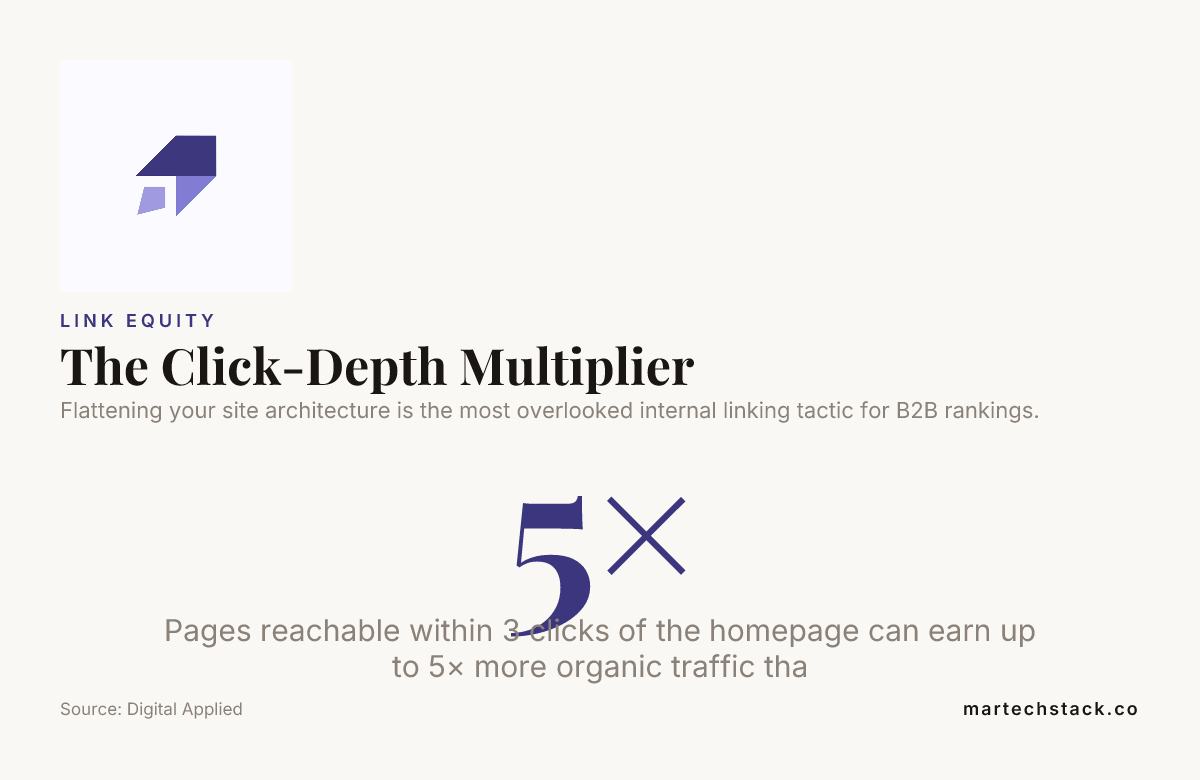
Flattening your site architecture is the most overlooked internal linking tactic for B2B rankings.

How to Audit Your Internal Linking in SEO
You can’t fix what you haven’t measured. A proper internal linking audit is part technical, part strategic.
Here’s the roadmap we walk every client through:
- Crawl your entire site. Use a crawler to map every URL and every internal link between them.
- Identify orphan pages. Cross-reference your crawl data against your sitemap and analytics platform to find pages receiving zero internal links.
- Measure click depth. Flag any priority page sitting more than three clicks from your homepage.
- Audit anchor text distribution. Look for repetitive or generic anchors that need variation.
- Check for broken internal links. Dead links waste equity and frustrate readers.
- Cross-reference with web analytics. Which pages get traffic but low internal support? Those are your priority fixes.
We pair this process with our own digital web analytics services, because link structure and user behavior data tell two halves of the same story.
A Practical Implementation Workflow for Internal Linking in SEO
Auditing is only half the work. Implementation is where the real growth journey begins.
Our team follows a straightforward, three-step approach with every client:
- Step 1: Honest assessment. We start by having an honest conversation about your current architecture and where the gaps sit.
- Step 2: Tailored linking plan. With your personalized plan in hand, we map out hub pages, spoke pages, and the exact anchor text to use for each connection.
- Step 3: Collaborative rollout. We dive in with a collaborative spirit, implementing links in priority order (highest-traffic pages first) and monitoring the impact.
This isn’t a one-time project. Internal linking in seo needs ongoing maintenance every time you publish new content, retire old pages, or restructure your services.
Where AI, LLMs, and Web Analytics Fit Into the Bigger Picture
The rise of ai and llm-driven search tools hasn’t made internal linking obsolete. If anything, it’s made structure more important.
AI seo tools increasingly rely on well-structured content to understand context and relationships between pages. A site with strong topical clusters gives these systems (and traditional crawlers) a clearer map to work from.
This is where the data-data duality comes in. Combining seo structure with real data analysis lets you see not just how pages are linked, but how people actually move through them.
Our data analysis services exist specifically to close that loop, turning raw link and behavior data into decisions you can act on.

Why This Matters More for B2B Than You Think
B2B buying cycles are longer, more research-heavy, and more skeptical than consumer purchases. Every page a prospect touches (case study, service page, comparison guide) needs to feel connected to a bigger story.
Internal linking in seo is the mechanism that tells that story. Done right, it turns a scattered collection of pages into a coherent online success story that builds trust with every click.
We’ve built our own site around this principle from the ground up. You can read more about how that philosophy shapes our work on our our story page.
Conclusion
Internal linking in seo isn’t a technical afterthought. It’s a growth lever that most B2B teams leave sitting on the table.
Fix your orphan pages. Flatten your click depth. Diversify your anchor text. Build real topic clusters instead of scattered content islands.
We love what we do, and we rock at internal linking in seo because we treat it as a partnership, not a checklist. If you’re ready to turn your site architecture into a genuine competitive advantage, reach out to our team and let’s map out your roadmap together.
Frequently Asked Questions
What is internal linking in seo, exactly?
Internal linking in seo refers to hyperlinks that connect pages within the same domain to each other. These links help crawlers discover content, distribute authority across your site, and guide visitors through related material.
How many internal links should a page have?
There’s no fixed number, but priority pages should receive enough internal links to sit within three clicks of your homepage. Focus on relevance over volume, every link should make sense in context.
Is internal linking still important in 2026 with ai seo tools?
Yes, arguably more so. AI seo systems and llm-based tools rely on clear content structure to understand relationships between pages, and internal linking in seo is exactly how you build that structure.
What’s the difference between hub-and-spoke architecture and regular internal linking?
Regular internal linking is often ad hoc, connecting pages loosely as content gets published. Hub-and-spoke architecture is a deliberate topic cluster model where a central hub page links to and from a set of related spoke pages.
Can bad internal linking actually hurt my rankings?
Yes. Orphan pages, over-optimized anchor text, and deep click depth all limit how well your content gets discovered and credited, which can suppress visibility even when the content itself is strong.
How often should I audit my internal linking structure?
We recommend a full audit at least twice a year, plus a lighter check every time you publish a major content batch or restructure your services pages. Ongoing web analytics review helps catch issues between formal audits.
Should I hire seo consulting help for internal linking, or handle it in-house?
It depends on your team’s bandwidth and technical crawling tools. Many B2B teams bring in seo consulting support specifically for the audit and architecture-mapping phase, then manage day-to-day link additions internally.

Founder of MarTech Stack. SEO, analytics and marketing automation.
LinkedIn