


Google’s AI Mode answers a large share of queries without ever sending a click to an outside site. That shift explains why every B2B marketing team we talk to is suddenly asking the same question: which ai seo tools actually move the needle, and which ones are just dashboards with a chatbot bolted on?
We’ve spent the last few years building content, technical audits, and internal linking structures for B2B brands, and we’ve watched the tool market get crowded fast. This guide breaks down what the real categories of ai seo tools do well, where they still need a human in the loop, and how to evaluate them without falling for the hype.
Key Takeaways
| Question | Short Answer |
|---|---|
| Are ai seo tools worth adopting in 2026? | Yes, for research, drafting speed, and technical audits. No tool replaces judgment on strategy or brand voice. |
| What’s the biggest gap in most teams’ stacks? | Tracking visibility inside AI answers. Most teams optimize for it without measuring it. |
| Do ai keyword research tools still matter if AI Overviews reduce clicks? | Yes. Topic and intent data still shapes what gets built and what gets cited. See our content strategy framework. |
| Can ai content optimization tools replace writers? | They speed up drafting and structure. Voice, accuracy, and original insight still need a person. |
| Do I need a dedicated ai seo audit tool? | Yes for sites over a few hundred pages. Log file patterns and crawl budget issues are hard to catch by hand. |
| What’s the fastest-growing category? | Generative engine optimization tools built to track citations in ChatGPT, Perplexity, and AI Overviews. |
| Where should I start if I only pick one category? | Internal linking and content structure. See our internal linking guide before adding new tools. |
What AI SEO Tools Actually Do Well (and Where They Don’t)
Let’s be plain about this. AI seo tools are genuinely good at pattern recognition across large data sets. They cluster keywords, spot crawl errors across thousands of URLs, and draft a first-pass outline in seconds.
What they’re not good at is knowing your business. They don’t know which client story actually converts, which product angle your sales team hears in every call, or which competitor claim is technically true but misleading.
That gap is exactly where a partnership with a real team still matters. We’re not here to tell you tools are bad. We’re here to tell you where the line sits.
- Good at: volume, pattern detection, first drafts, crawl-scale audits.
- Weak at: nuance, brand judgment, prioritization, knowing what’s worth building at all.
AI Keyword Research Tools: Finding What People Actually Search
Traditional keyword tools built lists around search volume. Modern ai keyword research tools go further. They cluster by intent, surface question-based queries, and increasingly flag which topics are already showing up inside AI-generated answers.
That last part matters more every quarter. The page types that get cited differ by engine: product and comparison pages tend to surface in chatbot answers, while list-style and how-to formats show up more often in AI Overviews. That’s a real signal for how you structure new pages, not just what keywords you target.
A good research tool will tell you what to write about. It won’t tell you why your audience should care, or how that topic fits your broader growth journey. That strategic layer is still a human job, and it’s the piece we build into every SEO consulting engagement.

AI Content Optimization Tools for Briefs and Drafting
The shift here has been fast. Two years ago, most marketing teams we spoke to weren’t using AI for blog drafting at all. Now it’s the exception to find one that doesn’t, which tells you how quickly ai content optimization tools went from novelty to standard practice.
These tools are genuinely useful for structure. They can build a brief with headers, target entities, and competitor gaps in a fraction of the time it takes a person to research the same thing manually.
Where they fall short is originality and trust. An AI draft tends to sound like every other AI draft unless a real editor reshapes it around your actual expertise and tone. We treat AI drafts as a starting point, never a finished piece, because that’s the only way the content stays tied to a content strategy that compounds instead of blending in.
AI SEO Audit Tools for Technical Crawling and Log Analysis
This is where AI genuinely earns its keep. An ai seo audit tool can crawl tens of thousands of pages, cross-reference server log data, and flag crawl budget waste far faster than any manual spreadsheet review.
Log analysis in particular is a category where AI shines. It can spot which bots are hitting which pages, where crawl frequency has dropped, and which sections of a site are being ignored entirely by both traditional crawlers and AI agents.
Schema markup checks fall into this bucket too. AI audit tools can flag missing or broken structured data at scale, which matters more now that AI answer engines lean on schema to understand page context quickly. What they can’t do is decide which fixes matter first when your dev team only has capacity for three changes this sprint. That prioritization is still a judgment call, and it’s a core part of the data analysis work we do alongside technical audits.
Internal Linking: Where AI Tools Still Need a Human Map
Internal linking is one of the most undervalued levers in a B2B site, and it’s also one of the trickiest for AI tools to handle alone.
AI-based systems depend on clean, crawlable internal structure to understand how your pages relate to each other. A tool can suggest links based on shared keywords or topical overlap, but it can’t always tell you which page actually deserves to pass authority to another.
That’s a strategic decision. It requires knowing which pages you want AI agents and traditional crawlers to treat as your authority pages, and building the map on purpose rather than letting a tool auto-suggest links based on surface-level similarity. We walk through this in detail in our internal linking framework, and it’s usually the single highest-leverage fix we make on a new client site.

Generative Engine Optimization Tools for AI Answer Visibility
Generative engine optimization tools are the newest category on this list, and arguably the most important one right now. Their job is simple to describe: track whether your brand actually gets cited when someone asks ChatGPT, Perplexity, or Google’s AI Mode a relevant question.
The honest pattern here is a winner-takes-most dynamic. In most categories we’ve looked at, a small handful of brands soak up the majority of AI-generated mentions, which means visibility in this space is concentrated rather than evenly spread.
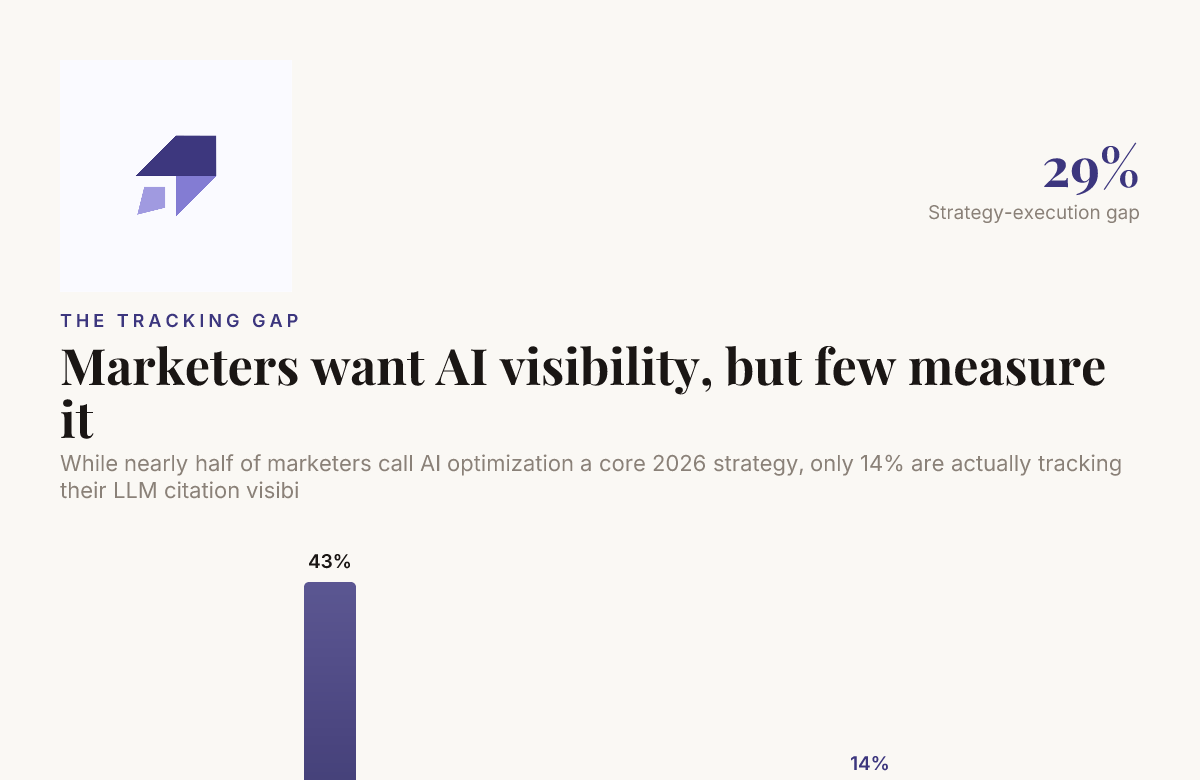
Survey data from Goodfirms: while nearly half of marketers call AI optimization a core 2026 strategy, only 14% are actually tracking their LLM citation visibility.
That gap between strategy and measurement is the real story right now. Plenty of teams say AI optimization is a priority, but very few have a tool actually confirming whether it’s working. If you’re only picking one new tool category to add this year, this is a strong candidate, because you can’t improve what you’re not tracking.
Reporting and Automation: Making Your AI SEO Software Work Harder
Reporting is where a lot of ai seo software quietly pays for itself. Automated dashboards that pull traffic, rankings, and now AI citation data into one view save teams real time every week.
Teams that wire AI into the reporting workflow tend to get a full day back each week, mostly from work nobody enjoyed doing by hand. That time saving is real, but it only shows up if the automation is set up correctly from the start, which is why we spend time on setup and QA before we ever hand a client a dashboard.
The part automation still can’t do is tell your leadership team what the numbers mean for the business. A chart showing traffic up 12% doesn’t explain whether that traffic is converting, and reporting tools rarely connect that dot without a person interpreting it. That’s the gap our web analytics work is built to close.
How to Evaluate AI SEO Software Before You Buy
With so many options claiming to be the best ai seo tools on the market, it helps to have a short, practical checklist before you sign a contract.
- Data transparency: Can you see where a recommendation came from, or is it a black box?
- Export flexibility: Can you pull raw data out, or are you locked into their dashboard?
- Update frequency: How often does the tool refresh crawl data and AI citation tracking?
- Team fit: Does it require a dedicated analyst, or can your existing team run it?
- Category coverage: Does it cover one job well, or claim to do everything mediocrely?
A quick gut check we use with clients: if a tool can’t explain its own recommendation in plain language, treat that recommendation with some skepticism. The best ai tools for seo augment a strategy that already exists. They don’t replace the strategy itself.

Fitting AI SEO Tools Into an Existing Workflow
The teams that get the most out of ai seo tools don’t rip out their whole process and start over. They add tools one category at a time, and they measure what changes before adding the next one.
A practical rollout usually looks like this:
- Start with an honest audit. Know what’s actually broken before you add a new tool to fix it.
- Pick one category to solve first. Usually technical crawling or content briefs, since those show results fastest.
- Build the internal linking map by hand. Let tools suggest, but keep a person making the final call.
- Add visibility tracking last. You need content and structure in place before tracking AI citations means anything.
Adoption isn’t the hard part anymore. Nearly every marketing team is using AI somewhere in the workflow, so sequencing and judgment are what separate the teams getting results from the ones paying for licences. That’s the part of the process we walk through with clients directly, and it’s why every engagement starts with an actual conversation, not a tool recommendation. If you want to talk through where your stack has gaps, reach out to our team and we’ll map it out together.
Conclusion
The category of ai seo tools has matured fast, and most of it genuinely works. Keyword clustering, technical audits, drafting support, and now AI citation tracking all save real time and surface real patterns a person would miss.
None of it replaces the judgment calls that actually drive results: which topics matter to your buyers, which pages deserve internal authority, and which draft is actually ready to publish. The teams winning with ai seo software in 2026 are the ones pairing it with people who know their business, not the ones hoping the tool does the thinking for them. We’ve built our whole approach around that pairing, and we’d rather be honest about where the tools stop than sell you a shortcut that doesn’t exist.
Frequently Asked Questions
What are the best ai seo tools for a small B2B team in 2026?
The right mix depends on your biggest gap, but most small teams get the most value starting with an ai seo audit tool for technical health and an ai content optimization tool for drafting speed. Add generative engine optimization tools once your content foundation is solid.
Are ai seo tools worth the cost in 2026?
For most B2B teams, yes, particularly for technical audits and reporting automation where time savings are immediate. The value drops off if you expect the tool to replace strategic thinking rather than support it.
Can ai keyword research tools replace a strategist?
No. They speed up the discovery of topics and questions, but deciding which topics fit your actual growth plan still needs a person who understands your buyers and your business.
How do generative engine optimization tools track AI visibility?
They monitor how often and how accurately your brand or content gets cited inside answers from tools like ChatGPT, Perplexity, and Google’s AI Mode. Most track this by running sample queries regularly and logging which sources appear in the response.
Do I still need traditional SEO if I’m using AI tools for seo?
Yes. A large share of sources cited inside AI-generated answers still rank in the top 10 of traditional results, so classic optimization work remains a prerequisite, not a replacement.
What’s the biggest mistake teams make with ai seo software?
Buying a tool for every category at once instead of solving one problem well first. It’s more effective to fix technical health or content quality thoroughly before adding visibility tracking or automation layers on top.
Is internal linking still worth doing manually if I have AI tools?
Yes. AI tools can suggest links based on topic overlap, but deciding which pages should hold the most authority is a strategic call that still needs a person familiar with your site’s actual priorities.

Founder of MarTech Stack. SEO, analytics and marketing automation.
LinkedIn