

Data analytics consulting can help you answer a difficult business question, build stronger reporting, or fill a specialist skills gap. The right choice depends on the work ahead, the capabilities you already have, and who will use the results.
Key Takeaways
- Choose external support for bounded, urgent, or technically complex work your team is not equipped to deliver.
- Build in-house capability when analysis is recurring and depends on close, ongoing collaboration with your commercial teams.
- Compare full costs in euros. Include fees or salary, employer costs, recruitment, tools, preparation, management, and maintenance.
- Use a hybrid model when you need specialist foundations and want your team to own routine analysis and decisions.
- Start with the decision. Agree what people need to decide, what evidence they need, and how you will measure progress before choosing tools.
- Plan for privacy and handover. Agree data access, GDPR responsibilities, documentation, training, and ongoing ownership at the start.
What data analytics consulting covers
Data analytics consulting turns data into evidence people can use to make business decisions. It starts with a question, such as where qualified leads are being lost, which accounts need attention, or why sales performance varies across markets. Choosing a tool before defining that question can produce a dashboard or analysis nobody uses.
Data analytics consulting services can span data strategy and governance, data integration and quality, statistical or predictive analysis, and business intelligence. A project might identify inconsistent CRM definitions, connect marketing and sales records, assess the quality of conversion tracking, or build reporting around pipeline performance.
Data engineering and data analysis do different jobs. Engineering builds and maintains the pipelines, data models, and clean datasets that make information usable. Analysis interprets that information to explain patterns or support a decision. Some projects need both, but treating them as interchangeable can leave teams with results that are hard to maintain or conclusions that lack reliable foundations.
Advanced analytics, artificial intelligence, and machine learning fit when the decision and the available data justify them. If a team needs to understand changes in lead volume, a trend analysis may be easier to validate and act on than a predictive model. If the decision depends on estimating which accounts are likely to convert, predictive analytics may offer a useful next step, provided the team can assess and apply its output.
For teams that need statistical analysis and findings explained to both technical and non-technical colleagues, Data Analysis uses Python, R, and SQL to examine data and provide reports. It suits work where the business question needs a clear, evidence-based answer rather than a dashboard alone.
These needs appear across commercial functions. Marketing teams may investigate channel quality or campaign measurement; sales teams may examine lead progression and account prioritisation; finance teams may reconcile forecasts and actuals; operations teams may look for delays or uneven workloads. The methods and data differ, so define the decision in the relevant function before you set the project scope.

Choose between a consultant and an in-house analyst
Use external data analytics consulting when the work is bounded, complex, or urgent and you lack the specialist skills to deliver it. That can include statistical modelling, analytics architecture, data integration, or implementing reliable web tracking. A consultant can bring focused capacity without making a permanent role responsible for a short-term need.
An in-house data analyst is a strong fit when questions recur every week, business priorities change quickly, and the work calls for regular collaboration with marketing, sales, or finance. Internal analysts can build knowledge of your definitions, customers, and operating context as they support daily decisions.
| Option | Best fit | Consider |
|---|---|---|
| Consultant | A defined project, specialist skills, or a near-term capacity gap | How the work will be handed over and maintained |
| In-house analyst | Recurring analysis and close links to business teams | Recruitment, employer costs, tools, and the breadth of skills required |
| Hybrid team | Specialist setup followed by regular internal use | Who owns the work, definitions, and future changes |
Compare the full cost in euros over the same period, not just a consultant’s fee against an employee’s salary. Include recruitment, employer contributions and benefits, onboarding, software and data costs, time spent preparing information, management effort, and the cost of maintaining the work after delivery. Employment costs differ across European countries, so use your organisation’s local, fully loaded figures rather than a generic salary estimate.
External support can also bring an independent perspective when teams disagree about attribution, KPI definitions, or what explains a change in performance. Keep business context and final decisions with your organisation, and ask the consultant to make assumptions and evidence visible so leaders can challenge and use the findings.
A historical US spending comparison shows a mix of internal and external capability. It is not a current European cost guide.
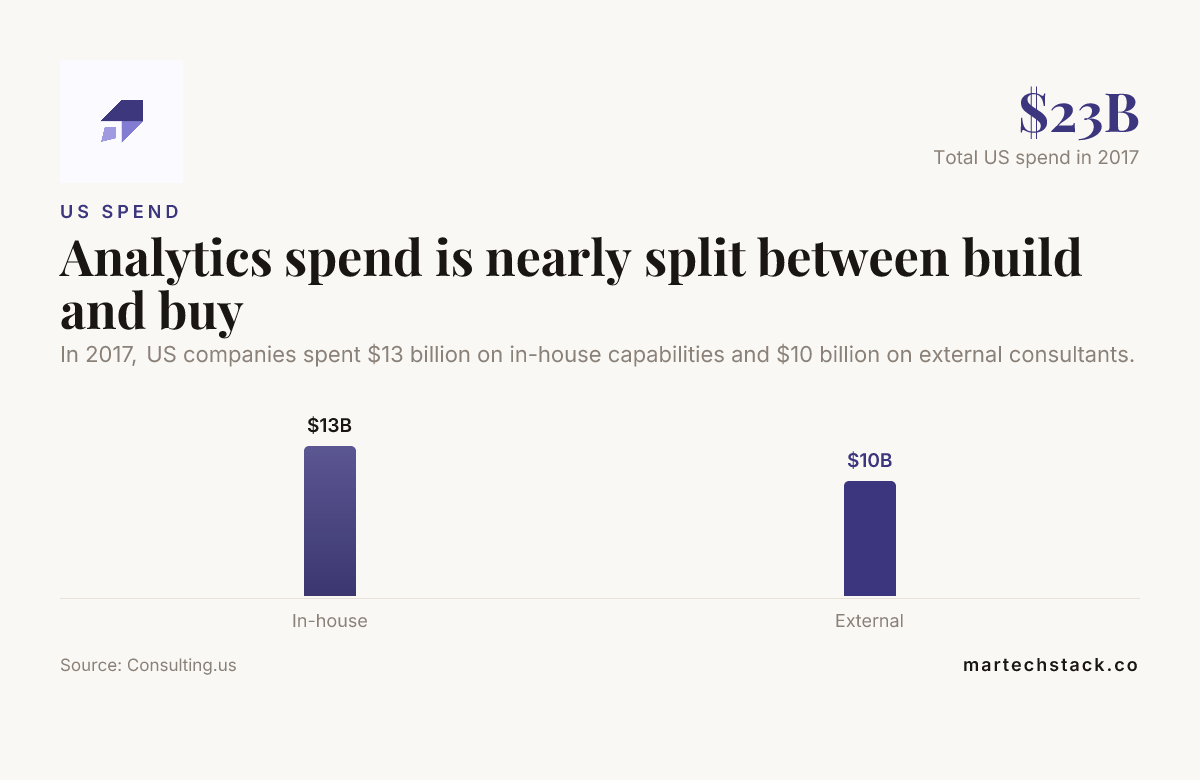
In 2017, US companies spent $13 billion on in-house capabilities and $10 billion on external consultants.
Source: Consulting.us
Use a hybrid model to build lasting capability
A hybrid model pairs external expertise with internal ownership. A consultant can set up a data model, measurement approach, or reporting workflow, while an internal owner maintains it and connects the findings to everyday decisions.
Make handover part of the scope from the outset. Agree that the team will receive documented definitions, reusable queries or models, training, access permissions, and a named owner for future changes. Without an owner, a well-built analysis can become difficult to update as systems or business priorities change.
A dashboard is a working tool, not the outcome. Name the people who will review it, the actions they can take, and the measure that will show whether those actions helped. This connects business intelligence and dashboards and reporting to change management, rather than treating publication as proof of value.
When leaders need decision-led Power BI reporting, Custom Power BI builds clean SQL views and tables from databases, then designs dashboards around the decisions a client makes. The service also includes training, making it relevant when an organisation wants a defined reporting foundation that its own team can learn to maintain.
Set the recurring review alongside the handover. A sales leader may need to use a pipeline view in forecast discussions, while a marketing team may review channel quality at campaign planning meetings. The best reporting rhythm is the one that matches the decisions people actually make.
Scope the engagement around a decision
Write a brief before you select a method or platform. Name the decision, the people who will act on the result, the questions the project must answer, and a measurable condition for success. For example, a project might assess whether a revised lead-routing process improves the share of qualified leads reaching the right sales team.
Agree deliverables and responsibilities explicitly. Depending on the work, these might include:
- A tracking plan or data-quality assessment
- Validated analysis, documented assumptions, and recommendations
- Implementation support and training
- A handover plan, with an internal owner for each ongoing decision
Prepare access to relevant data, subject-matter experts, and staff time to review findings. Analysts need people who understand how a lead, opportunity, or transaction is recorded in practice; otherwise, technically complete analysis can miss important business context.
Agree how you will assess adoption and business outcomes after delivery. Track whether teams use a recommended process and whether the target decision improves, rather than counting reports, dashboards, or pilots completed. This also gives leaders a clearer basis for deciding whether to extend, adapt, or end the work.

Check data readiness, privacy, and security
Map the relevant data sources, owners, definitions, and refresh frequency before estimating effort. Fragmented systems, inconsistent event names, and missing records can undermine conclusions and increase the work needed to prepare data.
For web measurement, agree which events and conversions matter before implementation. Then test that tracking fires accurately and consistently across the user journey, so reporting reflects the intended actions rather than gaps or duplicate events.
Digital Web Analytics covers GA4 and Google Tag Manager setup, including an audit, tracking plan, build, quality assurance, and reporting. For teams reviewing event implementation or measurement practice, the site’s analytics tracking articles provide related reading.
Under GDPR, establish the purpose and lawful basis for processing personal data, limit access and retention to what the project needs, and agree controller and processor responsibilities before sharing data with a consultant. Document security controls, data location, transfer arrangements, and any required risk assessment as part of planning, not after analysis begins.
Use pseudonymised or aggregated data when the work does not require identifiable records. This can reduce unnecessary exposure while preserving the information needed to answer the business question.
Assess the provider and spot red flags
Look for relevant experience with both the business function and the data problem. Ask the firm to explain how its proposed approach fits your existing systems, data quality, and team skills. A strong answer connects technical choices to the decision the project must support.
Ask how the team validates data and conclusions, documents assumptions, and checks predictive or machine-learning models over time if those outputs will influence business decisions. You should understand how the work will be tested and what would prompt a review.
Agree who owns and can access the work products, including code, data models, definitions, and documentation. Clear ownership gives your organisation a practical way to maintain and extend the work after the engagement ends.
Warning signs include:
- A proposal that starts with a preferred tool before clarifying the business decision
- Guaranteed business results without clear assumptions or measures
- Vague answers about data security, access, or transfer arrangements
- Deliverables that do not explain responsibilities or what happens after delivery
- No plan for knowledge transfer or internal capability-building
Choose a data analytics consulting firm that can explain its work in terms your technical and commercial stakeholders can both assess. You are looking for a clear working relationship, usable outputs, and a path from analysis to action.

Frequently Asked Questions
Do you need a data warehouse before working with a data analytics consultant?
No. A focused question can often be answered using existing CRM, ERP, or finance data, provided the relevant records can be accessed and interpreted. A warehouse becomes more valuable when teams need repeatable integration, shared definitions, or regular analysis across many systems.
Can one in-house analyst cover data engineering, analysis, and business intelligence?
One person may cover a broad range of work in a smaller or less complex environment, especially when reporting needs are modest. As pipelines, data models, analysis, and reporting become more demanding, separate skills or additional support help protect delivery quality and capacity.
How long does a data analytics consulting engagement usually take?
Duration depends on the scope, the number and condition of data sources, stakeholder availability, and whether implementation is included. Ask the provider to break the work into milestones so you can review progress and agree any scope changes before they affect later deliverables.
When is predictive analytics more useful than a straightforward reporting analysis?
Predictive analytics is useful when estimating a future outcome can change what a team does, such as how it prioritises accounts or allocates follow-up. Reporting analysis is the better starting point when the immediate need is to understand what happened and where it happened.
Can a data analytics consultant work alongside a CRM or ERP implementation partner?
Yes. Agree how both teams will handle field definitions, system mappings, and acceptance tests so reporting requirements stay connected to the implementation. A shared change log can help stakeholders track decisions that affect data and downstream analysis.
What should happen if the data does not support the original business hypothesis?
The team should present what the evidence does show and explain where it differs from the initial assumption. The decision owner can then agree whether to revise the question, gather different evidence, or stop the work without forcing a preferred conclusion.
Conclusion
Choose data analytics consulting for a defined need, specialist capability, or independent view; choose an in-house analyst for recurring work that depends on close business context. A hybrid model can bring both strengths together when the engagement includes a practical handover and a named internal owner.
Start with the decision, compare full costs in euros, and plan for data readiness, GDPR, security, and adoption. With a clear scope and ownership in place, analytics can support decisions your teams can explain, use, and improve.

Founder of MarTech Stack. SEO, analytics and marketing automation.
LinkedIn