
Organic search now generates 44.6% of all B2B revenue, more than any other single channel a marketing team runs. That number alone should change how you think about a B2B SEO strategy: it’s not a traffic project, it’s a pipeline project, and it needs to be built and measured that way from day one.

Key takeaways
Want a partner to build this with you rather than hand you a PDF? Our SEO consulting services are built around exactly this kind of pipeline-first work.
Why B2B SEO strategy looks nothing like B2C search marketing
Most search advice online is written for e-commerce and content publishers. It doesn’t hold up in B2B, and pretending it does wastes budget.
Three differences matter more than any others:
- Long sales cycles. A B2C purchase can happen in minutes. A B2B software or services deal often takes three to nine months, sometimes longer, which means your content has to nurture, not just convert.
- Buying committees, not buyers. The buying process typically involves 10 to 13 stakeholders, each researching independently. A CFO searches for ROI models. A technical lead searches for integration specs. Your keyword strategy needs to serve both.
- Low search volume, high intent. “Best CRM for manufacturing distributors” might get 20 searches a month. That’s fine. Those 20 searches are worth more than 20,000 searches for “what is a CRM.”
We say this often to clients: a B2B SEO strategy that chases volume is chasing the wrong metric. Chase the buyer, and the volume follows the deal.
Building the keyword-to-pipeline map
This is the core exercise. Before you write a single page, map every keyword you plan to target against a stage in the buying journey and a stakeholder role.
A working keyword-to-pipeline map has four columns:
- Keyword or query (what they type)
- Stakeholder (who’s searching it)
- Funnel stage (awareness, evaluation, decision)
- Revenue signal (does this content type historically produce demo requests, or just reads?)
Example row: “vendor risk assessment template” maps to a compliance stakeholder, sits at the evaluation stage, and historically produces high-intent form fills for SaaS security tools. Compare that to “what is vendor risk,” which maps to a junior researcher at the awareness stage and rarely produces a form fill on its own, but still needs to exist to earn the click that leads to the next page.
This map becomes your roadmap for content prioritization. It also becomes the document you bring to sales, so they stop asking why marketing is writing about “niche” topics nobody searches for.

Bottom-of-funnel and comparison content for buying committees
Comparison content is where most B2B SEO strategy work actually pays off. Pages like “Vendor A vs Vendor B” or “Best [category] tools for [specific industry]” sit exactly where a shortlist gets decided.
A strong comparison page includes:
- A clear feature-by-feature table (not just prose claims)
- Honest limitations, not just wins, for both your product and the competitor’s
- Pricing context where public pricing exists
- A specific “best for” recommendation by company size or use case
Skip the vague, generic “we’re the best” pages. Buyers read comparison content specifically because they don’t trust marketing copy, so meet them with something closer to a briefing document than a sales pitch.
B2B buyers typically consume between three and seven pieces of content before they ever speak with a salesperson. If your comparison and bottom-of-funnel pages aren’t part of that sequence, a competitor’s are.
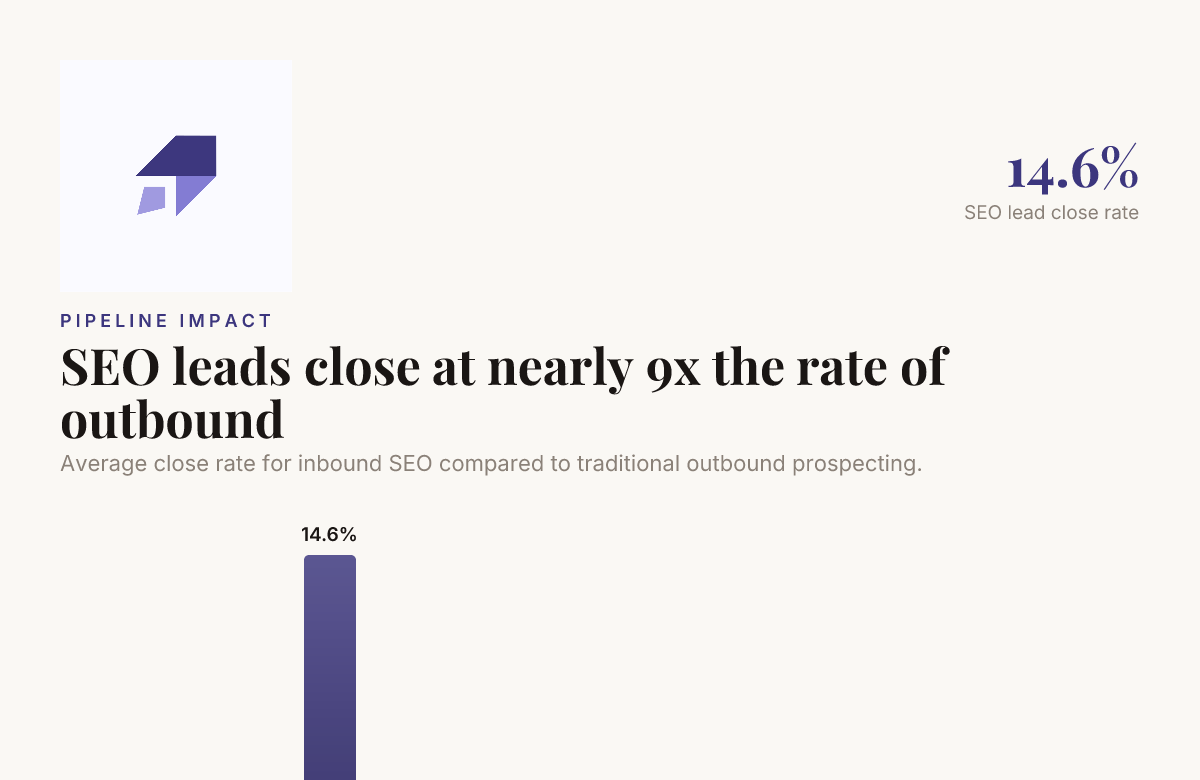
Average close rate for inbound SEO compared to traditional outbound prospecting.
Topic clusters and internal linking that guide the whole buying committee
Individual pages don’t win B2B deals. Clusters do.
Build a pillar page around a broad theme (say, “supply chain visibility software”) and link it out to supporting pages that answer narrower questions: implementation timelines, integration requirements, industry-specific use cases, and pricing models. Link those supporting pages back to the pillar and to each other where relevant.
This structure does two jobs at once. It helps a technical evaluator find the integration page while a finance stakeholder finds the ROI page, all inside the same cluster. And it tells search systems, including the AI tools now summarizing answers, that your site has real depth on the topic rather than one lonely article.
Companies seen as authoritative through this kind of structured content close deals with 89% larger average value. Topical depth isn’t a vanity metric. It changes deal size.
Technical foundations your B2B SEO strategy depends on
Content and clusters only work if the technical layer underneath them is sound. This is the unglamorous part of a B2B SEO strategy, and it’s also the part most commonly skipped.
The non-negotiables:
- Site speed: B2B buyers research on the same connections and devices as everyone else, and slow pages lose them before the pitch even starts.
- Structured data: Schema markup helps comparison tables, FAQs, and product pages get pulled into rich results and AI-generated answers.
- Crawlability and site architecture: If your pillar-and-cluster structure isn’t linked properly, none of it gets discovered efficiently.
- Mobile experience: A meaningful share of that early-stage research now happens on a phone during a commute, not a desktop during work hours.
Our SEO audits start here for a reason. A brilliant content plan built on a broken technical foundation is still a broken plan.

AI search, LLM citations, and what AI SEO means for B2B teams
AI search visitors convert at 14.2% compared to 2.8% for traditional search traffic. That’s a striking gap, and it tells you something important: the buyers reaching your site through an AI tool have already done a round of filtering before they arrive.
This is the new front door for a B2B SEO strategy. Buyers ask an AI assistant to compare vendors, summarize pricing models, or shortlist tools for a specific industry, long before they type a query into a browser. Getting cited inside those LLM-generated answers now matters as much as ranking on a results page.
What this means practically:
- Write direct, well-structured answers to specific questions. AI systems favor clear, quotable content over vague marketing copy.
- Keep facts, pricing, and specifications accurate and current. AI tools cite sources they trust to be right.
- Don’t abandon traditional search work for AI SEO. Nearly 60% of Google searches in the EU and UK now end with zero clicks, so your brand still needs visibility on the results page itself, not just inside the click-through content.
Measuring B2B SEO strategy against revenue, not sessions
Sessions and keyword positions are inputs. Pipeline and closed revenue are outputs. A senior marketing leader should be reporting on the second set, not the first.
The setup we recommend for clients pairs GA4 with your CRM:
- Tag every organic landing page so GA4 can attribute a form fill or demo request to the specific content that produced it.
- Pass that source data into your CRM at the lead level, not just the session level, so it survives past the first touch.
- Build a closed-won report segmented by first-touch content type: comparison page, pillar page, product page, blog post.
- Review quarterly which keyword-to-pipeline map rows are actually producing revenue, and reallocate content effort toward those.
This is exactly where our web analytics and data analysis work earns its keep. Dashboards that only show traffic are decoration. Dashboards that show which content produces closed revenue are a decision-making tool.
A realistic 90-day and 6-month timeline for B2B SEO strategy
Nobody should promise you overnight results here, and we won’t either. What we will give you is a real timeline built from real client work.
| Timeframe | What actually happens |
|---|---|
| Days 1-30 | Technical audit, keyword-to-pipeline map, GA4/CRM connection, competitor comparison gap analysis |
| Days 31-60 | Pillar page and cluster structure built, first bottom-of-funnel comparison pages published, internal linking pass |
| Days 61-90 | Publishing cadence stabilizes, early ranking movement on low-competition terms, first attribution data starts flowing into the CRM report |
| Months 4-6 | Comparison and cluster pages begin producing measurable pipeline, topical authority starts compounding, AI citation testing begins |
Companies publishing 16 or more posts a month generate 4.5x more leads than infrequent publishers, but volume without the keyword-to-pipeline map behind it just produces noise. Consistency matters. Consistency aimed at the right buyer matters more.

Where SEO consulting, data analysis, and web analytics fit into your B2B SEO strategy
A B2B SEO strategy isn’t a single deliverable. It’s three disciplines working together, and most teams only staff for one of them.
- SEO consulting covers the audits, technical fixes, on-page optimization, and content alignment that get your pages found in the first place.
- Data analysis builds the KPI dashboards and ROI tracking that connect that visibility to real business outcomes.
- Web analytics handles the tracking plan, implementation, and attribution modeling that make the whole system trustworthy.
We built our own agency around this exact combination. Martech and marketing don’t operate in separate silos here. Our story is one of pairing search visibility with genuine data rigor, because one without the other leaves you guessing.
If you want to see how these three disciplines work together end to end, our full services overview lays out the roadmap in detail, and if content strategy specifically is your bottleneck, we’ve written a deeper piece on building a content strategy that compounds.
Conclusion
A working B2B SEO strategy is a pipeline system, not a traffic project. Build the keyword-to-pipeline map first, layer in bottom-of-funnel comparison content, structure it into clusters, fix the technical foundation underneath it, and measure the whole thing against closed revenue in your CRM, not sessions in a dashboard.
We’re passionate about this work because we’ve watched it produce tangible success for clients who were tired of vanity metrics. If you’re ready to build a B2B SEO strategy around real pipeline instead of raw traffic, let’s start with an honest conversation about your numbers. Reach out to our team and we’ll map out where you actually stand.
Frequently asked questions
What makes a B2B SEO strategy different from regular SEO?
A B2B SEO strategy has to account for long sales cycles and buying committees of 10-13 stakeholders, rather than a single buyer making a fast decision. It targets lower-volume, higher-intent keywords tied to specific roles and prioritizes pipeline over raw traffic.
How long does it take to see results from a B2B SEO strategy?
Expect technical and structural groundwork in the first 90 days, with early ranking movement on lower-competition terms by day 60-90. Measurable pipeline impact from comparison and cluster content typically shows up between months four and six.
What content matters most for a B2B SEO strategy?
Bottom-of-funnel comparison and evaluation content matters most, since 83% of buyers define their requirements before contacting sales. Pair it with topic clusters that guide the 3-7 pieces of content a typical buyer consumes before that first sales call.
Do I need to worry about AI search and LLM citations in my B2B SEO strategy?
Yes. AI search visitors convert at 14.2% compared to 2.8% for traditional traffic, and buyers increasingly ask AI tools to compare vendors before visiting a website directly. A modern B2B SEO strategy plans for both traditional visibility and AI SEO citation.
How should I measure whether my B2B SEO strategy is working?
Connect GA4 to your CRM so form fills and demo requests are tracked back to the specific content that produced them, then build a closed-won report by content type. Sessions and keyword rankings are useful diagnostics, but revenue attribution is the real scorecard.
Is content strategy the same thing as a B2B SEO strategy?
No. Content is one pillar of a B2B SEO strategy alongside technical foundations, internal linking structure, and revenue measurement through data analysis and web analytics. Treating content as the entire strategy is one of the most common reasons B2B teams see traffic without pipeline.
Should a small SaaS company hire an SEO consulting firm or build this in-house?
It depends on whether you already have technical SEO, data analysis, and content resources in one place, which most small marketing teams don’t. An SEO consulting partner can build the keyword-to-pipeline map, fix technical gaps, and set up CRM-connected reporting faster than most in-house teams can staff for it alone.

Founder of MarTech Stack. SEO, analytics and marketing automation.
LinkedIn