
In 2026, most US searches end without a click, as Google resolves more queries directly using entity data and AI summaries.

Key Takeaways
- Practical starting point: map your “core entities” (company, executives, products, categories) before you touch templates. This is where entity based seo work begins.
- System design: wire schema markup into your CMS, not one-off pages. Consistency is the win.
- Topical authority: build entity clusters across content, FAQs, resources, and case studies so the knowledge graph can connect dots.
- Measurement: track entity mentions and structured data coverage alongside content performance. That’s how you keep the entity optimisation effort honest.
- If you want hands-on support: our SEO consulting service focuses on structure and on-page improvements that support entity clarity.
- For data-led verification: pair it with data analysis so your entity strategy has evidence behind it.
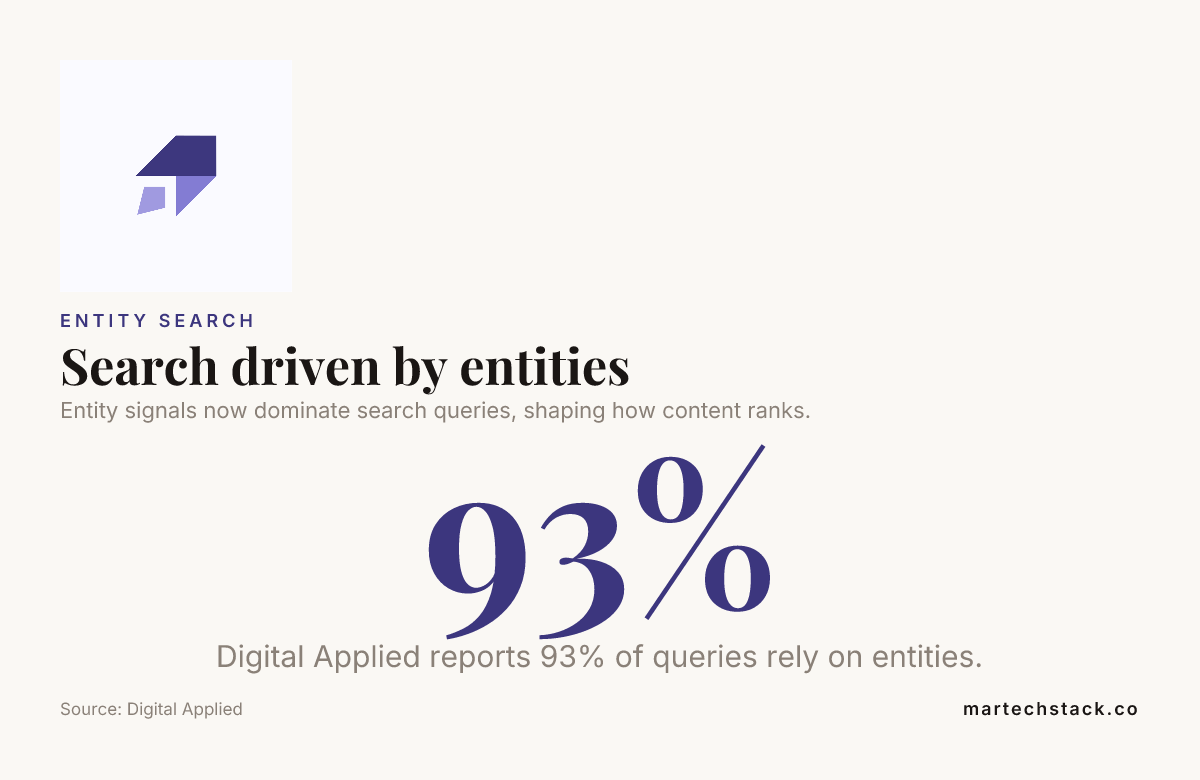
Entity signals now shape how search engines interpret content, not only how they match phrases.
What an entity is, and why it matters in entity SEO
Let’s keep this simple. A keyword is a word or phrase you target. An entity is a real-world item with identity, attributes, and relationships, like a company, person, product, industry, or location.
In entity SEO, you’re optimising for how platforms understand your organisation as a set of connected facts, not only how a page matches a query. That distinction becomes obvious when you look at your own content: you mention the same brand name across multiple pages, you describe the same services, and you refer to specific people and product capabilities.
That repetition is good. It becomes powerful when it’s precise, consistent, and linked with machine-readable context through schema markup.
How Google’s knowledge graph understands meaning (and where marketers get it wrong)
Google’s knowledge graph is built to connect entities and their attributes. The google knowledge graph approach relies on signals that show which text refers to which entity, and how that entity relates to other entities.
Most teams still work as if the page is the main unit of understanding. Page content matters, but the bigger picture is your entity’s “profile”, built across your site, your structured data, and the way third parties reference your brand.
- Identity signals: consistent brand name, domain, official website URL, and executive names.
- Relationship signals: which services you offer, which industries you serve, which product categories you belong to.
- Context signals: how your content describes your capabilities, deliverables, and scope.
- Disambiguation: preventing the same name from pointing to the wrong organisation or person.
In 2026, behaviour also matters. If users do not click and instead get a direct answer, the systems that generate those answers will lean harder on well-grounded entity information. That’s why entity optimisation is becoming an operating model, not a one-off content tweak.

Entity-based content strategy: build clusters around entities, not pages
If you want entity based seo to work, plan content as a set of connected entity clusters. A cluster usually includes a “hub” page for the main entity, plus supporting pages that strengthen relationships between that entity and adjacent concepts.
Think in terms of semantic SEO: you’re proving what your organisation is associated with, through explicit entity references and structured topic coverage.
Here’s a practical way to map an entity cluster for a B2B marketing services business.
- Choose your core entities: your organisation, key people (founders, delivery leads if appropriate), core service lines, and the recurring deliverables you produce.
- Define attributes for each: what you do, what you deliver, who you help, and how you operate (consulting, dashboards, analysis, implementation).
- Write supporting pages that connect: service pages, capability pages, and industry-specific resources that reuse your entity names and service descriptions consistently.
- Link related entities explicitly: within copy, FAQs, and resource pages that reference the same names and deliverables in a consistent way.
At MarTech Stack, our service structure naturally supports this. Your service hub becomes the entity “anchor”, then each service page reinforces the attributes and relationships that make the entity easier to understand.
- Service hub: SEO & analytics services
- Core service anchor: SEO consulting
- Supporting delivery evidence: digital web analytics
Schema markup for entities: making your facts machine-readable
This is where schema markup earns its keep. When you add structured data, you’re telling the machine which pieces of text map to which entity types.
For entity SEO, focus on schema that represents your organisation and people clearly, then extend to the relationship layer.
- Organization: official name, website URL, logo (if you use it consistently), contact points, and sameAs links to your verified profiles.
- Person: for key people where it matches your publishing practice, include job title, and link to their sameAs profiles where appropriate.
- sameAs: map your entity to known external identifiers so the entity ID is harder to confuse.
- about / mentions: use it to indicate what a page is primarily about, and which entities are referenced.
Do not treat schema markup like a checklist. Treat it like a data contract. If your organisation name or contact details change, update the schema at the same time. That’s entity optimisation you can maintain in 2026.
Topical authority through entity clusters
Topical authority is often described as “more content”. For entity SEO, the better framing is tighter relationships. You build topical authority by repeatedly connecting entities and concepts across your pages in a coherent structure.
When content stays “about the same thing”, the entity model has less ambiguity to resolve. It becomes easier to associate your organisation with a topic and a set of related facts.
Use that as a cue for how you structure content. Entity clusters usually include:
- Clear definitions: what your service does, and what you deliver.
- Consistent naming: the same entity names in headers, body copy, and FAQ answers.
- Structured Q&A: short answers that reuse the entity attributes you want associated.
Also, treat updates as part of your model. If your entity attributes evolve, your entity signals must evolve too. In entity based seo, stale content weakens the entity relationships over time.

Disambiguation and consistent NAP/brand signals
Disambiguation is the unglamorous part, but it’s a core requirement for entity SEO. If your organisation name matches other organisations, or if executives share common names, you need tighter identity signals.
Consistency covers three areas.
- Brand identity: your preferred legal name, your trading name, and your website domain must align across your pages and structured data.
- NAP details: make sure your Name, Address, and Phone details are formatted consistently (and only where it makes sense for your business model).
- Entity naming in copy: avoid alternating spellings, abbreviations, and informal nicknames for the same organisation.
If you serve multiple locations, separate the entity profiles properly. If you have one location, avoid sprinkling conflicting address formats across pages. This is how knowledge graph confusion starts.
Also consider internal consistency. When your content refers to your services, reuse your official service names. The goal is simple: the entity map should not require interpretation.
Entity optimisation for AI answers and LLM citations
In 2026, many people ask questions in AI tools and expect sourced answers. Entity SEO connects to that through entity grounding and repeatable facts.
AI responses tend to pull from information that is clear, structured, and consistent. If your organisation and services are described in a stable way, your facts are easier to cite and harder to distort.
- Use structured data: schema markup supports entity recognition and consistent attribute mapping.
- Strengthen entity mentions: the same organisation names, service deliverables, and key facts should show up across relevant pages.
- Keep information current: fresh explanations and capability details support the “entity profile” over time.
One pattern matters for this connection: content cited by AI engines tends to be fresher than what ranks in standard organic results. The implication is straightforward, keep your entity attributes and supporting pages up to date.
If you want this approach to fit your delivery model, we recommend working with your analytics too. Our data analysis and digital web analytics services help you measure what people do with your content, then connect that back to how your entity signals are being interpreted.
Steps you can run in 30 days to improve entity SEO
We’d never ask you to “hope” for entity understanding. You can do real work in a short window. Here’s a 30-day plan built for busy marketing and in-house SEO leads.
- Entity inventory (Day 1 to 5): list your core entities. Include organisation, key people, service lines, and any products or categories you want associated.
- Consistency audit (Day 6 to 10): check name spellings, service naming, and any address or phone formats. Fix the obvious inconsistencies first.
- Schema markup pass (Day 11 to 17): implement Organization and Person where relevant, plus sameAs links. Add about/mentions patterns to key templates.
- Cluster content plan (Day 18 to 22): pick two entity clusters. Create or update one hub page and two supporting pages per cluster.
- Internal linking and on-page structure (Day 23 to 27): ensure supporting pages reference the same entities and service attributes. Keep anchors descriptive.
- Verification and reporting (Day 28 to 30): check structured data coverage, monitor entity mention coverage, and document what changed.
When you do this, you’re doing entity optimisation in a way that compounds. Your next cycle becomes faster because your entity inventory and schema contract already exist.
Want a structured partner for the implementation and measurement side? Our SEO consulting can support the site architecture and on-page improvements that make entity signals consistent across your pages.

What entity SEO cannot do (and why that honesty matters)
Entity SEO can make your organisation easier to understand, but it cannot replace genuine expertise, credible proof, or accurate content. If you publish vague claims, no amount of schema markup will generate reliable entity understanding.
It also cannot guarantee outcomes on its own. Entity understanding is one part of an information system, and user intent, content quality, and your overall measurement approach still matter.
Use entity SEO as a way to express facts clearly. Then back those facts with real service delivery and ongoing improvement.
Conclusion
Entity SEO is about optimising for how the knowledge graph links real-world identities and attributes, through consistent entity optimisation and machine-readable schema markup. In 2026, the value shows up when your organisation and services are described in a stable, unambiguous way, supporting both human reading and AI-style answers that depend on grounding and repeatable facts.
Frequently Asked Questions
What is entity SEO in 2026, in plain English?
Entity SEO is the practice of describing your organisation, people, services, and products as connected entities, so their meaning is consistent. It relies on signals like schema markup, repeated entity mentions, and clear relationships that support the knowledge graph understanding.
How is entity SEO different from keyword-focused content?
Keyword-focused content targets phrases on a page. Entity SEO focuses on the identity and relationships around those phrases, using structured context so your knowledge graph profile is clearer and less ambiguous.
Do I need schema markup for entity optimisation?
You do not need schema markup for every outcome, but it strongly helps machine understanding of entity types and relationships. For entity optimisation, schema markup like Organization, Person, sameAs, and about/mentions makes your facts easier to interpret consistently.
What does entity based seo look like for a B2B services company?
It looks like building entity clusters: a clear service hub that defines your offerings, plus supporting pages that reinforce the same service names, deliverables, and associated concepts. You then keep naming and entity signals consistent across templates and content updates.
How does entity SEO connect to AI answers and LLM citations?
AI tools often cite information that is easy to ground in stable facts and clear entity descriptions. With entity SEO, your schema markup, consistent entity mentions, and updated service details support stronger grounding for citations, especially when users ask for sourced answers.
Can entity SEO guarantee more clicks or featured snippets?
No. Entity SEO can improve how your organisation is understood, but click outcomes depend on query intent, content usefulness, and how answers are presented. Use entity optimisation as one part of a wider content and measurement plan.
What should I prioritise first: topical authority or disambiguation?
Start with disambiguation and consistency, because unclear names and mixed identity signals create noise. Then build topical authority by expanding entity clusters with semantic SEO patterns and maintaining accurate updates to entity attributes.

Founder of MarTech Stack. SEO, analytics and marketing automation.
LinkedIn