

In 2026, teams still get blindsided by multilingual site setups because hreflang implementations can look “fine” in the code, while the actual language targeting breaks due to redirects, wrong codes, or missing link tags. That’s why a hreflang checker matters, and why we treat it like a validation step, not a one-time chore.

Key Takeaways
- hreflang tags must be consistent across all language versions, including return links.
- A hreflang validator should check both formatting (codes) and target behavior (status responses).
- When you use hreflang sitemap for scaling, validate that every referenced URL is reachable and not redirecting unexpectedly.
- If you manage international seo and multilingual seo programs, bake hreflang checks into your release process.
If you want context on how we approach service delivery and data steps, start with our
digital marketing services
and
SEO consulting.
What hreflang does (and what it does not)
Hreflang implementation is about signaling which URL is intended for which language (and optionally region). When it’s correct, your site can present the right language version to the right audience based on explicit mappings you provide.
Here’s the clean mental model we use when auditing international seo signals:
- Hreflang tags tell the site to pair a language-region code with a specific canonical URL.
- Those tags should be mutually consistent across all variants.
- The target URLs must be actually reachable and valid responses, not hidden behind broken redirects or non-indexable behavior.
And here’s what it does not do:
- It does not override a wrong canonical. If canonicals conflict, your hreflang plan can still collapse in practice.
- It does not “fix” a redirect strategy. A hreflang mapping that points to a URL that redirects in ways your system does not expect can fail your intent.
- It does not guarantee that the language landing page is usable. If the target URL returns an error or is blocked, the mapping is still wrong.
Practical takeaway: a hreflang checker is not only for code validation, it should validate that the mapped landing pages respond correctly.
How a hreflang checker audit works (validation steps you can trust)
When you run a hreflang checker, you want to confirm two things. First, the tag set is well-formed. Second, the referenced URLs behave the way you assume at runtime.
In a typical audit workflow, we expect the tool to do these steps in order:
- Discover hreflang tags from the page(s) you provide (HTML head link tags and, when present, HTTP header and sitemap sources).
- Normalize and validate language-region codes against ISO expectations (including ISO 639-1 language codes and ISO 3166-1 region codes).
- Check self-referencing tags are present (each page should list itself).
- Verify return tags (if A points to B, B should point back to A appropriately).
- Validate targets by probing the URLs and confirming they respond with healthy status responses.
- Detect duplicates and conflicts like multiple URLs claiming the same language code or language-region mapping inconsistency.
- Handle redirects carefully by distinguishing harmless normalization (for example http to https, www normalization) from geo-IP or other audience-based redirects.
One more thing we care about in 2026: if your site uses a single-page application pattern, the checker should still validate hreflang that may be rendered by JavaScript, not only raw HTML.

Most common hreflang errors we see in multi-language sites
This is where most hreflang errors hide. The tags exist, but something subtle is off. Your international seo plan is only as strong as the weakest mismatch.
1) Missing return tags (one-way hreflang)
A classic failure mode is when page A references page B, but page B does not reference page A. That breaks the consistency expectation you want across language variants.
2) Missing self-referencing hreflang
Every variant should include a hreflang entry for itself. If a hreflang validator flags a missing self link, fix it early.
3) Wrong or invalid language and region codes
Bad codes can slip in from templates and manual edits. Examples include wrong casing, unsupported formats, or incorrect separators. In 2026, we still see teams using codes that were “close enough” but not valid in practice.
Use the checker to confirm formatting rules, especially for script handling like zh-Hans and language-region combinations.
4) Conflicting canonicals across variants
If your hreflang targets point to URLs that advertise different canonical destinations than the actual page, you end up with conflicting signals. The checker can surface these inconsistencies when it normalizes and compares targets.
5) hreflang pointing to non-indexable or redirecting URLs
Even with perfect code, mappings fail if the referenced URL:
- returns error status responses
- is blocked by robots directives
- redirects in ways that depend on audience location or other conditional logic
A good hreflang checker distinguishes harmless redirects (http to https, www normalization) from redirects that change the content based on geo-IP.
6) Duplicate mappings for the same language-region code
If you map fr-CA to two different URLs, a checker should flag the conflict. This is the kind of issue that produces “random” outcomes in real browsing because the mappings are not unique.
Correct hreflang examples you can copy (HTML head tags)
Let’s make this concrete. Below are examples of hreflang tags for an English US page and a German page. The key rule is symmetry, including self-referencing and return tags.
Example: English (United States) and German (Germany)
On https://example.com/en-us/ (canonical: https://example.com/en-us/)
<link rel="alternate" hreflang="en-US" href="https://example.com/en-us/" />
<link rel="alternate" hreflang="de-DE" href="https://example.com/de-de/" />
<link rel="alternate" hreflang="x-default" href="https://example.com/" />
On https://example.com/de-de/ (canonical: https://example.com/de-de/)
<link rel="alternate" hreflang="de-DE" href="https://example.com/de-de/" />
<link rel="alternate" hreflang="en-US" href="https://example.com/en-us/" />
<link rel="alternate" hreflang="x-default" href="https://example.com/" />
x-default hreflang usage
x-default hreflang is a catch-all. You use it for users whose language does not match any of your explicit tags. For many B2B sites, x-default often points to:
- a global landing page
- a language chooser page
- a version that intentionally supports the broadest audience
And yes, a checker should validate that the x-default hreflang target behaves correctly and is not a broken or redirecting endpoint.

Three hreflang implementation methods, and when to use each
There are three common ways to deliver hreflang implementation signals. The right choice depends on your stack and scale.
1) HTML head link tags
This is the most direct approach. You add <link rel="alternate" hreflang="..."/> inside the page head. It works well when:
- you generate full HTML for each variant
- your templates can render correct return tags
- you want straightforward testing page-by-page
A hreflang checker can validate these tags quickly, especially when you supply a list of key URLs.
2) HTTP headers
HTTP header delivery can work in setups where the server controls headers for language variants. Use this when:
- your infrastructure is header-driven
- HTML templates are not ideal for adding tags
- you need a centralized generation point
Validation still matters. We recommend a hreflang validator that reads header-based signals and confirms targets respond correctly.
3) XML sitemap entries (hreflang sitemap)
For very large multilingual programs, sitemap-based signals can be easier to maintain. It is also a strong way to scale because your tooling can treat the sitemap as a source of truth. Use a hreflang sitemap when:
- you have many regional variants
- you want consistent automation across new pages
- you are building an audit pipeline that starts from sitemap discovery
In that workflow, you still validate that each referenced language URL exists, returns healthy responses, and does not redirect in unexpected ways.
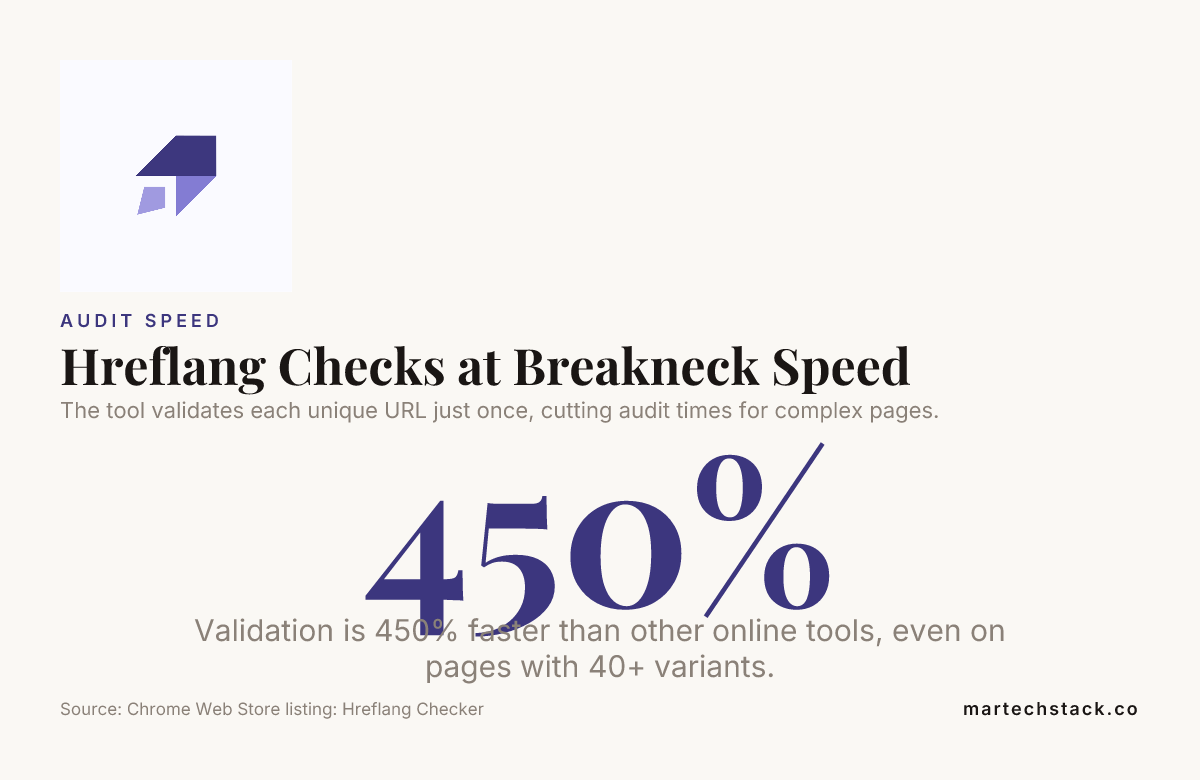
The tool validates each unique URL just once, cutting audit times for complex pages.
Practical hreflang checker workflow (audit, fix, and re-validate)
If you want this to stick, you need a workflow. Not vibes. Not “we think it’s correct.” Here’s the practical sequence we use for hreflang implementation changes.
Step 1: Define the scope (which URLs matter)
Start with the pages that matter for language landing and conversion paths. For B2B, that often includes:
- product and service pages
- resource pages that are localized
- top navigation entry pages (where language switchers lead)
Then add variants you know are frequent in production, especially after template updates.
Step 2: Extract hreflang signals from your implementation method
If you use HTML head link tags, you extract from rendered HTML when possible. If you use header delivery, confirm your server is sending correct values. If you use a hreflang sitemap, treat it as a source of truth and validate against it.
Step 3: Run the hreflang validator checks
For every language and region mapping, validate:
- valid codes (language and region, including script codes where needed)
- self-referencing entry exists
- return tags exist across all variants
- no duplicates or conflicting mappings
- target URLs respond with healthy status responses
- redirect behavior is acceptable (harmless normalization vs geo-IP style redirects)
If your checker supports it, also check whether it handles JavaScript-rendered hreflang tags for single-page patterns.
Step 4: Fix in the system that generates hreflang
This matters. If hreflang tags are generated by templates, fixing just the affected pages is temporary. Fix the generator and the logic that builds:
- language-region lists
- canonical URL sources
- return tag mapping rules
- x-default hreflang assignment
In 2026, most failures come from template drift, manual overrides, or mismatched canonical inputs.
Step 5: Re-run after changes that affect targets
We recommend you run hreflang checks from time to time, especially after changes that could affect your tags or destination URLs. For example, editing web structure, changing canonical URL logic, or modifying redirect rules.
Then confirm the checker output is clean for both:
- code correctness (codes and tag presence)
- target correctness (response behavior and redirect normalization)
If you want a quick way to start aligning teams, use your internal workflow to define “done” as passing all hreflang validator checks on the scope list.
How we fit hreflang checker into an international program
We don’t treat this like a one-off cleanup. We treat it like part of the execution loop for your international multilingual seo program. That means we connect hreflang work with your broader implementation and analytics discipline.
If you’re operating as a B2B marketing team or SEO lead, we recommend you pair your hreflang checker outputs with your ongoing service delivery. For example, if you’re already working with our team on:
- digital web analytics for measurement of localized journeys
- data analysis to spot rollout patterns that correlate with localization changes
- a scoped SEO and analytics engagement when international rollout is tied to scope
That way, hreflang validator results become operational signals, not just audit reports.

Conclusion
A hreflang checker is the fastest way to validate that your hreflang tags, targets, and mapping logic are consistent across language variants. In 2026, the main value is practical validation, codes that match ISO expectations, and landing pages that respond correctly, including smart redirect handling and x-default hreflang checks.
Use a structured workflow, fix the generator behind your hreflang implementation, then re-run after any canonical or site-structure changes. That’s how you reduce hreflang errors and keep your international signals clean.
Frequently Asked Questions
What does a hreflang checker validate, beyond checking hreflang tags?
A hreflang checker validates the actual hreflang tags and also confirms the language landing pages respond properly when probed. It should catch invalid language or region codes, missing self-referencing tags, and mapping conflicts, not only syntax issues.
How do I check x-default hreflang properly in 2026?
Run your hreflang validator and specifically verify that your x-default hreflang target is present and not broken. You also want to confirm the x-default target URL behaves correctly and is consistent with the canonical and redirect behavior of your site.
Why do my hreflang implementation results look correct in code, but still fail in practice?
Because code correctness alone is not enough. If hreflang points to URLs that redirect conditionally, return errors, or conflict with canonical logic, your mapping intent breaks. A hreflang checker helps surface those cases reliably.
Can a hreflang checker detect duplicate hreflang mappings and conflicting language-region targets?
Yes, a solid hreflang checker should detect duplicates and conflict detection where the same language-region code maps to multiple URLs. That’s one of the fastest ways to identify hreflang errors created by template logic or manual edits.
Should we use hreflang sitemap or HTML head tags for international rollout?
Use HTML head tags for simpler setups where templates render alternate links directly. Use a hreflang sitemap when you need scalability across many variants, and confirm the sitemap-referenced URLs are reachable and behave consistently.
Is it worth running a hreflang checker after changing canonicals or site structure?
Yes. We recommend re-running a hreflang checker any time changes could affect your tags or destination URLs, including canonical URL changes and web structure edits. That’s the practical way to prevent new hreflang errors from slipping in.
What are the most common hreflang errors a multilingual seo team should look for first?
Start with missing return tags, missing self-referencing tags, invalid language or region codes, conflicting canonicals, and hreflang pointing to redirecting or erroring targets. A hreflang checker flags these quickly so you can fix the generator logic instead of patching individual pages.

Founder of MarTech Stack. SEO, analytics and marketing automation.
LinkedIn