

Programmatic SEO built G2 into a comparison-page powerhouse, then watched the company lose 80% of its organic traffic by late 2025 when the templates got thin and the differentiation disappeared. That’s the real story behind scaling pages: the same system that builds you up can tear you down just as fast, and the difference usually comes down to one thing, whether every page actually earns its spot.

Key Takeaways
- Programmatic SEO works when you have unique, structured data, not when you’re spinning the same paragraph 10,000 times.
- Google’s scaled content abuse policy targets volume without value. It doesn’t care how the pages got made, it cares whether they’re useful.
- Page templates need a real data model behind them, with distinct facts, numbers, and context per page.
- Internal linking and crawl budget management decide whether Googlebot ever finds your best pages in a 50,000-page set.
- Thin content and index bloat are the two symptoms that show up first when a rollout goes wrong.
- Measuring performance per page cluster, not just site-wide traffic, tells you which templates are actually working.
- Need a second opinion on your template before you publish 10,000 pages? Our SEO consulting team reviews data models before they go live, not after they get filtered.
What Programmatic SEO Actually Is (and When It Fits)
Programmatic SEO is the practice of generating large sets of pages from a structured data source, using one template that adapts to each unique data point. Think city-by-city pricing pages, product-by-integration pages, or profession-by-location directories.
It’s not about writing more content faster. It’s about building a system that produces one genuinely useful page for every genuinely distinct query a person might type.
Here’s why it works: 95% of all search queries are long-tail terms with 10 or fewer monthly searches each, according to Instant Press. No writer can cover that volume of specific intent one article at a time. A well-built template can, because the demand is real even when the individual search volume looks small.
Programmatic SEO fits when three things are true. You have a real, non-trivial data set. Each row of that data set answers a different question. And you have the resources to keep the template maintained, not just launched and forgotten.
The Data Model Behind a Good Page Template
This is where most rollouts succeed or fail before a single page goes live. The data model is the spreadsheet, database, or API feed that fills your page templates with facts, and it needs to hold up to scrutiny.
A good data model includes:
- Unique numerical data per page (prices, dates, dimensions, scores, ratios)
- Distinct contextual copy that reflects the specific entity, not boilerplate with a name swapped in
- Source attribution so readers (and algorithms) can verify the claim
- Freshness logic so stale data gets flagged and updated on a schedule
Spun text fails here because it fakes uniqueness at the sentence level while the underlying substance stays identical. A template built on real data doesn’t need to fake anything. Adding statistics to your content also carries a measurable payoff: QuickSEO found a 40% boost in AI search visibility for pages that included data points instead of generic description. Our data analysis services exist for exactly this step, turning raw data sets into a model that’s ready to power thousands of unique pages.

How Google’s Scaled Content Abuse Policy Draws the Line
Google’s scaled content abuse policy, formalized in its March 2024 update, doesn’t target automation itself. It targets the outcome: pages made at scale that provide no incremental value to the person reading them.
The policy applies whether the pages are written by a person, a script, or an AI model. The test is the same one you’d apply yourself: does this specific page tell me something the last five didn’t?
If your programmatic SEO pages could be shuffled and relabeled without anyone noticing, that’s the pattern the scaled content abuse policy is built to catch.
The scale of the enforcement should get your attention. QuickSEO reports that Google’s March 2024 spam and core updates removed 45% of unoriginal content from its results, much of it generated at volume with little unique substance. That’s not a rounding error, that’s nearly half of a category wiped out in one cycle.
Quality Gates Before You Publish at Scale
Every programmatic set needs checkpoints before it goes live, not just a launch date. We treat this as a roadmap, not a single decision point.
Before publishing a page template at scale, run it through these gates:
- The swap test: Pull three random pages. If you can’t tell them apart without reading the data variable, the template isn’t ready.
- The minimum viable data check: Does every page have at least three unique, verifiable facts?
- The human-would-search-this check: Does a real person type this query, or did the data set just happen to allow the combination?
- The maintenance plan: Who updates this data six months from now, and how often?
Pages that fail the swap test are the ones scaled content abuse enforcement was built to catch. Our team runs this exact audit as part of our SEO and analytics services, because catching a bad template before ten thousand pages ship saves months of cleanup later.
Internal Linking and Crawl Budget for Large Page Sets
A programmatic page set is only as good as its discoverability. Internal linking is how you tell Googlebot which pages matter, and crawl budget is the finite attention Googlebot has to spend finding them.
QuickSEO found a striking ratio here: 14 pages get crawled by Googlebot for every 1 referral sent back to the site that hosts them. That gap is exactly why internal linking discipline matters so much once you’re operating at real scale.
Practical rules we apply to every large page set:
- Build hub pages that link out to logical clusters (by category, region, or use case), not one flat list of 50,000 links
- Keep click depth from the homepage to any programmatic page at three clicks or fewer
- Use XML sitemaps segmented by section, so you can monitor indexation cluster by cluster
- Prune or noindex low-performing pages instead of letting them dilute crawl budget indefinitely
Crawl budget isn’t infinite, and treating it that way is how good templates end up buried under thin ones.

Programmatic SEO Examples That Work (and Ones That Get Filtered)
The clearest way to understand the line between a working set and a filtered one is to look at real outcomes.
What works: Wise built pricing and currency-conversion pages for thousands of currency-pair and country combinations, each backed by live exchange-rate data. The result speaks for itself, with 90% of Wise’s organic traffic now coming from programmatic pages, and 54 million monthly organic visits spread across 1.7 million of them.
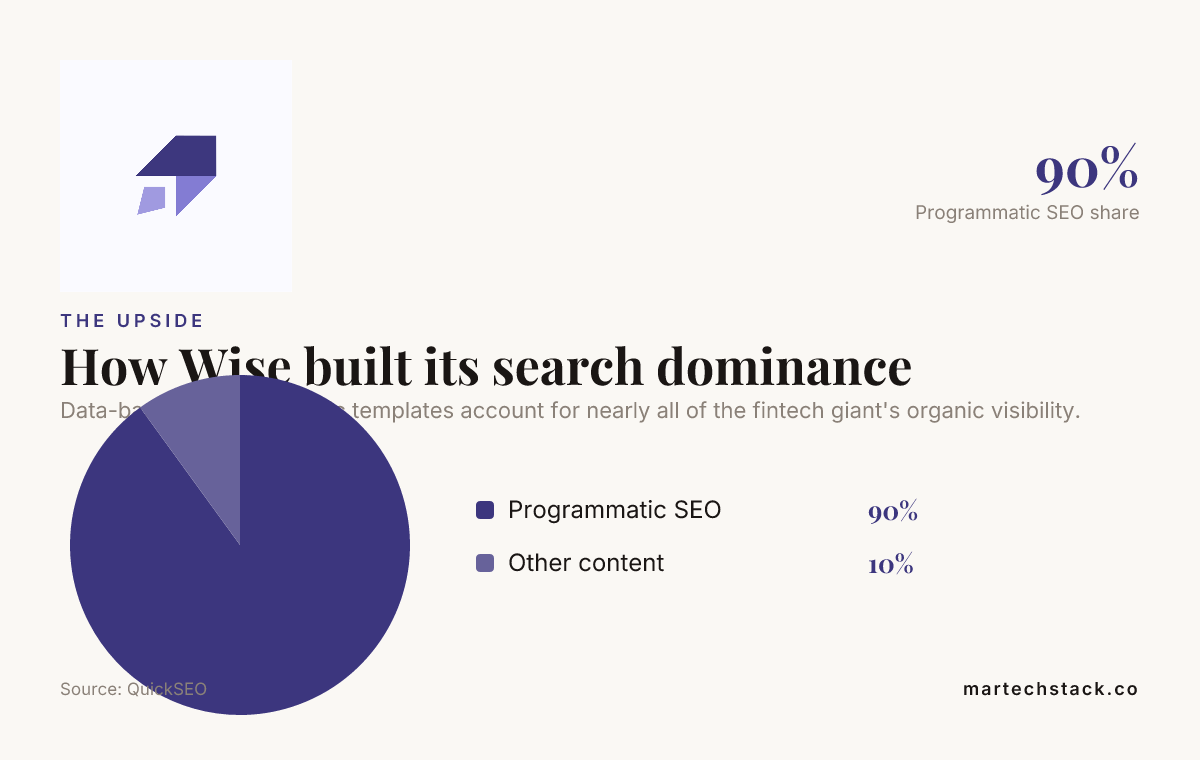
Data-backed programmatic templates account for nearly all of the fintech giant’s organic visibility.
Canva shows a similar pattern at a different scale. Roughly 38 million monthly visits get attributed to around 190,000 indexed template and tool pages, each tied to a specific design need someone actually searches for.
What gets filtered: Comparison pages built purely from a permutation table (“X vs Y” for every possible pairing of two lists) without any unique analysis per pairing. G2’s traffic collapse is the cautionary tale here, and it happened because volume outran differentiation. The lesson isn’t “don’t build comparison pages.” It’s “don’t build them without something genuinely different to say on each one.”
Avoiding Thin Content and Index Bloat as You Grow
Thin content and index bloat are two sides of the same problem: too many pages, not enough substance per page. Index bloat happens when Google has indexed far more of your pages than are actually earning visits or clicks, which drags down the perceived quality of the whole set.
Warning signs we watch for on every rollout:
- A large share of indexed pages get zero organic visits over a 90-day window
- Average word count per page sits below what’s needed to answer the query completely
- Duplicate or near-duplicate meta descriptions across dozens of pages
- Pages that rely entirely on template copy with no page-specific data point above the fold
The fix usually isn’t more content. It’s fewer, better pages. Noindexing the bottom 20% of a page set by performance is often the single highest-leverage move you can make once thin content starts showing up in the data.

Measuring Whether Your Page Set Is Earning Its Keep
Traffic alone doesn’t tell you if a programmatic set is working. You need to measure it the way you’d measure any other growth investment, with real outcomes attached.
Metrics we track for every template cluster:
| Metric | What It Tells You |
|---|---|
| Indexed-to-crawled ratio | Whether Googlebot is finding pages faster than they’re getting indexed |
| Visits per page, by cluster | Which template variants are pulling weight and which aren’t |
| Conversion rate per cluster | Whether traffic is turning into the outcome you actually need |
| Click-through rate over time | Whether visibility gains are translating into actual visits |
Getting this right matters more now than it used to. Instant Press found that 68.01% of US Google searches ended without a click in early 2026, and appearances aren’t guaranteed to convert into a visit anymore even when a page shows up prominently.
That’s exactly why we build measurement into every digital analytics engagement, using dashboards that show performance per template cluster instead of one flat traffic number that hides which pages are actually earning their keep.
Conclusion
Programmatic SEO isn’t a shortcut, and it was never meant to be one. It’s a system, and like any system, it rewards the people who build it carefully and punishes the ones who don’t.
Get the data model right, respect the scaled content abuse policy, manage internal linking and crawl budget like the finite resources they are, and measure every cluster on its own merit. Do that, and programmatic SEO becomes one of the most efficient growth levers available to you. Skip any one of those steps, and you’re building the next G2 story instead of the next Wise one.
We’ve spent our own growth journey helping teams tell the difference between the two. If you’re weighing whether a large page set is worth building, or you’re already seeing thin content creep into an existing one, reach out and let’s talk through your data before you scale another page.
Frequently Asked Questions
Is programmatic SEO still worth it in 2026?
Yes, when it’s built on real, unique data rather than spun text. Companies like Wise generate the majority of their organic traffic from programmatic pages, but the ones that fail usually skipped the data model step entirely.
What’s the difference between programmatic SEO and just publishing a lot of content?
Programmatic SEO uses one structured template filled with genuinely distinct data per page, while mass content publishing often reuses the same ideas with different wording. The scaled content abuse policy specifically targets the second pattern, not the first.
How many pages is too many for a programmatic SEO rollout?
There’s no fixed number. The real limit is how many pages you can back with unique, verifiable data and keep current, not how many your database happens to allow you to generate.
What causes index bloat in a programmatic page set?
Index bloat happens when far more pages get indexed than actually earn visits, usually because the underlying data was too thin to support the volume of pages generated. Noindexing the lowest-performing segment is the most common fix.
Does internal linking actually affect crawl budget for large sites?
Yes, significantly. Poor internal linking structure is one of the fastest ways to waste crawl budget on a large page set, since Googlebot relies on link paths to prioritize which pages to revisit.
What page types get filtered most often under scaled content abuse enforcement?
Comparison pages built from permutation tables without unique analysis, location pages with swapped city names and identical copy, and thin directory listings are the most common casualties. Each of these can work when built with real data, but they’re the first to get caught when they aren’t.
How do I measure if a programmatic SEO page set is working?
Track visits, conversions, and click-through rate per template cluster instead of relying on one site-wide number. That level of detail is the only way to know which specific templates are earning their keep and which ones need to be pruned.

Founder of MarTech Stack. SEO, analytics and marketing automation.
LinkedIn