

Here’s a number that should stop you mid-scroll: 68% of Google searches ended without a single click in early 2026. That means the majority of your potential audience never even makes it to your website unless your listing grabs them right there on the results page. This is exactly why understanding the 5 schema markup types that actually move the needle has become non-negotiable for any brand serious about visibility.

Key Takeaways
| Question | Quick Answer |
|---|---|
| What is schema markup? | Structured data schema you add to your site’s code so machines (and AI models) can read your content accurately, not just guess at it. |
| Which schema types matter most in 2026? | Product, Review/AggregateRating, FAQ, LocalBusiness, and Organization/Article schema. These are the 5 schema markup types that actually move the needle. |
| Does schema markup help with AI search? | Yes. Clean structured data markup is how large language models ground their answers in your actual data instead of a competitor’s. |
| How do I test my structured data? | Run your pages through a schema markup test tool regularly, especially after any redesign or platform migration. |
| Is schema a one-time task? | No. It’s part of an ongoing seo consulting practice, not a checkbox you tick once. |
| Can data markup improve conversion, not just visibility? | Absolutely. Rich results and AI citations tend to convert at higher rates because the intent match is stronger before the click ever happens. |
| Who should manage this for my business? | A team that treats seo and analytics as one connected discipline, not two separate departments. |
Why Structured Data Schema Became a 2026 Priority
Google schema markup isn’t new. What’s new is what’s reading it.
We’re no longer just optimizing for a crawler that ranks blue links. We’re optimizing for Answer Engines, AI Overviews, and large language models that pull facts straight from your data schemas to build their responses.
Our team put together The 2026 Technical SEO & Data Integrity Audit Checklist for exactly this reason. Your technical foundation isn’t just about being “indexed” anymore. It’s about data precision and AI-readiness, and that starts with your schema.
The 5 Schema Markup Types That Actually Move the Needle
We’ve audited more sites than we can count, and the pattern is always the same. Businesses either go all-in on schema and see real results, or they slap on one generic tag and wonder why nothing changed.
Here are the 5 schema markup types that actually move the needle, ranked by the impact we consistently see.
1. Product Schema
If you sell anything online, this is ground zero. Product schema tells machines your price, availability, and specs without them having to guess from a paragraph of marketing copy.
Product detail pages are notoriously hard for machines to parse on their own. Without clean data markup, you’re leaving your best converting pages practically invisible to AI-driven shopping tools.
2. Review & AggregateRating Schema
Trust sells. And trust shows up as stars right next to your listing when this schema is done right.
97% of consumers read reviews before ever visiting a business. If your AggregateRating schema isn’t in place, that trust signal never makes it onto the results page where it matters most.
3. FAQ Schema
FAQ schema is one of the fastest wins we implement for clients. It gives your content a direct shot at answering a question before a competitor’s page even loads.
This matters even more now that AI tools pull answers directly from structured Q&A content. Clear, well-marked-up FAQs are practically an invitation for an LLM to quote you.
4. LocalBusiness Schema
For any brand with a physical presence, LocalBusiness schema is how you show up in map packs, local voice queries, and “near me” searches. It’s also the schema behind click-to-call functionality that service businesses depend on.
Done well, this single schema type can boost mobile conversion rates by up to 200% for local service businesses relying on phone-based leads.
5. Organization & Article Schema
This is your identity layer. Organization schema tells Google (and every AI model scraping the web) who you are, what you do, and how you’re connected across the internet.
Article schema does the same for your published content, feeding publish dates, authorship, and topic relevance directly into the data pipeline that AI Overviews rely on.


Structured Data Markup and the Rise of AI SEO
Let’s talk about the elephant in the room: ai seo. Traffic from AI tools to ecommerce sites grew 393% year-over-year, and that number only gets bigger from here.
Yet 90% of brands currently have zero presence in AI search answers. The gap isn’t talent or budget, it’s data markup. If an LLM can’t parse your structured data schema, it simply skips you and cites someone else instead.
This is where the “data-data” duality of our work really shows up. Good seo gets you found. Good data analysis tells you whether that visibility is actually converting. Schema sits at the intersection of both.
How to Run a Google Schema Checker (Without Losing Your Mind)
Testing your markup shouldn’t be an afterthought. It should be a habit.
- Run every template through a schema mark up test before launch, not after.
- Re-check with a google schema checker any time your CMS or theme updates.
- Validate that your product, review, FAQ, local, and organization schema all fire correctly on the same page without conflicts.
- Watch for warnings, not just hard errors. Warnings are often where AI-readiness quietly breaks down.
We built our internal audit process around this exact discipline. It’s baked into our 2026 technical audit checklist, because a single missed closing bracket in your google markup can silence an entire page.

Turning Schema Into Measurable Growth With Web Analytics
Adding schema is only half the story. You need to see what it’s actually doing for you.
Our web analytics work exists for exactly this reason. We track rich result impressions, click-through shifts, and AI citation appearances so you’re not just hoping the schema worked, you’re watching it work.
We’re all about outcomes you can see and growth you can measure. Schema without measurement is a guess. Schema with proper analytics is a growth journey with a clear roadmap.
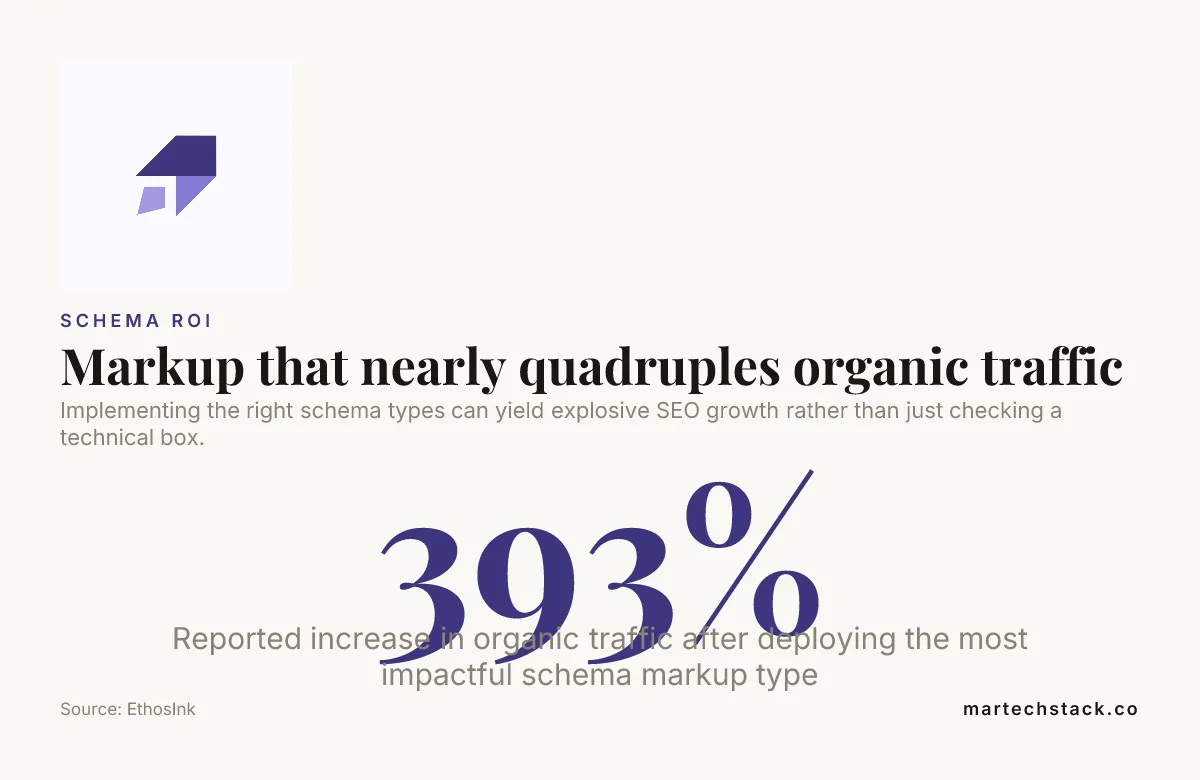
Implementing the right schema types can yield explosive SEO growth rather than just checking a technical box.
Why Data Analysis Belongs in Every Schema Strategy
Only three of the top 20 ranking pages typically get cited in a given AI answer. Ranking well and being machine-readable are two different games, and you need to win both.
This is exactly why data analysis matters here. We look at which of your product pages, review clusters, or FAQ blocks are actually pulling their weight in AI citations, and which ones need a schema refresh.
Leverage the power of machine learning algorithms to make predictions and classifications about which pages deserve schema investment first. That’s not guesswork, that’s a data-driven decision.
The MarTech Stack Approach: A Partnership, Not a Checklist
We’re more than consultants, we’re partners invested in your triumph. Schema markup isn’t a favor we do for you once and forget.
Our story is one of passion, expertise, and an unyielding commitment to our clients’ success. We love what we do. And we rock at it.
Here’s our roadmap for getting your structured data schema right:
- Honest conversation. We start by having an honest conversation about your needs, your platform, and where your current markup stands.
- Tailored audit. With your personalized plan in hand, we dive in with a collaborative spirit, mapping every schema gap across product, review, FAQ, local, and organization data.
- Ongoing partnership. Our team of passionate people puts their heads together to make things happen, monitoring, testing, and adjusting as Google and AI models evolve.
Together, we’ll navigate the digital landscape and steer your online success story, one clean data schema at a time. Learn more about who we are in our story, or reach out through our contact page to start the conversation.

Conclusion
Structured data markup isn’t a technical footnote anymore, it’s the language your business speaks to Google, to AI Overviews, and to every LLM deciding whether to mention you at all. The 5 schema markup types that actually move the needle, Product, Review/AggregateRating, FAQ, LocalBusiness, and Organization/Article, aren’t optional extras. They’re the foundation of tangible success in a search landscape that’s changing faster than most businesses can keep up with.
We’d rather show you than tell you. Let’s unlock your data together and build a schema strategy that actually earns its place on the page.
Frequently Asked Questions
What are the 5 schema markup types that actually move the needle in 2026?
The five that consistently deliver results are Product, Review/AggregateRating, FAQ, LocalBusiness, and Organization/Article schema. Together, these cover visibility, trust, direct answers, local discovery, and machine-readable identity.
Is schema markup still worth it in 2026?
Yes, arguably more than ever. With 68% of searches ending without a click and AI tools driving hundreds of percent more traffic year-over-year, structured data schema is how you stay visible on and off the results page.
How do I test my structured data markup?
Run a schema mark up test through a google schema checker before launch and after any major site change. Consistent testing catches broken data markup before it costs you visibility.
Does structured data schema actually help with AI search results?
Yes. LLMs and AI Overviews pull grounded facts from clean google schemas rather than guessing from unstructured text, which is exactly why ai seo and schema strategy now go hand in hand.
Can small businesses benefit from LocalBusiness schema?
Absolutely, and often more dramatically than large brands. Prominent click-to-call features enhanced by LocalBusiness schema can boost mobile conversion rates by up to 200% for service-based businesses.
What’s the difference between structured data schema and general seo?
General seo covers your overall visibility strategy, while structured data schema is a specific technical layer that makes your content machine-readable. Think of schema as the vocabulary that lets seo consulting efforts actually get understood by Google and AI tools.
Should I hire help for schema markup, or DIY it?
DIY schema often works until your site scales or your platform updates, at which point small errors compound quickly. A dedicated martech partner catches those gaps early through ongoing web analytics and data analysis, not a one-time fix.

Founder of MarTech Stack. SEO, analytics and marketing automation.
LinkedIn