

Running a proper e-commerce SEO audit isn’t optional if you’re serious about protecting revenue that’s already sitting on your site. A recent study found that 53% of e-commerce websites have missing canonical tags, a gap that quietly drains crawl budget and index visibility on the exact product pages meant to convert.

Key Takeaways
- Canonical tags matter more than most teams realize. Missing or broken canonical handling on variant and parameter URLs is one of the most common issues we find in an e-commerce SEO audit.
- Faceted navigation creates crawl bloat. Filter combinations generate thousands of near-duplicate URLs that waste crawl budget on pages nobody needs indexed.
- Thin category pages cost visibility. Pages with little unique copy and weak internal linking struggle to earn a spot for the terms shoppers actually type.
- Site speed on product templates ties directly to conversion. Slow-loading product pages lose sales before a shopper even sees the “Add to Cart” button.
- Product schema affects merchant listing eligibility. Without clean structured data, your products may not qualify for the rich listings that drive free clicks.
- Out-of-stock handling needs a policy, not guesswork. Discontinued products left live (or deleted without a plan) create dead ends that hurt both shoppers and visibility.
- Every finding should map to a dollar figure. An audit only gets prioritized by stakeholders when findings are tied to estimated revenue impact, not just technical severity. Our SEO consulting work always starts with this connection.
What an E-commerce SEO Audit Actually Covers
An e-commerce SEO audit isn’t a single checklist. It’s a structured review of how your catalog gets crawled, indexed, and presented to shoppers across product templates, category pages, and the metadata that ties them together.
We treat it as a diagnostic, not a report you file away. The goal is a tailored roadmap that your team can act on this quarter, not a 90-page document that sits in a shared drive.
At MarTech Stack, we pair this audit work with data analysis so every recommendation is backed by numbers, not opinion. That combination is what turns a technical review into a growth journey your whole team can get behind.
Crawl and Index Bloat From Faceted Navigation
Faceted navigation is one of the biggest sources of index bloat on any e-commerce store. Every filter combination (color, size, price range, brand) can generate a unique URL, and without controls, those URLs multiply fast.
A store with 500 real products can easily produce 50,000 filtered URL variations. Most of those pages have zero unique value and pull crawl attention away from the pages that actually need to be indexed.
What to check during your audit:
- Are filter URLs blocked in robots.txt or handled with proper canonical tags pointing back to the parent category?
- Are parameter URLs (like ?sort= or ?color=) showing up in your index coverage report in large numbers?
- Does your internal linking structure ever link directly to a faceted URL instead of the clean category page?
Duplicate and Thin Product and Category Pages
Duplicate content on product pages usually comes from one of two places: manufacturer descriptions copied straight from a feed, or size and color variants that each get their own URL with near-identical copy.
Thin category pages are the other half of the problem. A category page with a grid of products and nothing else gives shoppers, and any crawler, very little to work with.
The lowest-performing e-commerce sites we’ve reviewed almost always share one trait: 90% of them have measurable user experience issues on their category and product templates, according to Reboot Online.
Fixing thin pages doesn’t mean stuffing paragraphs above the fold. It means adding genuinely useful buying guidance, size charts, or comparison content that answers what a shopper is actually trying to figure out before they buy.

Canonical Handling for Product Variants
Variant URLs are where canonical tags either save you or quietly cost you visibility. If a t-shirt comes in six colors and each color has its own URL, you need a clear decision: consolidate under one canonical, or let each variant compete on its own.
There’s no universal right answer here, but there is a wrong one: leaving it inconsistent. We see stores where half the catalog canonicalizes variants and the other half doesn’t, and that inconsistency is exactly what an audit is built to catch.
Product Schema and Merchant Listing Eligibility
Structured data on product pages isn’t a nice-to-have anymore. Price, availability, review rating, and shipping information all need to be marked up correctly for your products to qualify for merchant listing placements.
The overlap between what shows up in AI-generated answer boxes and what ranks in a traditional top ten list is surprisingly small. Yotpo found only 16.7% overlap between sources cited in AI Overviews and standard organic results, which means eligibility for one doesn’t guarantee eligibility for the other.
This is where AI SEO and traditional visibility work start to diverge, and why we treat schema audits as their own line item rather than folding them into general on-page checks.
Category Page Content and Internal Linking
Category pages carry more weight than most store owners give them credit for. They’re the bridge between a broad shopper intent (“running shoes for wide feet”) and the specific product that answers it.
Weak internal linking compounds the problem. If your best-selling products aren’t linked from your top category and collection pages, you’re asking shoppers, and any crawler, to work harder than they should to find your money pages.
A quick internal linking check:
- Pull your top 20 highest-margin products.
- Check how many clicks it takes from your homepage to reach each one.
- Flag anything past three clicks for a linking fix.
Out-of-Stock and Discontinued Product Handling
Out-of-stock pages are a common blind spot. Some teams delete the page entirely (losing accumulated link equity and any existing visibility), others leave it live indefinitely with no path forward for the shopper.
Neither is a strategy. A better approach:
- Keep the page live if the product will restock, and add a “notify me” option.
- Redirect to the closest in-stock alternative if the product is permanently discontinued.
- Never leave a 404 as the default outcome for a product a shopper was actively trying to buy.

Site Speed and Core Web Vitals on Product Templates
Product templates tend to be the heaviest pages on any store: large images, review widgets, upsell carousels, and often three or four tracking scripts stacked on top of each other.
The average Lighthouse score across e-commerce sites sits around 67 out of 100, according to Reboot Online, which tells you most stores have real room to improve. Every second of load time on a product page is a second a shopper spends deciding whether to leave.
Our digital web analytics reviews often start right here, because speed issues on product templates are usually the fastest fix with the clearest payoff.
Tying Audit Findings to Revenue Impact
A technical finding without a dollar figure attached rarely gets prioritized. Stakeholders act on numbers, and it’s on us to connect a broken canonical tag or a slow product template to actual traffic and sales.
Here’s a simple way to frame it: take the estimated organic sessions a page currently gets, apply your site’s average conversion rate, and multiply by average order value. That gives you a revenue-at-risk number for every audit finding, not just a severity label.
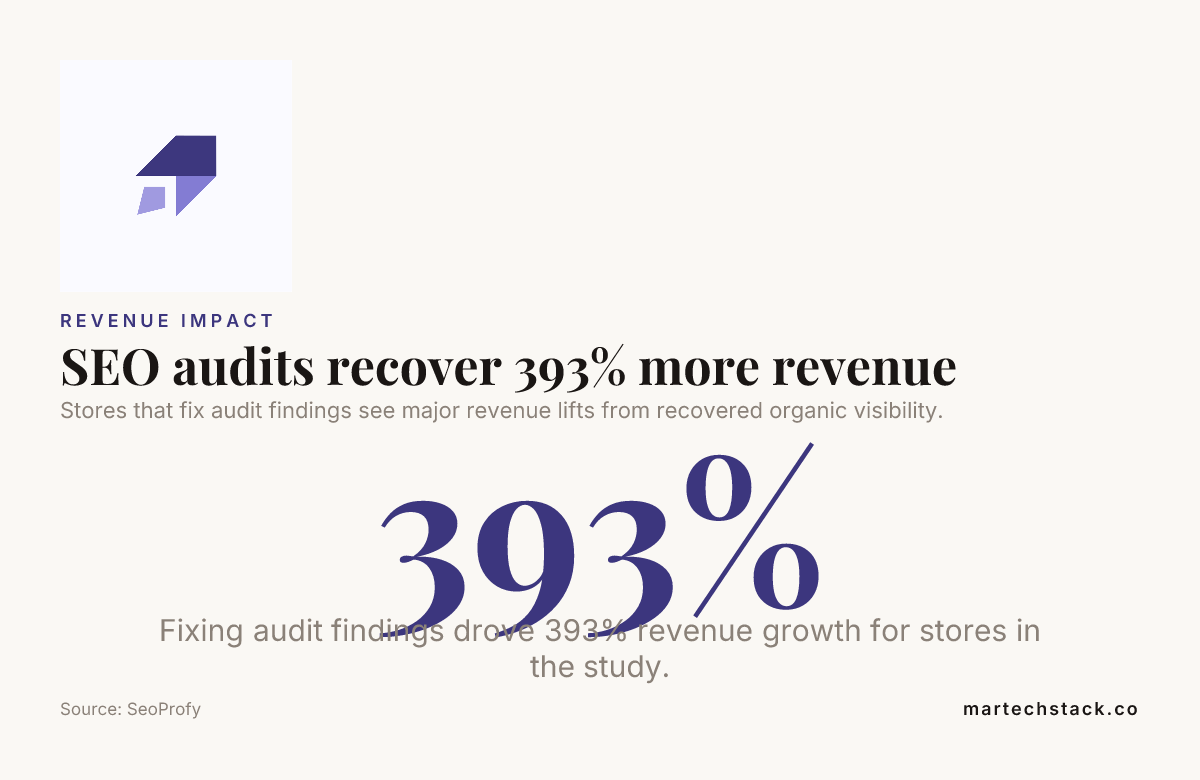
Stores that fix audit findings see major revenue lifts from recovered organic visibility.
With global retail conversion rates sitting around 1.4% in early 2026 per SeoProfy, small percentage-point improvements found in an audit carry outsized weight against total revenue. That’s the tangible success we aim for with every client engagement.
A Practical Step-by-Step E-commerce SEO Audit Workflow
An e-commerce SEO audit works best when it follows the same sequence every time, so findings stay comparable across quarters.
- Crawl the full site with a tool that respects robots.txt and flags parameter URLs separately from clean paths.
- Pull index coverage data to see what’s actually indexed versus what you think should be indexed.
- Audit canonical tags on a sample of variant and category pages across different product types.
- Check structured data against current merchant listing requirements for price, availability, and reviews.
- Review page speed on your five highest-traffic product templates using real device data, not just lab scores.
- Map internal links from top category pages to your highest-margin products.
- Document out-of-stock handling across a sample of discontinued SKUs.
- Attach revenue estimates to every finding before presenting it to stakeholders.
This is the same roadmap we walk clients through as part of our SEO and analytics services, because a consistent process is what makes month-over-month progress visible.

A Prioritization Framework That Stakeholders Actually Approve
Not every finding deserves the same urgency. We sort issues into three buckets: high traffic impact and low effort, high traffic impact and high effort, and everything else.
Position matters enormously here. Moving from position 2 to position 1 on a competitive term drives a 74.5% increase in clicks, according to AIOSEO, which is a compelling number to bring into a budget conversation with leadership.
| Priority Tier | Example Finding | Typical Timeline |
|---|---|---|
| Tier 1: Fast and impactful | Missing canonical tags on variant URLs | 1 to 2 weeks |
| Tier 2: Impactful but slower | Rebuilding thin category page templates | 1 to 2 months |
| Tier 3: Monitor and revisit | Minor schema field gaps on legacy SKUs | Next quarter |
Non-branded organic search still generates 68 times more revenue than ChatGPT referrals according to SEO Sherpa, which is worth remembering when a new AI trend tempts a team to deprioritize the fundamentals covered in a standard audit.
Why Data Analysis and Web Analytics Belong in Every Audit
An audit that only checks technical boxes misses half the picture. Pairing it with real data analysis means every recommendation gets tested against actual shopper behavior, not just best practice guidelines.
This is the martech duality we build our whole practice around: SEO visibility work paired with web analytics that tells you whether the fixes actually moved the needle. It’s a partnership between technical accuracy and measurable outcomes, and it’s why we treat SEO consulting and data analysis as two halves of the same job rather than separate departments.
Search behavior itself is shifting too. Google AI Overviews now appear on 48% of high-intent queries according to Yotpo, and 60% of searches end without a click at all per AIOSEO, which means SKU-level data needs to be structured for both traditional visibility and LLM-based answer engines going forward.
Conclusion
An e-commerce SEO audit isn’t a one-time cleanup project. It’s an ongoing practice that catches the crawl bloat, canonical issues, thin content, and speed problems that quietly erode revenue month after month.
We approach every e-commerce SEO audit as the start of a real growth journey, not a static report. If you’re ready to find out what your own audit would uncover, reach out to our team and let’s have an honest conversation about where your revenue is hiding.
Frequently Asked Questions
What is an e-commerce SEO audit and why does my store need one?
An e-commerce SEO audit is a structured review of how your product catalog gets crawled, indexed, and presented across category and product pages. Stores need one because issues like missing canonical tags and thin category content quietly cost visibility and revenue without any obvious warning sign.
How often should I run an e-commerce SEO audit?
Most growing stores benefit from a full audit every six months, with lighter technical checks quarterly. If you’re adding new product lines frequently or migrating platforms, an e-commerce SEO audit should happen right before and after the change.
What’s the biggest technical issue found in e-commerce SEO audits?
Missing or inconsistent canonical tags on variant and parameter URLs is one of the most common findings, affecting over half of e-commerce sites studied. This single issue can cause significant crawl and index bloat across an entire catalog.
Does site speed really affect e-commerce conversion rates?
Yes, and the effect is measurable. Rakuten 24 recorded a 33.13% conversion rate increase after improving Core Web Vitals, which shows why site speed on product templates deserves a dedicated section in any e-commerce SEO audit.
How do I prioritize which audit findings to fix first?
Sort findings by traffic impact against implementation effort, and attach an estimated revenue figure to each one. Fixes with high impact and low effort, like canonical tag corrections, should always come before larger structural rebuilds.
Should my e-commerce SEO audit include AI search visibility now?
Yes, AI Overviews now appear on 48% of high-intent search queries, so checking product schema and structured data for AI SEO eligibility belongs in a modern audit. That said, non-branded organic search still generates far more revenue than AI chat referrals, so don’t deprioritize the fundamentals.
Can I run an e-commerce SEO audit myself, or do I need a consultant?
Smaller catalogs can start with a self-guided audit using crawl tools and index coverage reports. Larger catalogs, or stores dealing with recurring visibility drops, usually get more value from working with an SEO consulting partner who can pair technical findings with data analysis and web analytics.

Founder of MarTech Stack. SEO, analytics and marketing automation.
LinkedIn