

Most SEO audits die in a shared drive. Not because the findings were wrong, but because the report gave nobody a reason to act on Monday morning. A good seo audit report template fixes that: it turns a pile of technical findings into a ranked list of decisions with names and dates attached.

Key Takeaways
- What is an SEO audit report template? A structured deliverable that translates findings into business outcomes, owners, and timelines.
- Why does structure matter? Decision-makers act faster when insights connect to revenue, not just technical detail.
- What must be included? Executive summary, scoring model, prioritised issues, ownership, and follow-up cadence.
- How do you tie to business impact? Use web analytics and data analysis to quantify lost revenue and upside.
- Where to start? Explore SEO consulting services to align reporting with implementation.
- What tools help? Dashboards from digital web analytics services and structured data models.
- Who owns execution? Named owners per issue, tracked through your martech stack and reporting cadence.
Why Your SEO Audit Report Template Fails Without Business Context
We have all seen it. Fifty pages of crawl data, no story, no action.
A modern seo audit report template is not about listing issues. It is about guiding decisions, tying data analysis to revenue, and making it easy for non-technical teams to act.
That is where martech, web analytics, and AI SEO workflows come together. You are not just reporting. You are building a roadmap your stakeholders can follow.
The Core Sections Every SEO Audit Report Template Must Include
This is your foundation. Miss one of these, and momentum drops.
- Executive summary, what matters, what to do next
- Scoring and prioritisation model, how you rank effort vs impact
- Issue deep dives, structured, not raw exports
- Effort vs impact matrix, visual clarity for decisions
- Owner assignment, accountability drives execution
- Timeline and cadence, how progress is tracked
We build these into every engagement across our core service offerings, because structure creates momentum.

Executive Summary in an SEO Audit Report Template That Drives Action
This is the only section some stakeholders will read. Make it count.
Your executive summary should answer three questions:
- What is broken or underperforming
- What it costs the business
- What happens if we fix it
Use web analytics and data analysis to quantify impact. A line like “the checkout page has been non-indexable since the March release, and it used to bring in a fifth of our non-brand entrances” lands. That gets buy-in. “Missing canonical tags on 412 URLs” does not.
Keep it short. Keep it sharp. No jargon.
Build a Scoring Model Using Data Analysis, AI, and LLM Signals
Not all issues are equal. Your seo audit report template needs a consistent scoring system.
We recommend combining:
- Impact, revenue potential, traffic influence, conversion effect
- Effort, dev time, dependencies, complexity
- Confidence, how good is the evidence behind the estimate
Confidence is the one most templates skip, and it is the one that protects your credibility. A high-impact guess and a high-impact measurement should not sit in the same row looking identical. AI and LLM tooling helps here mainly on the grunt work: clustering hundreds of similar issues, spotting patterns across large exports, and drafting the first version of an impact estimate you then sanity-check yourself.
Reporting on AI visibility is not a novelty section anymore. If your stakeholders are asking whether the brand shows up in ChatGPT or AI Overviews, the audit is where that question gets answered.
How to Structure Issue Tables in Your SEO Audit Report Template
This is where most reports fail. They dump exports instead of guiding action.
Your issue tables should be clean and consistent:
- Issue name
- Business impact
- Priority score
- Recommended action
- Owner
- Status
Each row should read like a decision-ready insight. Not a data point. If a row cannot be summarised in one sentence a developer could act on, it is not finished yet.
We connect this layer directly with data analysis services to ensure every issue ties back to measurable outcomes.
Effort vs Impact Matrix in an SEO Audit Report Template
This is your visual shortcut. Stakeholders like it because it simplifies everything.
Break work into four quadrants:
- High impact, low effort, do now
- High impact, high effort, plan
- Low impact, low effort, quick wins
- Low impact, high effort, avoid
One caution: effort is not yours to estimate alone. Run the matrix past whoever owns the codebase before it goes in the deck, or you will confidently label a three-sprint migration as a quick win.
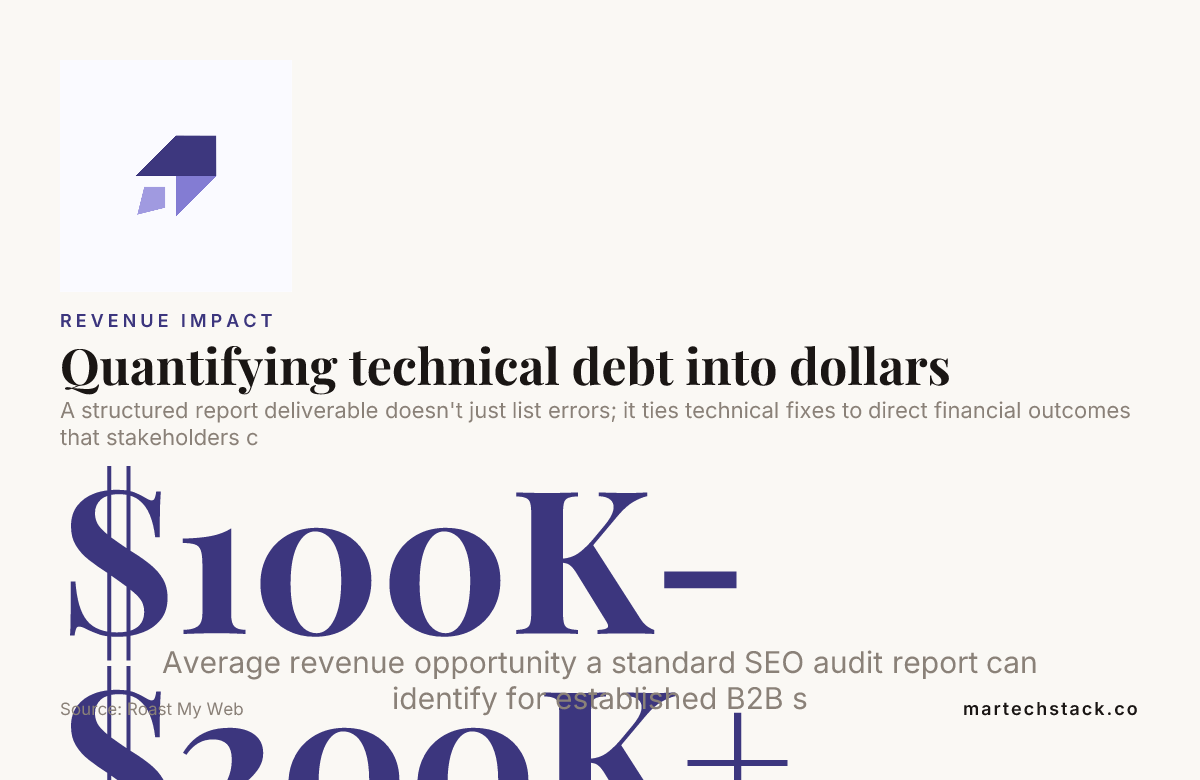
A structured report deliverable doesn’t just list errors; it ties technical fixes to direct financial outcomes that stakeholders care about.

Assign Owners and Build Accountability Into Your SEO Audit Report Template
No owner means no action. Every time.
Your seo audit report template must assign:
- A clear owner per issue
- A supporting team if needed
- A deadline or sprint alignment
A team name is not an owner. “Engineering” will not fix anything; a named person with the ticket in their sprint will. This is also where martech integration matters, because the report should connect with the project tools and dashboards your team already works in rather than living as a static file.
Follow-Up Cadence That Keeps Momentum Alive
A report without follow-up fades fast.
Set a cadence:
- Weekly progress check-ins
- Monthly performance reporting
- Quarterly re-evaluation using updated data analysis
Dashboards from web analytics systems help here. They turn static reports into living systems.
Consistency wins. Every time.
Common Mistakes in an SEO Audit Report Template
Let’s be direct. These kill adoption.
- Dumping raw crawler exports
- No prioritisation model
- No business context or revenue tie-in
- No assigned owners
- No timeline or follow-up plan
There is a sixth one worth naming: a report so long nobody finishes it. If the audit runs to eighty slides, the executive summary is doing all the work and the rest is an appendix. Format it that way from the start.

A Practical SEO Audit Report Template You Can Copy
Use this as your starting point. Adapt it to your workflow.
1. Executive Summary
Top 3 issues, estimated business impact, next steps2. Performance Snapshot
Key metrics from web analytics, trends, anomalies3. Scoring Model
Impact, effort, confidence explained4. Priority Issues Table
Structured list with actions, owners, and status5. Effort vs Impact Matrix
Visual prioritisation6. Deep Dive Sections
Grouped by theme, technical, content, AI visibility7. Ownership and Roadmap
Who does what, and when8. Reporting Cadence
Weekly, monthly, quarterly checkpoints
Sections one to five are what you present. Six is what you leave behind for the people doing the work. Keeping that split clear is most of the battle.
Conclusion
An seo audit report template is not just a document. It is your bridge between insight and execution.
When you combine martech, web analytics, data analysis, and AI-driven insights, your report becomes a roadmap. One your stakeholders actually follow.
If you want a partner who builds audit reports that get implemented rather than filed, start with an honest conversation at our contact page.
Frequently Asked Questions
What is the best SEO audit report template in 2026?
The best SEO audit report template includes an executive summary, prioritisation model, issue tracking, and clear ownership. It must connect findings to business outcomes using web analytics and data analysis.
How do I present an SEO audit to non-technical stakeholders?
Focus on revenue impact, not technical jargon. A strong SEO audit report template translates issues into lost opportunities and clear next steps.
Can AI and LLM tools improve an SEO audit report template?
Yes, mostly on the repetitive parts. AI and LLM tools help cluster issues, draft impact estimates, and cover AI visibility reporting, but the prioritisation calls still need a human who knows the business.
What should I avoid in an SEO audit report?
Avoid raw data dumps, missing priorities, and unclear ownership. A weak SEO audit report template leads to no action.
How often should I update my SEO audit report?
Update monthly with performance data and revisit quarterly. Your SEO audit report template should support continuous improvement.
Why is web analytics important in audit reporting?
Web analytics provides the data needed to tie findings to real outcomes. It turns an SEO audit report template into a decision-making tool.
Do I need SEO consulting to build a strong report template?
Not always, but SEO consulting helps align your template with execution. It ensures your report drives results, not just discussion.

Founder of MarTech Stack. SEO, analytics and marketing automation.
LinkedIn