Ninety-three percent of queries inside Google’s AI Mode now end without a single click to a website. If that number stopped you cold, good, because ai and seo in 2026 isn’t a minor update to your old playbook. It’s a full rewrite, and we’ve been living inside that rewrite with our clients every single day.
We’re MarTech Stack, and we’ve spent our careers at the intersection of seo, data analysis, and web performance. This year, that intersection got a lot more crowded, and a lot more interesting.

Key Takeaways
- AI Overviews now dominate B2B research. Roughly 82% of B2B technology queries trigger an AI-generated summary before a user ever scrolls to organic results.
- Citation beats ranking. Only 17% of AI Overview citations come from pages sitting in the traditional top 10, so classic ranking signals aren’t the whole game anymore.
- Traffic quality is shifting upward. Visitors arriving from AI search convert at 4.4x the rate of standard organic visitors, according to SeoProfy.
- LLM referral traffic is exploding. Elementor tracked a 527% year-over-year jump in referral visits coming from large language models.
- Brand accuracy is a new risk. 27% of marketers say an AI response has already misrepresented their brand, per ContentGrip.
- Your measurement stack needs rebuilding. We walk clients through this exact shift in our digital web analytics engagements.
- A structured technical foundation still matters. Our 2026 technical SEO data integrity audit checklist is a good starting point if you haven’t touched your crawl health in a while.
Why AI and SEO Now Mean Something Different for B2B Teams
For years, seo meant one thing: get your page to rank, and the clicks will follow.
That equation is broken. AI Overviews answer the question directly, inside the results page, before your carefully optimized page ever loads.
For B2B marketers specifically, this hits hard. Buyers researching software, services, or vendors are exactly the audience most likely to see an AI-generated summary first.
We’re not here to tell you seo is dead. We’re here to tell you the definition of visibility has changed, and your strategy has to change with it.
The teams winning right now treat ai and seo as one connected discipline, not two separate line items on a budget spreadsheet. Content, technical structure, and measurement all have to work together, or none of it works at all.
How AI Overviews and LLMs Are Rewriting the B2B Buyer Journey
Your buyer’s journey no longer starts with a search box and ends with a landing page visit. It starts with a conversation, sometimes with ChatGPT, sometimes with Perplexity, sometimes with Google’s AI Mode.
ChatGPT alone now accounts for roughly 17.1% of total digital queries, a genuine challenge to traditional search dominance that we haven’t seen in two decades.
Here’s what that means practically:
- Buyers form opinions about your company before they ever visit your site.
- Your competitors might get cited in an ai summary while you don’t, even if you outrank them traditionally.
- The research phase compresses. Fewer clicks happen, but the clicks that do land are higher intent.
That last point is the silver lining. Visitors who make it through an AI Overview convert at 4.4 times the rate of standard organic visitors. Fewer people are clicking, but the ones who do are much closer to a decision.

Getting Cited: Content Structured for AI and SEO Visibility
Citation is the new currency. Brands cited inside an AI Overview see a 35% increase in organic clicks, so getting quoted matters more than getting ranked.
We tell our clients the same thing we tell you now: write for extraction, not just for reading.
That means:
- Answer the question in the first two sentences. AI systems pull the most direct, unambiguous statement they can find.
- Use clear structure. Headers, lists, and short paragraphs make it easy for a model to lift and cite your content accurately.
- Back claims with data. Specific numbers and named sources get cited far more often than vague generalizations.
- Update your content regularly. Stale pages lose citation share to fresher, more current sources.
This is exactly the kind of tailored content strategy we build inside our SEO consulting engagements. We don’t just chase keywords anymore. We chase the sentence that gets quoted.
Entity and Topical Authority: The New Currency of AI SEO
Keywords alone won’t carry you anymore. AI systems reason about entities: your company, your people, your specific claims, and how consistently those show up across the web.
Topical authority means owning a subject completely, not just publishing one article and moving on. If you write about martech consulting once and never again, an AI model has no reason to trust you as the authority on it.
We build topical authority for clients the same way we’ve always built it: consistently, methodically, and with a genuine commitment to depth over volume. That means:
- Clustering content around a core topic instead of scattering one-off posts.
- Making sure your company name, service names, and claims are consistent everywhere they appear online.
- Getting mentioned (not just linked) on other authoritative sites in your space.
This is where the data side of our work comes in. Data analysis tells us which topics actually move the needle for your audience, and seo execution turns that insight into content an llm will trust and cite.
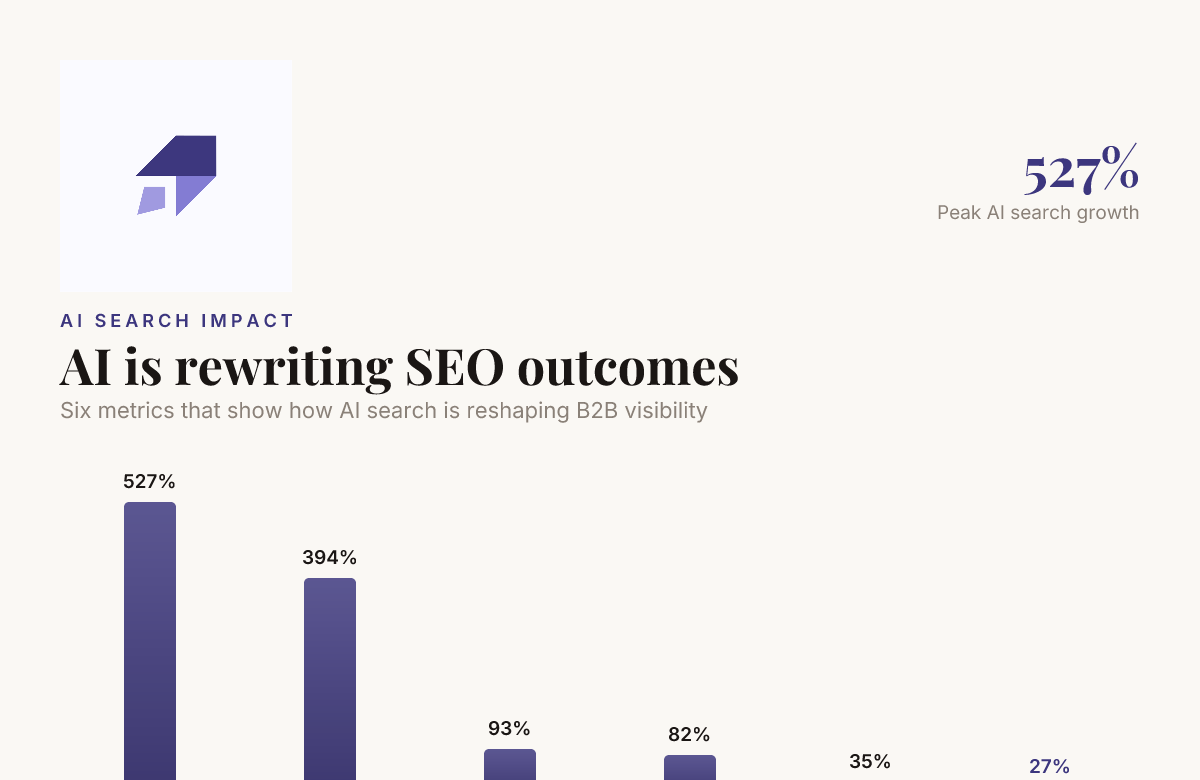
Six metrics that show how AI search is reshaping B2B visibility

Measurement Changes: Why Web Analytics Needs a New Framework in 2026
Here’s an uncomfortable truth: your dashboard is probably lying to you a little.
Traditional click-through rate metrics assume a user clicks, lands, and converts. But with AI Overviews present, the CTR for a #1 organic result drops by 34.5% on average, according to iNet Ventures.
And of the small slice of users who do interact with an AI Overview, only about 1% click any link inside it at all. That doesn’t mean the traffic disappeared. It means the value moved somewhere your old dashboard wasn’t built to see.
Here’s what we recommend measuring instead:
| Old Metric | 2026 Metric to Track Instead |
|---|---|
| Organic click-through rate | Share of AI citations across target queries |
| Keyword position tracking | Brand mention frequency inside AI answers |
| Total organic sessions | Conversion rate of AI-referred visitors (LLM traffic segment) |
| Bounce rate | Assisted conversions from brand awareness gained via AI exposure |
We build these frameworks directly into our web analytics work, layered on top of the data analysis we already run for clients. Unlock your data, and you’ll see the AI-driven picture your old reports were hiding.
Where AI Tooling Helps vs. Where It Hurts Your SEO Consulting Strategy
Let’s be honest about something most agencies won’t say out loud: ai tools are not a shortcut to good seo.
They’re a force multiplier for teams that already know what they’re doing, and a fast track to generic, forgettable content for teams that don’t.
Where AI tooling genuinely helps:
- Drafting first-pass content briefs and outlines at speed.
- Running large-scale content audits across hundreds of pages in minutes.
- Identifying entity gaps and topical clusters through data analysis at a scale humans can’t match manually.
- Monitoring how your brand gets described across AI Overviews and chatbot responses.
Where AI tooling hurts you:
- Publishing raw AI output without human review, which flattens your voice and your credibility.
- Trusting AI-generated data claims without verification. Models hallucinate statistics more often than most marketers realize.
- Skipping the technical foundation. No amount of clever ai seo content fixes a site with broken crawl paths or duplicate content.
We love what we do, and we rock at it, but we’d never tell a client that AI tools replace the judgment of an experienced consultant. They amplify good judgment. They don’t create it.
This balance is exactly why we treat martech as a team sport. Our team of passionate people puts their heads together to make things happen, using AI where it earns its place and skipping it where it doesn’t.
Building Your 2026 AI and SEO Roadmap
We’ve said it before: with your personalized plan in hand, we dive in with a collaborative spirit. That approach hasn’t changed, but the roadmap itself has.
Here’s the three-step approach we use with clients navigating ai and seo right now:
- Audit and align. We start with an honest conversation about your current technical health, your entity presence, and where AI systems already mention (or misrepresent) your brand.
- Structure for citation. We rebuild priority content to answer questions directly, backed by real data, formatted for both human readers and AI extraction.
- Measure and adapt. We track AI citation share and LLM referral conversions alongside your traditional metrics, adjusting monthly as the landscape shifts.
Together, we’ll navigate the digital landscape and steer your online success story through this transition, one deliberate step at a time.
Conclusion: Your Next Move in AI and SEO
Ai and seo in 2026 rewards teams that combine structured content, real entity authority, and measurement that actually reflects how buyers research today. It punishes teams that keep chasing 2020-era ranking metrics while their competitors get cited and they don’t.
We’re more than consultants. We’re partners invested in your triumph through this shift, and we’re all about outcomes you can see and growth you can measure. If you’re ready to embark on that work, reach out and let’s start the conversation, or browse our full range of services to see where we can help first.
Frequently Asked Questions
Is traditional SEO still worth investing in with AI search growing so fast?
Yes. Traditional seo fundamentals like site structure, content quality, and technical health remain the foundation AI systems pull from when deciding what to cite. Skipping seo to chase AI visibility alone leaves you with nothing solid underneath.
How do I get my content cited in AI Overviews?
Structure your content to answer questions directly within the first few sentences, back claims with specific data, and keep pages updated regularly. Brands cited in AI Overviews see a 35% lift in organic clicks, making citation a legitimate goal for your ai seo strategy.
What’s the difference between AI SEO and traditional SEO?
Ai seo focuses on getting cited and mentioned accurately inside AI-generated answers, while traditional seo focuses purely on ranking position. In 2026, the two overlap heavily, but citation now matters as much as ranking, sometimes more.
Should B2B marketing teams use AI tools to write SEO content?
AI tools work well for drafting, auditing, and scaling research, but published content still needs human review for accuracy and voice. Relying entirely on unedited AI output tends to produce generic pages that AI systems themselves are less likely to cite.
How do I measure success if AI Overviews are reducing clicks?
Track AI citation share, brand mention frequency, and conversion rates of AI-referred visitors instead of relying solely on click-through rate. Our data analysis services help translate these newer metrics into decisions you can act on.
What is entity authority and why does it matter for AI search?
Entity authority is how consistently and credibly an AI system recognizes your company, people, and claims across the web. Strong entity authority increases the odds an llm cites you accurately instead of a competitor or, worse, misrepresents your brand entirely.
Is it too late for B2B companies to adapt their SEO strategy for AI search in 2026?
No, but the window to build topical authority and clean technical foundations is narrowing as more competitors catch on. Start with a technical audit, like our 2026 technical SEO data integrity checklist, and build outward from there.

Founder of MarTech Stack. SEO, analytics and marketing automation.
LinkedIn