

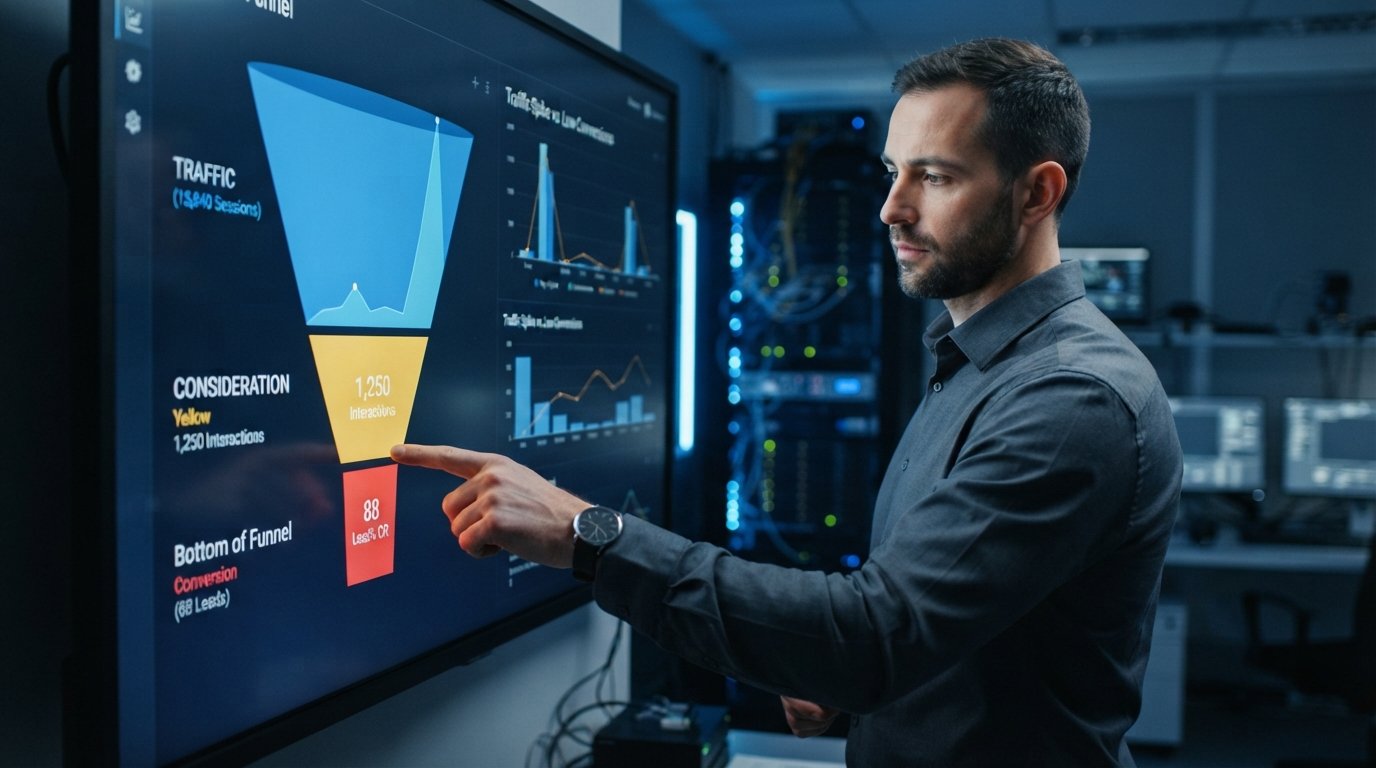
In B2B, a lot of teams chase volume while the real issue stays hidden. Organic search is usually the broadest channel you have, which means it arrives carrying the widest spread of intent, and that spread is exactly what a sessions number cannot show you.
Key takeaways
| Signal | What it tells you |
| Funnel drop-off | Where users stop taking the next step, not where they arrive. |
| Landing page conversion rate | Whether the page matches intent and earns the next action. |
| Segment behaviour | Whether specific buyer types convert, and whether new versus returning users behave differently. |
| Page value weighting | Prioritise the pages that can move pipeline, not the pages that just rack up sessions. |
| Measurement discipline | Treat website conversion optimisation as a system: define, instrument, test, and learn. |
| Next step | If you want a structured CRO approach, start with our services, then refine with an initial consultation. |
Conversion rate optimisation starts with a disconnect, not a checklist
If you have meaningful organic traffic in 2026 but weak pipeline, you are usually seeing a metrics mismatch. Sessions are not outcomes. Traffic tells you you brought people in, but it does not tell you whether your site turned attention into the next step.
That is why conversion rate optimisation, and conversion optimisation more broadly, has to begin with the disconnect. The key question is simple: are your users failing to progress, or is your traffic simply not the right kind?
For B2B teams, this is even more common because buying journeys are longer and decisions are committee-led. So you will often see “busy” analytics, while the enquiry process stays quiet.
Rule of thumb: If your top pages get visitors but your pipeline does not respond, you likely have a conversion issue, not a traffic issue.
Diagnose the real bottleneck with GA4 funnel and segment analysis
Let’s make this practical. You need to diagnose whether your website conversion rate issue sits in behaviour, intent, or friction.
We start in GA4, because it gives you the segmentation you need for B2B journeys, and the event-level visibility you need for measurement discipline. If your reporting still stops at sessions and bounce rate, work through analysing web traffic in Google Analytics 4 first, then come back to this.
1) Build a B2B funnel that matches your pipeline motion
Do not copy a generic funnel. Model your actual progression. Typical B2B steps look like:
- Landing view (the page that brought them in)
- Engagement proxy (scroll depth, time on page, or key content visibility)
- Action (demo request, contact form start, download, call booking)
- Completion (form submitted, thank you page viewed)
Then compare drop-off by landing page and by segment. If you see that certain landing pages consistently lose users before the form starts, you have a landing page conversion rate problem. If users start but do not complete, you have friction in the enquiry process.
2) Use segment analysis to separate buyer intent from general browsing
In B2B, behaviour often differs between returning and new visitors. Returning visitors usually convert at a noticeably higher rate than first-time visitors, which is a strong hint that the right audience exists on your site, but only progresses after familiarity.
Segment examples you should apply in 2026:
- New vs returning users, and first session source
- Company size and role if you have it (from forms or enrichment)
- Device, browser, and geography (UK and Europe can behave differently)
- High-intent page sequences (page A then pricing or contact)
If returning users are converting much more often, your current issue may be that new visitors do not see enough proof, clarity, or next steps on the first landing page.
3) Check intent mismatch between query and page
A frequent pattern is “qualified-looking traffic” landing on a page that reads like an overview rather than a decision page. The user might want a specific answer, but your page gives general information.
In practice, diagnose intent mismatch by pairing:
- High-traffic query terms (from your analytics referrer data or your reporting inputs)
- The landing page they hit
- Whether that page includes the exact reassurance needed for that intent (outcomes, process, timelines, proof, and clear next action)
When intent is misaligned, conversion rate optimisation becomes copy and structure work, not traffic work. This is also the point where CRO and search work stop being separate projects, which is the argument behind our B2B SEO strategy approach.

Landing page conversion rate: find the pages that leak pipeline
Your landing page conversion rate tells the truth fast. If your best pages do not convert, traffic volume will only amplify disappointment.
So we do landing page level analysis, not just site-wide averages. Site-wide conversion often hides performance concentration. You typically have a small set of pages doing most of the good work, and many pages doing almost nothing.
What to measure per landing page
- View-to-action rate (from landing view to form start)
- Action-to-completion rate (form start to submission)
- Secondary engagement (does the user reach key sections like services, process, pricing, or proof)
- Segment split (new vs returning, UK vs EU if relevant, device type)
Intent alignment checklist (structural and copy elements)
This is where website conversion optimisation becomes a craft. Your page has to do three jobs:
- Confirm they are in the right place (headline, first 5 seconds, and the page’s promise)
- Reduce uncertainty (process, what happens next, timeframes, proof, and credible specifics)
- Make the next step feel safe and simple (one primary call-to-action, friction removed, expectations set)
If you use multiple competing calls-to-action above the fold, you often get “clicking around” instead of commitment.
And be careful with form length. Every extra field is one more reason to abandon, and the cost compounds down the form, so when conversion rate optimization focuses only on copy, you can miss the bigger lever.
Prioritise by value, not by volume, using a page scoring model
Most teams start with the wrong priority list. They pick the pages with the most traffic, then wonder why website conversion optimisation feels slow.
In 2026, you need to prioritise by value. Not by sessions, but by revenue impact potential.
Build a “value score” for each page
At its simplest, the value score blends:
- Traffic quality (which segments land there and whether those segments show buying intent)
- Current conversion (landing page conversion rate and form completion rate)
- Funnel proximity (are users moving toward contact, demo, or purchase intent)
- Potential for improvement (where drop-off occurs, and what you can plausibly change)
Then rank pages by expected pipeline uplift, not absolute traffic.
How to spot “fake problems” quickly
- High traffic, low conversion but strong engagement might mean intent mismatch and copy clarity are the issue.
- High traffic, low engagement often points to page structure, messaging fit, or loading performance impacting the experience.
- Form start high, completion low usually means friction, trust gaps, or multi-step confusion.
This is also where measurement discipline matters. You need to be able to say, “we changed X and it moved Y,” not “we improved the page.”

Structural and copy elements that move conversion rate optimisation
Let’s be specific. Conversion rate optimisation in B2B usually fails because teams adjust the wrong layer. So we focus on the structural and copy elements that actually influence the decision moment.
Structure: make the page guide the buyer
- Single dominant CTA (one primary next step, not three competing actions)
- Above the fold promise that matches the page’s intent (who it is for, what outcome they get)
- Proof where uncertainty is highest (process, results, experience, and credible details)
- Clear form expectations (how long, what happens after submission, what they get)
- Remove visual clutter that forces scanning without progress
It is not about aesthetics. It is about getting the user from “interested” to “willing to enquire” without hesitation.
Copy: answer the questions buyers are thinking
Write for the buyer’s internal checklist. For B2B, those questions tend to revolve around fit, process, and risk.
- Fit: what situation is this for, what problems do you solve
- Process: what happens first, what happens next
- Timeline: how long steps usually take
- Proof: evidence that you deliver, not vague claims
- Outcome: what changes after engagement
If your page reads like a brochure, you usually get low landing page conversion rate from first-time visitors.
Where ecommerce conversion rate optimization fits
If you have ecommerce components, friction can show up as checkout drop-off, not just lead forms. Ecommerce conversion rate optimization needs the same discipline, just with different milestones: product view to cart, cart to checkout, and checkout completion.
Even on ecommerce sites, value-based prioritisation holds. You do not just optimise your highest-traffic product pages. You optimise the ones with the highest pipeline potential, account for basket size, and focus on the highest-intent segments.
Run conversion rate optimisation as a measurement discipline
In 2026, the biggest difference between teams that improve conversion rate optimisation and teams that spin is measurement discipline.
If you treat website conversion optimisation as a list of tips, you will never learn reliably. If you treat it as a repeatable measurement process, you do.
A simple operating rhythm that works
- Define the outcome (what event changes, and for whom, measured in GA4)
- Instrument properly (events, funnels, landing page mapping, and form completion)
- Pick the page set by value score (expected pipeline impact)
- Run controlled changes (copy, structure, form fields, trust elements)
- Review results by segment (not only site averages)
- Document learnings (what worked, where, and why)
When you do this, conversion optimisation becomes predictable. It also reduces internal disagreement, because everyone is looking at the same measured outcomes.
What teams typically miss in GA4 measurement
- Mixing engagement events with conversion events, then concluding the wrong thing
- Not mapping actions to the landing page that started the journey
- Not segmenting by new versus returning visitors
- Testing changes without a measurement baseline
Our view is straightforward: the job is to turn analytics into decisions your team can act on, so the next change rests on evidence rather than opinion.
How MarTech Stack supports conversion rate optimisation in practice
Our approach is not “give you a list.” We combine services that work together, so your website conversion optimisation effort is measured, modelled, and improved with data you can trust.
If you want a partner, not just consultants, you need the full loop. That is why we structure work across analytics, data analysis, and CRO insights.
Conversion rate optimisation foundations, built into our service mix
- Digital web analytics, including Looker Studio dashboards, enhanced eCommerce tracking, and conversion rate optimization measurement support. See our digital web analytics services.
- Data analysis for data cleansing, modelling, and visualisation, so you can diagnose what is happening and forecast impact. See our data analysis services.
- SEO consulting where keyword research and on-page work are linked to CRO potential, so you stop generating traffic that will not convert. See our SEO consulting services.
And if you want the full scope in one place, start at our services, then we’ll map your current funnel and landing page conversion rate to a clear roadmap.
Conclusion: when traffic is high, conversion rate optimisation reveals where pipeline leaks
High traffic can hide a conversion problem, especially in B2B. Conversion rate optimisation fixes the disconnect by measuring funnels, segment behaviour, landing page conversion rate, and intent fit, then prioritising work by value rather than volume.
Do it as a measurement discipline in 2026, not as a list of tips. When you build the system, website conversion optimisation becomes repeatable, and your pipeline starts to move for the right reasons.
Frequently asked questions
What is conversion rate optimisation for B2B, and how is it different from general marketing?
Conversion rate optimisation for B2B focuses on turning qualified site behaviour into the next step your pipeline needs, measured through funnels and landing page conversion rate. Unlike general marketing reporting, it treats conversion as an outcome to engineer, using conversion rate optimization methods tied to specific pages and segments.
How do I know if my traffic problem is really a conversion rate optimisation problem?
Check GA4 funnel drop-off and compare landing page conversion rate by page and segment. If users arrive but do not move to form start or completion, you likely have conversion optimisation issues, not a traffic generation issue.
What should I optimise first for website conversion rate optimisation on a B2B site?
Start with pages that combine meaningful traffic with low view-to-action rates, then focus on the biggest drop-off point (form start versus completion). This is website conversion rate optimization with value scoring, so you fix pages that can move pipeline, not just pages that are popular.
How do landing page conversion rate and intent mismatch relate?
If your query intent expects a decision page but the visitor lands on an overview, landing page conversion rate drops because uncertainty stays high. You can diagnose this by pairing the landing page with the segment behaviour and whether proof, process, and next steps are clearly answered.
Can conversion rate optimisation help ecommerce as well, or is it only for lead generation?
It works for both. Ecommerce conversion rate optimization uses the same discipline, just with different milestones like product view to cart, cart to checkout, and checkout completion.
Is conversion rate optimization testing worth it in 2026 for B2B?
Yes, because B2B conversion rate optimization changes often depend on specific page structure and form friction, which averages hide. Using controlled A/B tests for landing page conversion rate gives you evidence, so your team stops guessing and starts learning.
What do conversion rate optimisation services usually include?
Conversion rate optimisation services typically cover measurement setup (events and funnels), landing page analysis, prioritisation by value, and structured experimentation on copy and structure. If you want conversion optimisation delivered properly, look for a team that combines analytics, data analysis, and CRO insights through dashboards and ongoing measurement discipline.

Founder of MarTech Stack. SEO, analytics and marketing automation.
LinkedIn

