Only 1% of search sessions end in a click on an AI Overview citation, compared with 8% for a standard organic result sitting alongside it. That gap changes what “visibility” means, and it’s why learning how to rank in AI Overviews has become a genuine priority for any in-house SEO lead running a competent organic programme in 2026.
This guide is written for marketers who already understand traditional SEO and now need a working answer to a harder question: what actually gets a passage lifted into Google’s AI-generated summary, and how do you measure it once it happens?

Key Takeaways
| Question | Short Answer |
|---|---|
| What triggers an AI Overview? | Informational, comparative, and “why” queries, plus questions Google can answer by combining several related sub-queries. |
| Do you need to rank organically first? | Usually, yes. Most citations come from pages already in the organic top 10, so a solid SEO consulting foundation still matters. |
| What content structure gets cited? | Short, self-contained answer blocks with a definitional opening sentence and a clear question in the heading above it. |
| Does structured data help? | Yes. Pages using schema markup make up a large share of citations, because it helps machines parse meaning without guesswork. |
| How fresh does content need to be? | Recently updated pages are cited more often. A quarterly review cycle is a reasonable minimum. |
| How do you measure AI Overview visibility? | Through impression and citation tracking rather than clicks alone, backed by proper web analytics setup. |
| What wastes effort? | Keyword stuffing, thin FAQ blocks bolted onto unrelated pages, and trying to chase every possible query. |
What Actually Triggers an AI Overview?
Google doesn’t show an AI Overview for every query. It tends to appear when the system judges that a synthesised answer will serve the searcher better than a list of blue links.
“Why” and reason-based queries are the clearest example. These trigger an AI Overview 59.8% of the time, the highest rate of any informational query type Ahrefs has measured.
Comparison queries, process questions (“how does X work”), and multi-part questions behave similarly. If a query can be answered by pulling together several related facts rather than one simple fact, expect an AI Overview.
This is the practical starting point for how to rank in AI Overviews: audit your query set and separate the ones with genuine synthesis potential from the ones that are simple navigational or transactional searches. Don’t build a strategy around queries that were never going to trigger the feature in the first place.
How Google Selects and Cites Passages for AI Overviews
Google doesn’t write from scratch. It grounds its summary in existing web content and cites the passages it draws from.
Organic standing still matters here. 76% of AI Overview citations come from pages already ranking in the top 10 organic results for that query, which means AI Overview visibility is layered on top of conventional SEO performance, not separate from it.
There’s a second layer worth understanding: fan-out queries. Google frequently generates related sub-questions behind the scenes to build a fuller answer, and pages that rank for those sub-queries are 161% more likely to be cited than pages that only target the primary query.
In practice, this means a page competing only for its “main” keyword is leaving citation opportunities on the table. Covering the adjacent questions a reader would naturally ask next is now part of the job.

Passage-Level Structure: Writing Blocks an AI Overview Can Lift Directly
Traditional SEO optimises for a whole page. Ranking in AI Overviews optimises for a single, extractable passage inside that page.
The median AI Overview answer runs to 119 words on desktop, dropping to 91 words on mobile. That’s a strict constraint, and it means your best content asset is a tight, self-contained paragraph that answers one question completely.
A few structural habits make passages easier to lift:
- Definitional openers. Start the answer paragraph with a direct statement of what the term or concept is, before adding nuance.
- One question, one block. Match each H2 or H3 to a single question, and answer it fully within that section rather than spreading the answer across the page.
- Lists where they belong. 78% of AI Overviews include a list format, so if your answer has steps, criteria, or comparisons, present them as a list rather than a paragraph.
- Restraint on length. Grounding quality plateaus around 540 words per section. Beyond that point, extra length adds little and can dilute the factual density that made the passage useful in the first place.
This is where content and technical SEO consulting genuinely overlap. Writing tightly for extraction still needs to sit inside a page that satisfies a human reader’s full intent, not just a machine’s summary requirement.
Entity and Topical Authority Signals
AI Overviews draw on more than a single page. Google’s systems weigh how consistently a domain, and the people behind it, are recognised as an authority on a subject.
This is entity strength, and it builds slowly. It comes from consistent terminology across your site, author bylines with real credentials, and a body of content that covers a topic from multiple angles rather than a single article trying to do everything.
A clear “about” narrative helps here too. When we set out our own story as SEO and analytics consultants, the goal was the same one we’d recommend to any client: make it unambiguous who is behind the content and what they actually do.
Off-page signals matter as well. The correlation between YouTube mentions and AI Overview visibility sits at 0.74, the strongest single off-page factor measured in recent citation studies. That’s a reminder that entity authority is built across formats, not just written pages.
Structured Data and Technical Signals for Machine Parsing
Structured data doesn’t guarantee a citation, but it removes ambiguity that would otherwise force an AI system to guess at meaning.
60% of AI Overview citations come from pages using structured data markup. FAQ schema, HowTo schema, and Article schema all give large language models (LLMs) a clean, labelled version of your content to work from, separate from the visual layout a human reader sees.
The underlying logic is simple. An LLM assembling an answer has to decide, quickly, which passage is trustworthy and which claim belongs to which entity.
Schema, clean heading hierarchy, and consistent internal linking all reduce the interpretive work the model has to do. This is the technical half of AI SEO, and it’s an area where a martech stack built for structured content management pays for itself.
| Signal Type | Traditional Organic Ranking | AI Overview Citation |
|---|---|---|
| Primary unit optimised | Whole page | Single passage or paragraph |
| Ideal answer length | Flexible, often 1,000+ words | Roughly 91 to 119 words per answer block |
| Role of structured data | Helpful, not decisive | Present in 60% of cited pages |
| Freshness sensitivity | Moderate | High, 2.5x more citations for content updated in the last 90 days |
| Success metric | Position and click-through rate | Citation presence and share of visibility |
Content Freshness and Why It Matters for AI Overview Citations
Freshness carries more weight for AI Overviews than it typically does for standard organic results.
Content updated within the last 90 days is cited 2.5 times more often than stale pages, since AI systems are trying to reflect current information rather than a snapshot from a year ago.
Practically, this means a content calendar built purely around new publication is incomplete. A recurring review cycle for your highest-value pages, checking facts, figures, and dates, is now part of a working AI SEO programme rather than an optional extra.
Crawler Accessibility for AI Agents
None of the above matters if the content can’t be reached in the first place.
Google’s AI Overview systems rely on the same crawling infrastructure as standard search, alongside dedicated fetchers used for grounding and retrieval. If a page is blocked in robots.txt, gated behind a login, or rendered entirely through client-side JavaScript with no server-side fallback, it’s invisible to those systems regardless of how well the content is written.
A basic accessibility check should confirm:
- Key pages return a clean 200 status and aren’t accidentally disallowed for AI-specific crawlers.
- Core answer content is present in the initial HTML response, not injected only after a script runs.
- Sitemaps are current and reflect the pages you actually want considered for citation.
- Canonical tags point to the version of the page you want treated as authoritative.
This is unglamorous work, but it sits underneath every other tactic in this playbook.
Measuring AI Overview Visibility When Clicks Aren’t Attributed
Standard analytics were built around clicks. AI Overviews break that model, since a citation can influence a reader without producing a session in your usual reports.
A few approaches fill the gap:
- Manual and tool-based tracking. Rank tracking platforms that specifically monitor AI Overview presence can confirm whether your domain is being cited for a given query, even without a click.
- Branded search movement. If a citation is doing its job, you’d expect a corresponding rise in branded queries and direct traffic over time, both visible through standard web analytics reporting.
- Referral segmentation. Some AI-driven traffic does arrive with identifiable referral patterns. Segmenting these out, rather than lumping them into “Direct”, gives a clearer read.
- Assisted conversion modelling. This is where data analysis work earns its keep, connecting citation appearances to downstream pipeline movement rather than expecting a single attributed click to tell the whole story.
The honest answer is that measurement here is still maturing. Treat AI Overview visibility as one input among several, not a metric you can report in isolation with full confidence.

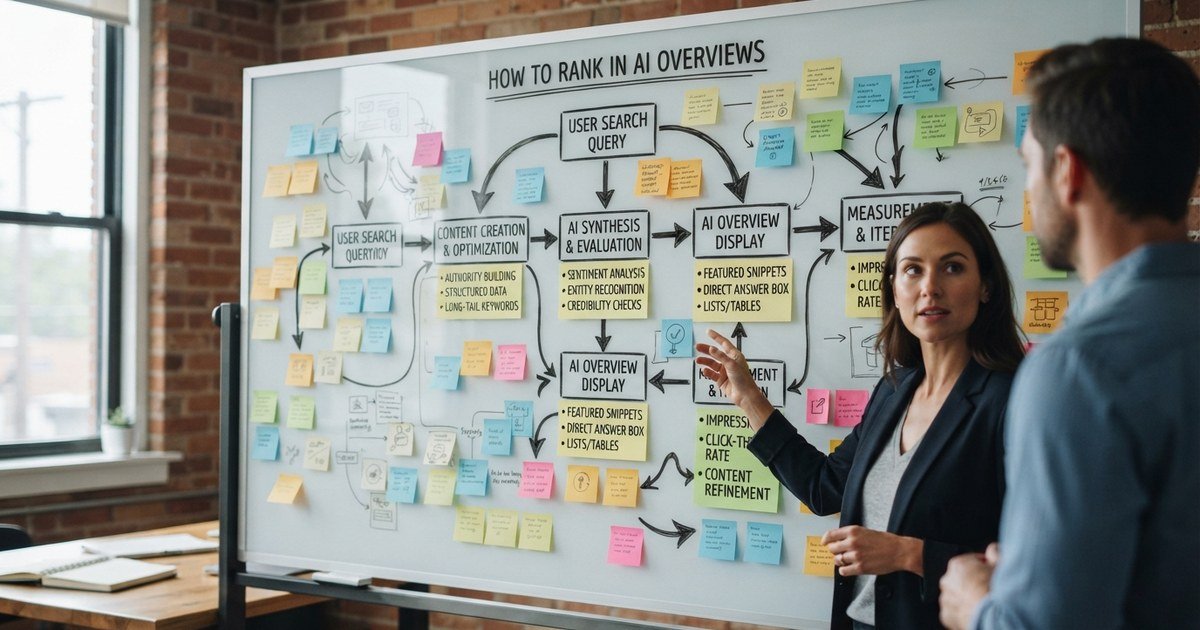
How to Rank in AI Overviews: Step-by-Step Implementation
Bringing the above together into a working process:
- Audit your query set. Identify which target queries actually trigger AI Overviews today, and note the fan-out sub-queries Google surfaces alongside them.
- Confirm organic standing. Check whether the relevant pages already sit in the top 10. If not, that’s the first problem to solve through core SEO consulting work before layering on AI-specific tactics.
- Restructure key passages. Rewrite the answer sections for your priority pages as short, self-contained blocks with a definitional opening sentence and a matching question heading.
- Add structured data. Apply FAQ, HowTo, or Article schema where it genuinely reflects the page content, not as a blanket tactic.
- Build a freshness cycle. Set a quarterly review for your highest-priority pages, checking dates, statistics, and claims for accuracy.
- Verify accessibility. Run a crawl check to confirm AI fetchers can reach and render the content without obstruction.
- Set up measurement. Combine AI Overview tracking tools with branded search and assisted conversion analysis so you’re not relying on click data alone.
- Review and repeat. Treat this as a running programme, not a one-off project, revisiting the query audit every quarter as fan-out patterns shift.
None of these steps work well in isolation. A well-structured page with no organic standing won’t get cited, and a well-ranking page with no structural clarity won’t get lifted either.
What Does Not Work
A few tactics consistently waste effort, and it’s worth naming them plainly.
- Keyword stuffing. Repeating a target phrase unnaturally doesn’t help an LLM understand a passage, and it usually makes the passage harder to lift cleanly.
- Thin FAQ spam. Bolting a generic FAQ block onto every page, disconnected from the page’s actual content, signals low quality rather than depth.
- Chasing every query. Trying to win a citation for every conceivable question spreads effort too thin. Prioritise the queries with real commercial or informational weight for your audience.
Conclusion
Learning how to rank in AI Overviews isn’t a separate discipline bolted onto existing SEO work. It’s an extension of it, built on the same organic foundation but demanding tighter passage structure, stronger entity signals, cleaner structured data, and a genuine freshness cycle.
The measurement side is still catching up, which means treating AI Overview visibility as one signal among several rather than a single number to chase. If you’d rather work through this with a team that combines SEO consulting, web analytics, and data analysis under one roof, get in touch with us and we’ll talk through where your content currently stands.
Frequently Asked Questions
What is the difference between traditional SEO and ranking in AI Overviews?
Traditional SEO optimises a whole page for a ranking position, while ranking in AI Overviews optimises a single passage for extraction and citation. The two overlap heavily, since most AI Overview citations still come from pages already ranking well organically.
Is GEO the same thing as AI SEO?
GEO (generative engine optimisation) and AI SEO are used largely interchangeably to describe the practice of structuring content so AI systems can find, understand, and cite it. Both sit alongside, rather than replace, standard SEO work.
Does structured data guarantee an AI Overview citation?
No, but it removes ambiguity that would otherwise slow down an LLM trying to parse your content. Around 60% of cited pages use structured data markup, which suggests it’s a meaningful supporting signal rather than a guarantee.
How often should content be updated to stay eligible for AI Overview citations?
Content updated within the last 90 days is cited roughly 2.5 times more often than stale content. A quarterly review cycle for your priority pages is a reasonable working standard.
Can you track AI Overview visibility without clicks?
Yes, through dedicated citation tracking tools, branded search movement, and assisted conversion analysis rather than relying on direct click attribution. Standard web analytics still play a role, just not the same role they play for organic clicks.
Is it worth targeting AI Overviews in 2026 if click-through rates are low?
It depends on the goal. If the aim is direct clicks, the current 1% click rate on AI Overview citations is modest, but brand visibility, entity authority, and downstream branded search often benefit even without a click.
Do FAQ pages help you rank in AI Overviews?
A well-structured FAQ section tied closely to genuine reader questions can help, particularly with FAQ schema applied. A generic FAQ block added purely for the sake of having one, disconnected from real search intent, tends not to help and can look like thin content.

Founder of MarTech Stack. SEO, analytics and marketing automation.
LinkedIn