


Structured versus unstructured data isn’t an abstract IT debate anymore. It’s the line between marketing teams who know what’s happening with their customers and teams who are drowning in files they can’t use. In fact, an estimated 90% of all enterprise-generated data is unstructured, often stacking up into terabytes or petabytes that never get touched.
We built our data analysis practice around this exact gap. Marketers sit on mountains of martech data, but only a sliver of it lives in tidy rows and columns.
This guide breaks down structured versus unstructured data in plain terms: what each one looks like, where it lives, and how to actually put it to work.

Key Takeaways
- Structured data lives in predictable fields (think CRM records, ad spend tables, transaction logs) and fits neatly into relational databases.
- Unstructured data includes call transcripts, social posts, video, and support tickets, formats that don’t fit into rows and columns without extra work.
- Databases handle structured data best. Data lakes are built to hold unstructured and semi-structured data at scale.
- Marketers who work with both data types get a fuller picture of customer intent than those relying on structured reporting alone.
- AI and LLM tools are rapidly changing how unstructured content gets classified, tagged, and made useful for analysis.
- Schema markup is one of the few tools marketers have to turn unstructured web content into machine-readable structured data. See our breakdown of schema markup types that move the needle in 2026.
- Getting structured versus unstructured data right is now a foundational part of SEO consulting and web analytics work, not a side project for the data team.
What Is Structured Data, Really?
Structured data is anything that fits neatly into a predefined format. Rows, columns, fields, tags. It’s the stuff a spreadsheet was born to hold.
For marketers, structured data usually looks like:
- CRM contact records (name, email, deal stage, lifecycle stage)
- Ad platform reporting (impressions, clicks, spend, conversions)
- E-commerce transaction data (SKU, price, quantity, timestamp)
- Web form submissions
This is the data that plugs directly into dashboards. It’s clean, it’s searchable, and it answers direct questions fast.
What Is Unstructured Data? (And Why It’s Piling Up)
Unstructured data doesn’t follow a fixed format. There’s no consistent field for “sentiment” in a customer support call or a defined column for “tone” in a product review.
Common marketing examples include:
- Customer service call recordings and chat transcripts
- Social media comments and reviews
- Video and image assets from campaigns
- Long-form blog content and PDFs
- Open-ended survey responses
Unstructured data is growing at 55 to 65% annually, three to four times faster than structured data. That growth rate alone should change how your team plans storage and analysis for the next few years.

Structured Versus Unstructured Data: Where Each One Lives
Storage is where structured versus unstructured data really starts to diverge. Pick the wrong system and you’ll fight your own architecture for years.
Databases: Built for Structured Data
Relational databases (think MySQL, PostgreSQL, or your CRM’s backend) organize structured data into tables with defined schemas. Every field has a type. Every row follows the same rules.
This makes databases fast for queries like “show me every customer who purchased in the last 30 days.” They’re precise, but rigid. Try to force a video file or a free-text review into a relational table and you’ll hit a wall fast.
Data Lakes: Built for Everything Else
A data lake stores raw data in its native format, structured, semi-structured, or unstructured, all in one place. No schema required upfront.
This is where marketing teams increasingly park call transcripts, campaign creative, and raw clickstream data before they’ve decided exactly how to use it. It’s flexible by design, but that flexibility comes with a cost: without governance, a data lake turns into a data swamp fast.
Structured Versus Unstructured Data in Marketing Analytics
Most marketing dashboards only tell half the story. Campaign performance metrics (structured) show you what happened. Customer conversations (unstructured) tell you why.
Our digital web analytics work often starts by mapping both sides:
- Structured layer: sessions, conversion rate, revenue per visit, channel attribution
- Unstructured layer: session recordings, on-site search queries, chatbot transcripts, review text
Marketing mix modeling is a great example of this blend in action. It pulls in structured spend data alongside messier, aggregate signals like seasonality and competitor activity to measure impact that last-click attribution misses. We covered this in detail in our 2026 breakdown of marketing mix modeling.
How AI and LLMs Are Changing Unstructured Data Work
AI has made unstructured data dramatically more usable than it was even two years ago. An LLM can read a thousand customer reviews and summarize the recurring complaint in seconds, something that used to take an analyst days.
But it’s not all smooth sailing. 61% of IT leaders now rank data preparation and classification for AI as a top storage priority for the coming year. And 56% of organizations say classifying and tagging data is their single biggest challenge when preparing it for AI applications.
That’s the honest truth about AI and unstructured data: the model is only as good as the prep work behind it. Poor data quality already costs organizations an average of $12.9 million a year, and unstructured data is usually where that mess starts.
We see this play out constantly in ai seo work too. Answer engines and AI Overviews don’t reward messy, unstructured content. They reward content with clear structure underneath it.
Schema Markup: Turning Unstructured Content Into Structured Signals
Your blog posts, product pages, and reviews are technically unstructured content from a machine’s point of view. Schema markup is the bridge that turns that content into structured data search engines and AI systems can actually parse.
We broke down the five schema types that matter most in our 2026 schema markup guide, including:
- Product Schema: exposes price, availability, and specs directly to crawlers and AI
- Review & AggregateRating Schema: turns scattered customer sentiment into a trust signal
- Organization/WebSite Schema: gives search engines and answer engines clean context about who you are
This is where structured versus unstructured data stops being a backend storage question and becomes a visibility question. Get your schema right, and you’re feeding AI systems structured facts instead of hoping they guess correctly from unstructured text.
Data integrity matters just as much as the schema itself. Our 2026 technical SEO and data integrity audit checklist walks through exactly how to check your foundation before AI systems ever touch it.

Real-Time Data Adds Another Layer of Complexity
Structured versus unstructured data gets even trickier when data is moving in real time. Single Page Applications that load content dynamically via JavaScript challenge traditional data collection in ways static pages never did.
We tackled this exact problem in our case study on the 2026 World Cup bracket platforms, where tournament networks moved staggering volumes of live data every second. The lesson applies directly to marketers running live dashboards, flash sales, or real-time personalization: your data pipeline needs to handle structured and unstructured signals without breaking under speed.
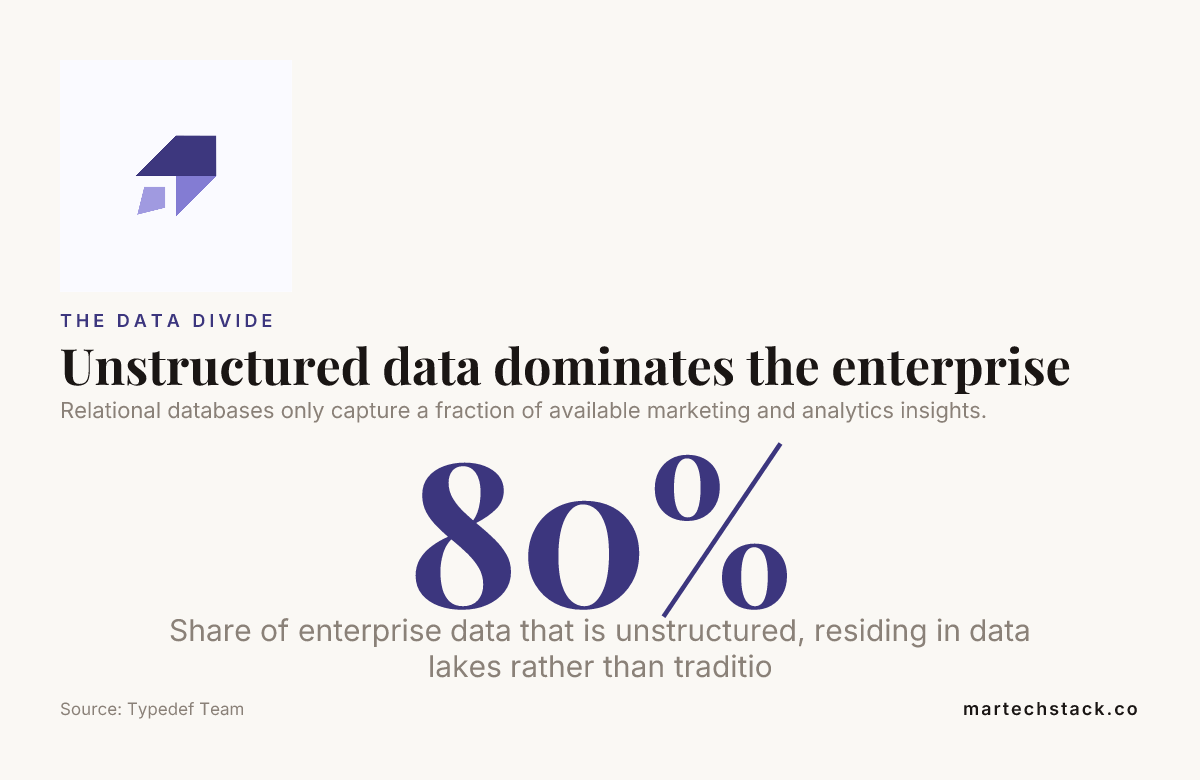
Relational databases only capture a fraction of available marketing and analytics insights.
A 3-Step Roadmap for Working With Structured Versus Unstructured Data
We don’t believe in overwhelming clients with a 40-point framework on day one. Here’s the roadmap we actually use.
Step 1: Audit What You Already Have
Map your structured sources (CRM, ad platforms, analytics) against your unstructured sources (support tickets, reviews, video, PDFs). Most teams are shocked by how much unstructured data they’re already sitting on.
Step 2: Choose the Right Home for Each
Structured data belongs in your database and BI tools. Unstructured and semi-structured data belongs in a data lake or a dedicated content repository built for scale.
Step 3: Build the Bridge
This is where schema markup, tagging taxonomies, and AI-assisted classification come in. The goal is a system where unstructured content gets tagged, categorized, and made searchable, without a human manually labeling every file.
Let’s start by having an honest conversation about your needs. Every roadmap we build gets tailored to the data you actually have, not a generic template.
Common Challenges When Managing Both Data Types
Structured versus unstructured data work sounds simple until you’re a few months in. Here’s what trips teams up most often:
- Classification bottlenecks: tagging and categorizing unstructured content by hand doesn’t scale.
- Governance gaps: data lakes without clear ownership rules turn into unusable data swamps.
- Siloed teams: the SEO team, the analytics team, and the data science team often work with different pieces of the same puzzle.
- AI readiness: LLM tools need clean, well-labeled data to produce trustworthy outputs, not raw, messy files.
Our data-driven SEO consulting engagements are built specifically to close these gaps between teams and tools.

Where SEO Consulting and Data Analysis Meet
Structured versus unstructured data isn’t just an analytics topic. It’s a martech topic that touches SEO, content, and data science all at once.
Our SEO consulting work increasingly involves structuring unstructured content (blog posts, product descriptions, FAQs) so AI Overviews and answer engines can parse it correctly. Meanwhile, our data analysis team is turning unstructured customer feedback into structured insight reports clients can act on immediately.
We’re more than consultants. We’re partners invested in your triumph, whether that means better rankings or better decisions from the data you already have.
“We love what we do. And we rock at it.” That’s not a slogan we use lightly. It’s how we approach every structured versus unstructured data problem a client brings us.
Conclusion: Structured Versus Unstructured Data Isn’t Either/Or
Structured versus unstructured data was never meant to be a competition. The organizations that win are the ones using both, structured data for speed and precision, unstructured data for depth and context.
With every click, line of code, and insight, we desire to create meaningful work that speaks directly to your needs. If your team is ready to finally make sense of the unstructured data piling up behind your dashboards, reach out to our team and let’s map out your roadmap together.
Read more of our thinking on the MarTech Stack blog, or learn our story and why data-driven partnership is at the center of everything we build.
Frequently Asked Questions
What is the main difference between structured and unstructured data?
Structured data fits into predefined fields like rows and columns, think CRM records or ad spend reports. Unstructured data, like videos, call transcripts, and reviews, doesn’t follow a fixed format and needs extra processing before it’s analysis-ready.
Is unstructured data more valuable than structured data for marketers in 2026?
Neither is inherently more valuable. Structured versus unstructured data works best as a combination: structured data shows you what happened, unstructured data often explains why it happened.
Should I store unstructured data in a database or a data lake?
Databases are built for structured data with defined schemas. Data lakes are designed to hold structured, semi-structured, and unstructured data together, making them the better home for large volumes of unstructured content.
How does AI help with unstructured data analysis?
AI and LLM tools can read, summarize, and classify unstructured content like reviews or support tickets far faster than manual analysis. That said, the output quality still depends heavily on how well the underlying data is prepared and tagged.
Why does structured versus unstructured data matter for SEO in 2026?
Answer engines and AI Overviews rely on structured signals like schema markup to understand unstructured content such as blog posts and product pages. Getting this right is now a core part of AI SEO, not an optional extra.
What percentage of enterprise data is unstructured?
Estimates put unstructured data at around 90% of all enterprise-generated data, often reaching terabytes or petabytes in volume. That’s a massive share of information most companies aren’t fully using yet.
Is it worth investing in structured versus unstructured data strategy now?
Yes. With unstructured data growing three to four times faster than structured data each year, teams that build a clear strategy now will have a significant analytics advantage over those still relying on spreadsheets alone.

Founder of MarTech Stack. SEO, analytics and marketing automation.
LinkedIn