
Marketing mix modeling is having a moment, and for good reason. Over 60% of the web is already cookieless, which means the deterministic tracking your team relied on for years simply can’t see what it used to see anymore.
That blind spot is exactly why marketing mix modeling has moved from “nice to have” to board-level priority for growth teams navigating the digital landscape in 2026.

Key Takeaways
- Marketing mix modeling (MMM) measures the impact of every channel, online and offline, without relying on individual user-level tracking.
- Marketers now rank MMM as the most reliable measurement methodology, ahead of multi-touch attribution.
- Privacy regulations and cookieless browsing have created real blind spots that only model-based approaches can close.
- A well-built MMM program typically drives 10 to 30% efficiency gains within the first year of implementation.
- Marketing mix modeling works best alongside strong web analytics foundations and clean data governance.
- AI and machine learning are speeding up model calibration, making marketing mix modeling accessible to teams that once thought it was too complex or too expensive.
- Pairing MMM with SEO consulting gives you a fuller picture of how organic visibility contributes to revenue, not just clicks.
What Is Marketing Mix Modeling, and Why Does It Matter Right Now?
Marketing mix modeling is a statistical approach that measures how much each of your marketing activities contributes to sales, revenue, or another business outcome you care about.
Unlike attribution, it doesn’t need to track an individual person’s journey. It looks at aggregate data over time, weather, seasonality, pricing, competitor activity, and channel spend, and figures out what actually moved the needle.
That distinction matters more in 2026 than it ever has. Privacy regulations, cookie deprecation, and walled gardens have made person-level tracking unreliable at best and impossible at worst.
Marketing mix modeling sidesteps all of that. It works with the data you already have and doesn’t ask permission from a browser to do its job.
Why Marketing Mix Modeling Is Winning Back Marketers’ Trust
Trust in marketing measurement has taken a hit. About 60% of marketers say internal stakeholders, especially finance, question the validity of their metrics at least sometimes.
That’s a real problem when you’re trying to defend budget in a boardroom.
Marketing mix modeling earns credibility because it’s grounded in statistical rigor, not last-click guesswork. Marketers now identify it as the single most reliable measurement methodology available, ranking it above multi-touch attribution and holistic measurement combined.
We’ve seen this shift firsthand. Clients come to us frustrated with dashboards that contradict each other, and marketing mix modeling gives everyone a single, defensible source of truth.
- It accounts for offline channels like TV, out-of-home, and print.
- It captures brand-building effects that don’t show up in last-click reports.
- It holds up under finance scrutiny because it’s built on causal statistics, not cookies.
Marketing Mix Modeling vs. Attribution: What Each Model Actually Measures
Attribution and marketing mix modeling aren’t enemies. They’re built for different questions.
Attribution tells you which touchpoint a specific customer interacted with before converting. Marketing mix modeling tells you how much each channel, in aggregate, contributes to your overall growth journey.
The trouble is, 47% of marketers say they struggle with multi-touch attribution, making cross-channel comparisons unreliable without a unified framework. That’s a lot of teams flying partially blind.
| Question | Attribution | Marketing Mix Modeling |
|---|---|---|
| Tracks individual users? | Yes | No |
| Works without cookies? | Limited | Yes |
| Includes offline channels? | Rarely | Yes |
| Best for | Channel-level optimization | Budget-level strategy |
Only about 36% of marketers believe they can accurately measure ROI today. Combining both frameworks is how you close that gap instead of picking a side.
The Martech Stack Behind Modern Marketing Mix Modeling
Marketing mix modeling doesn’t run in a vacuum. It needs a solid martech foundation underneath it, clean data pipelines, consistent naming conventions, and reliable spend tracking across every channel.
This is where a lot of teams stumble. Your martech stack might be collecting the data, but if it’s messy or inconsistent, your model output will be too.
We approach this with disciplined data governance from day one. Reliable inputs mean reliable insights, and that’s the whole point of investing in marketing mix modeling services in the first place.
How AI and LLM Technology Are Reshaping Marketing Mix Modeling
AI has changed what’s possible with marketing mix modeling. Models that used to take weeks to calibrate now run in a fraction of the time.
Machine learning algorithms handle the heavy lifting, testing thousands of variable combinations to find the ones that actually explain your results. That’s not a small thing. It’s the difference between a model that sits on a shelf and one your team actually uses to make decisions.
LLM technology is starting to play a role too, helping teams query model outputs in plain language instead of digging through spreadsheets. Ask a question, get an answer, adjust your budget. That’s the direction this is heading.
We leverage the power of machine learning algorithms to make predictions and classifications that turn raw marketing mix modeling data into decisions you can act on the same week you get the results.
Where Web Analytics and Data Analysis Fit Into Your MMM Strategy
Marketing mix modeling is only as strong as the data feeding it. That’s why web analytics and data analysis sit right alongside it in any serious measurement strategy.
Your web analytics setup captures the digital signals: sessions, conversions, on-site behavior. Your data analysis practice turns those signals, plus offline inputs, into something a model can actually use.
We build digital web analytics foundations that translate raw data into business outcomes, not just charts nobody looks at twice. And our analytics consulting work makes sure the numbers going into your model are ones you can actually trust.
- Clean, structured web analytics data reduces noise in your marketing mix modeling inputs.
- Consistent data analysis practices catch errors before they skew your results.
- Custom dashboards make model outputs understandable to non-technical stakeholders.
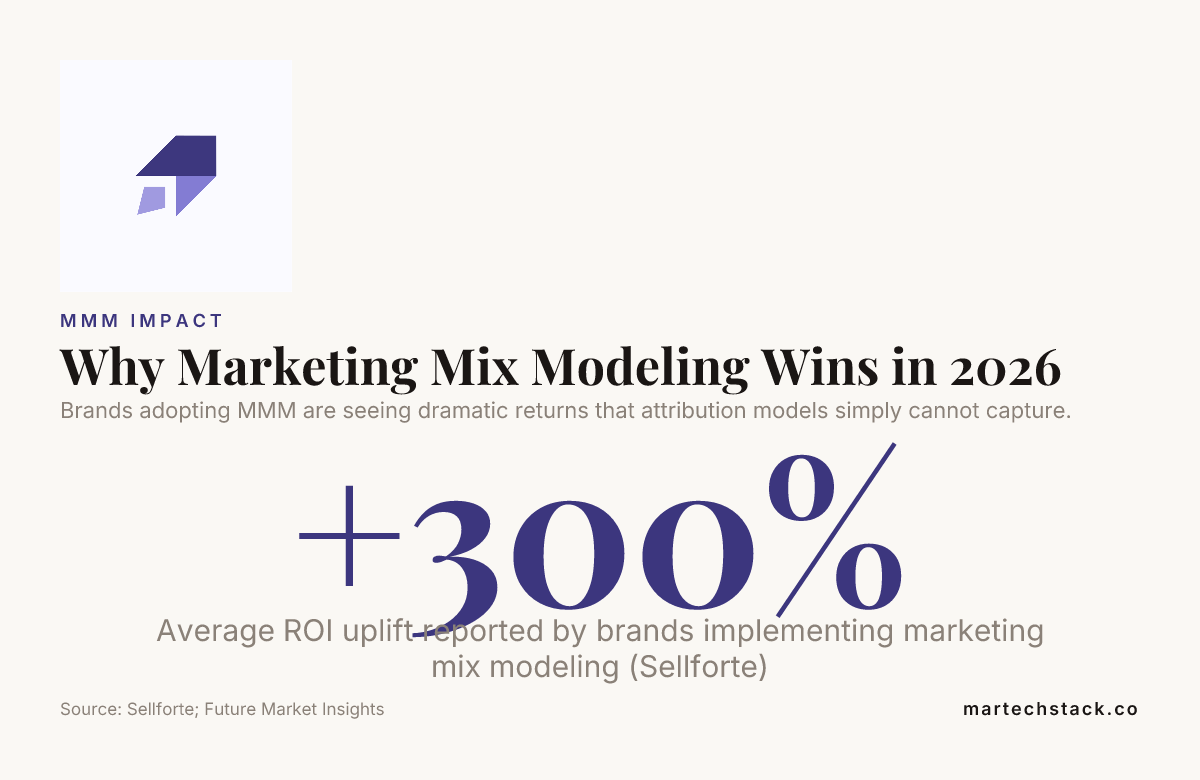
Brands adopting MMM are seeing dramatic returns that attribution models simply cannot capture.

SEO Consulting, AI SEO, and the New Marketing Mix Modeling Inputs
Organic visibility is a channel too, and marketing mix modeling should treat it that way. That means feeding your model with real SEO data, not just paid spend numbers.
Search behavior has shifted with AI SEO practices and the rise of answer engines, and that shift changes how organic contributes to your growth journey. A strong SEO consulting partnership helps you quantify that contribution instead of guessing at it.
The search volume for “marketing mix modeling” itself has jumped over 300% from early 2021 to mid-2025, a clear sign that marketing leaders are actively looking for this expertise. That growth alone tells you organic demand deserves a real line item in your model.
We treat SEO and data science as one landscape, not two separate disciplines fighting for budget. When organic visibility and marketing mix modeling work together, you get a fuller, more honest picture of what’s driving your business.
Building Your Marketing Mix Modeling Roadmap: A 3-Step Approach
Getting started with marketing mix modeling doesn’t have to be overwhelming. We break it down into three steps, and we stick to them.
- Honest conversation. We start by talking through your current data, your channels, and your goals. No assumptions.
- Tailored plan. With your personalized roadmap in hand, we map out data sources, model structure, and reporting cadence.
- Collaborative build. Our team of passionate people puts their heads together with yours to build, test, and refine the model until it earns your trust.
Nearly half of U.S. brand and agency marketers say marketing mix modeling is their next major investment to combat signal loss and fragmentation. If you’re one of them, this roadmap is where you start.
Turning Marketing Mix Modeling Into Tangible Business Results
A model is only useful if it changes what you do next. That’s the whole point of investing in marketing mix insights in the first place.
Brands running advanced, causally-calibrated MMM typically see 10 to 30% efficiency gains within the first year. That’s not a small win. That’s real budget freed up to reinvest in what’s actually working.
Marketers who actively measure ROI are also 1.6 times more likely to be awarded higher budgets next cycle. Measurement isn’t just about proving what happened. It’s about earning the resources for what comes next.
“We’re all about outcomes you can see and growth you can measure. Marketing mix modeling gives you both.”
We also lean on data integrity practices and BI data frameworks to make sure the numbers behind every recommendation hold up under scrutiny.
Why the Global Shift Toward Model-Based Measurement Is Accelerating
The global marketing mix optimization market is projected to reach USD 5.97 billion in 2026 as demand for model-based attribution escalates. That’s not a niche trend anymore. That’s an industry-wide correction.
Cloud-based deployment is expected to represent 64.2% of that market this year, reflecting how quickly teams are moving away from clunky, on-premise modeling setups toward faster, SaaS-driven analytics.
We help clients navigate that shift through Google Analytics consulting and broader our services lineup, connecting the dots between what’s tracked, what’s modeled, and what actually gets decided in your next budget meeting.
Our story is one of passion, expertise, and an unyielding commitment to getting marketing mix modeling right for every client we work with.
Conclusion
Marketing mix modeling isn’t a passing trend. It’s the response to a measurement landscape that broke, and it’s how growth teams are rebuilding trust in their numbers.
We’re more than consultants. We’re partners invested in your triumph, and marketing mix modeling is one of the clearest paths we know to real, defensible growth.
Together, let’s navigate what comes after attribution and steer your online success story with a marketing mix modeling approach built on data you can actually trust.
Frequently Asked Questions
Is marketing mix modeling worth it in 2026?
Yes, especially now that over 60% of the web is cookieless and traditional tracking has real gaps. Marketing mix modeling fills those gaps with a statistical approach that doesn’t depend on individual user data.
What’s the difference between marketing mix modeling and multi-touch attribution?
Multi-touch attribution tracks individual customer journeys across touchpoints, while marketing mix modeling analyzes aggregate data to measure overall channel contribution. Most teams get the best results using both together, not choosing one over the other.
How long does it take to see results from marketing mix modeling?
Brands typically see 10 to 30% efficiency gains within the first year of implementing a properly calibrated model. Results depend on data quality, so clean web analytics and consistent data analysis practices speed things up considerably.
Do small and mid-size companies need marketing mix modeling, or is it just for big brands?
Marketing mix modeling has traditionally been associated with large enterprise budgets, but AI-driven tools have made it far more accessible. Cloud-based deployment is expected to make up 64.2% of the market in 2026, which has lowered the cost and complexity barrier significantly.
How does AI improve marketing mix modeling?
AI and machine learning speed up model calibration, testing far more variable combinations than a human team could manage manually. LLM tools are also making it easier to query model outputs in plain language, which shortens the gap between insight and action.
Can SEO and organic search be included in a marketing mix model?
Absolutely, and it should be. Search volume for “marketing mix modeling” has grown over 300% since 2021, and pairing SEO consulting with your model gives you a clearer picture of how organic visibility contributes to revenue.
What data do I need before starting marketing mix modeling?
You’ll need historical spend data across channels, sales or revenue data, and ideally some external factors like seasonality or pricing changes. Strong data governance and clean web analytics foundations make the entire marketing mix modeling process far more accurate.

Founder of MarTech Stack. SEO, analytics and marketing automation.
LinkedIn