
Let’s start with the number nobody puts in the sales deck: 30-40% of customer data platform projects fail outright, not because the software is bad, but because the underlying data was never ready for it. That’s the honest starting point for this conversation. Before you sign a contract or greenlight a budget line, you deserve a straight answer about whether a customer data platform actually solves your problem, or whether it’s a very expensive way to avoid fixing something simpler.

Key Takeaways
| Question | Quick Answer |
|---|---|
| Does my company need a customer data platform? | Only if data is scattered across five or more systems and personalization has become manual guesswork. |
| What’s the real difference between a CDP and a CRM? | A CRM manages known relationships. A customer data platform unifies anonymous and known behavior across every channel, including data a CRM never sees. |
| How much does a customer data platform cost? | Budget realistically. Enterprise-grade deployments run well into five figures monthly once integration and staffing are included. |
| What causes most CDP failures? | Data readiness gaps, not the software. Messy source data breaks even the best platform. |
| Can a data warehouse replace a CDP? | For teams with strong data analysis capability, a warehouse-native approach can do the job for far less. |
| Is a customer data platform overkill for smaller B2B teams? | Often, yes. A CRM plus solid web analytics covers most lean funnels just fine. |
| What should I evaluate before buying? | Identity resolution accuracy, activation speed, integration count, and total cost of ownership, not just the demo. |
What a Customer Data Platform Actually Solves
Strip away the marketing language and a customer data platform exists to do three things well.
- Identity resolution: stitching together the same person across devices, email addresses, and anonymous browsing sessions into one record.
- Unified customer profiles: pulling firmographic, behavioral, and transactional data into a single source of truth.
- Data activation: pushing that unified profile back out to your ad platforms, your email tool, and your sales team in real time.
That’s it. No magic, no AI wizardry baked in by default.
Marketers consistently name the first item as their biggest headache. Roughly 40% say building a complete customer view is the single hardest part of their first-party data strategy, according to CDP.com. That’s not a software gap. That’s a data discipline gap, and a platform alone won’t fix discipline.
Customer Data Platform vs CRM vs DMP vs Data Warehouse
This is where most B2B buyers get confused, and honestly, the vendors don’t help.
| Tool | Primary Job | Best For |
|---|---|---|
| CRM | Manages known contacts and deal stages | Sales pipeline and account management |
| DMP | Handles anonymous, cookie-based ad audiences | Programmatic advertising at scale |
| Data Warehouse | Stores raw structured and semi-structured data | Technical teams doing custom data analysis |
| Customer Data Platform | Resolves identity and unifies profiles for activation | Marketing teams needing one usable customer view |
A CRM alone can’t see your anonymous web traffic. A data warehouse alone doesn’t activate anything without engineering support. A customer data platform sits in the middle, and that middle position is exactly why it’s either indispensable or redundant depending on your stack.

When a Customer Data Platform Genuinely Helps
We’ll be direct. A customer data platform earns its budget line when a few specific conditions are true.
- Customer data currently lives in 10 or more disconnected tools, and nobody can say with confidence which record is the “real” one.
- Marketing, sales, and product teams each have their own version of the customer, and those versions disagree.
- You need to activate segments in real time across paid media, email, and onsite personalization simultaneously.
- Your data analysis team is spending more time reconciling exports than actually analyzing anything.
Straits Research found the average customer data platform now integrates with 17 separate technology applications just to build one profile. If that number sounds close to your own martech stack, a CDP is probably worth the conversation.
When a Customer Data Platform Is Overkill for Your Team
Here’s the part vendors won’t tell you. If you have fewer than five systems holding customer data, a customer data platform is likely solving a problem you don’t have yet.
A well-configured CRM combined with tight web analytics setup already answers “who is my customer and what did they do” for most small and mid-size B2B teams. Adding a CDP on top just adds another license, another integration, and another dashboard nobody opens.
If your growth journey is still early-stage, spend the budget on cleaner data collection first. A platform can’t unify data that was never captured correctly in the first place.
Straits Research also notes that 62% of large U.S. retailers run 50 or more systems housing customer information. That scale of complexity is exactly why identity resolution matters at the enterprise level, and exactly why it’s overkill for a 40-person B2B company running six tools.
What a Customer Data Platform Actually Costs
This is the number that shocks most finance teams. VWO’s benchmarking puts genuine customer data platform investment at $4,000 to $12,500 per month, and that’s before implementation staffing or ongoing governance.
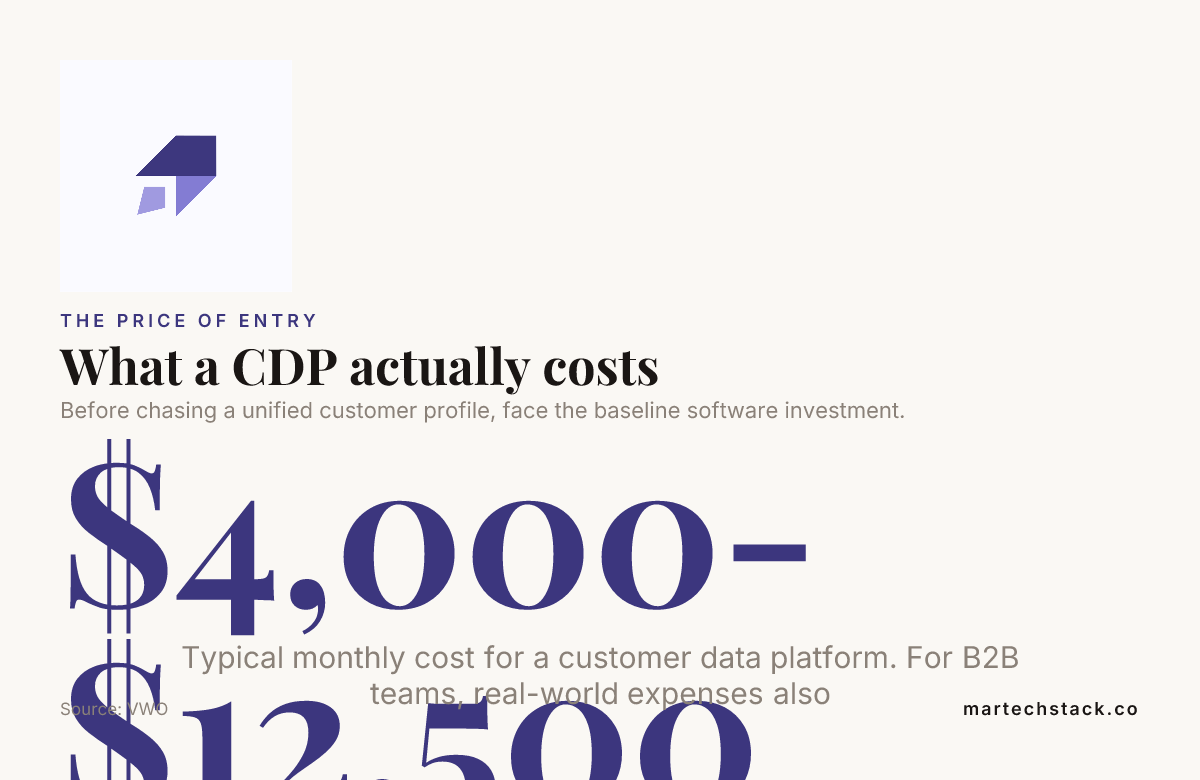
Before chasing a unified customer profile, face the baseline software investment.
There is a cheaper path. Warehouse-native, composable customer data platforms can cut costs by 30-50% compared to traditional packaged tools, according to Improvado. That’s a real option if your team already has strong internal data analysis chops and a modern warehouse in place.
The payoff, when it works, is real. VWO reports 93% of companies that successfully leveraged a customer data platform saw a measurable drop in customer acquisition cost. That’s tangible success, not a hypothetical.

Common Customer Data Platform Failure Modes
We’ve seen the same mistakes repeat across B2B teams, and they’re worth naming plainly.
- Buying before auditing: teams purchase a CDP before mapping which systems actually need to feed it.
- No data governance owner: nobody is accountable for field naming, deduplication rules, or data quality standards.
- Treating it as a plug-and-play tool: identity resolution requires ongoing tuning, not a one-time setup.
- Ignoring activation until later: teams unify the data beautifully, then never build the workflows to actually use it.
Only 25% of marketers report being satisfied with their current customer data unification, per LayerFive. That’s a low bar, and it tells you the problem is rarely the platform itself. It’s the roadmap around it.
Evaluation Criteria: How to Vet a Customer Data Platform Before You Buy
Skip the demo theater. Ask vendors these questions directly.
- How does identity resolution actually work across anonymous and known data? Ask for the matching logic, not a slide.
- What’s the true integration count and effort for our specific martech stack?
- How fast can a segment move from “unified” to “activated” in a live campaign?
- What does total cost of ownership look like at 12 months, including staffing?
- Can our own data analysis team query the underlying data directly, or are we locked into their reporting layer?
A vendor that can’t answer question one clearly isn’t worth a second meeting.
How AI, LLMs, and AI Search Are Reshaping Data Activation
Every martech vendor now claims AI. Here’s the honest version.
AI and large language models are only as good as the customer data feeding them. Nearly all marketing teams, 98%, using AI report hitting at least one data-related barrier to personalization, per LayerFive. That’s not an AI problem. That’s a data foundation problem, and no LLM fixes bad inputs.
This same principle runs through AI search optimization work. Whether you’re feeding an LLM a customer profile or optimizing a page for AI-driven search visibility, the model can only reason as well as the data underneath it. Clean data first. AI second. That order never reverses, no matter how the sales pitch reads.
It’s also worth remembering that composable, warehouse-native customer data platform vendors are growing employment at 7.8%, nearly six times the industry average, per CDP.com. That’s a signal the market itself is shifting toward leaner, data-team-owned architectures rather than heavyweight packaged suites.

A Practical Decision Framework for B2B Teams
We built our own roadmap around three honest questions, and we’d suggest you ask them too before you embark on a CDP purchase.
- Do we have a data problem or a tool problem? Audit your current systems first. Most teams find the gap is process, not software.
- Can our existing stack, tuned properly, get us 80% there? A sharper CRM plus better digital web analytics setup often closes most of the gap for less money.
- If we do need a CDP, do we have the governance to run it? Someone has to own data quality daily, not just at launch.
Let’s start by having an honest conversation about your needs. That’s genuinely step one, before any tool gets discussed.
Our team is passionate about the digital landscape, and we’ve built our practice on exactly this kind of straight talk. If a customer data platform is the right move, we’ll say so. If your budget is better spent tightening SEO consulting and analytics fundamentals first, we’ll say that instead. We’re more than consultants. We’re partners invested in your success, not in selling you software you don’t need.
Conclusion
A customer data platform can be a genuine unlock for identity resolution, unified profiles, and real-time activation, but only when the underlying data and governance are ready for it. For many B2B teams, the honest answer is to fix data collection and reporting discipline first, and revisit the customer data platform question once that foundation is solid. That’s not a pessimistic take. That’s the roadmap to real results instead of another dashboard nobody opens.
Ready to figure out where your team actually stands? Reach out and let’s map the path forward together.
Frequently Asked Questions
Is a customer data platform worth it in 2026?
It’s worth it if your customer data spans 10+ disconnected systems and personalization has stalled without a unified profile. For leaner B2B teams, a tuned CRM and solid web analytics setup often deliver similar value at a fraction of the cost.
What’s the difference between a CDP and a DMP?
A DMP handles anonymous, cookie-based audiences mainly for advertising, while a customer data platform builds persistent, identity-resolved profiles across both anonymous and known touchpoints. CDPs are built for long-term customer relationships, not just ad targeting.
How long does it take to implement a customer data platform?
A realistic enterprise implementation takes three to six months once integrations, identity resolution rules, and governance are accounted for. Rushed timelines are one of the most common causes of CDP project failure.
Can a data warehouse replace a customer data platform?
For teams with strong internal data analysis and engineering resources, a warehouse-native approach can replace a packaged CDP and cut costs by 30-50%. It requires more hands-on data work but offers more flexibility and control.
What size company actually needs a customer data platform?
Companies managing customer data across many systems, often the kind seen in large retail or enterprise B2B environments, benefit most. Smaller teams usually get more value tightening their existing martech stack first.
Does a customer data platform improve AI and personalization?
Only if the data feeding it is clean and well-governed. AI and LLM-driven personalization inherit whatever quality problems already exist in your customer data, so a CDP helps mainly by fixing the foundation those models depend on.
What should I ask a CDP vendor before signing a contract?
Ask exactly how identity resolution works, how many of your current systems require integration, how quickly a unified segment can be activated, and what total cost of ownership looks like after year one. A vendor that can’t answer these clearly isn’t ready for your business.

Founder of MarTech Stack. SEO, analytics and marketing automation.
LinkedIn