
Only 15% of global marketers felt fully ready for a cookieless world as of last year, and that readiness gap hasn’t closed on its own. First-party data is the answer to that gap, and it’s quickly become the only reliable foundation for measurement, targeting, and personalization in 2026. If your team is still leaning on third-party cookies or borrowed audience data, you’re building your growth journey on ground that’s already shifting beneath you.
We work with B2B marketing and analytics leaders every day who are navigating this exact transition. This guide breaks down what first-party data actually is, why it matters right now, and how to collect and activate it the right way.

Key Takeaways
| Question | Quick Answer |
|---|---|
| What is first-party data? | Data your own brand collects directly from customers, through your site, app, CRM, or sales conversations. |
| Why does it matter now? | Third-party cookies are disappearing and privacy laws are expanding, so owned data is the only durable measurement source left. |
| How do brands collect it? | Through consented forms, web analytics platforms, CDPs, and server-side tagging. |
| What’s a data clean room? | A secure environment where two parties match datasets without either side exposing raw customer records. |
| What’s the biggest barrier? | Ownership. Over half of marketing teams don’t actually own their data strategy internally. |
| Does it actually improve ROI? | Yes. Brands that integrate first-party data into targeting see meaningfully higher return on ad spend than those relying on third-party sources. |
| Where do we start? | Start with a data analysis audit of what you already collect before you buy new tools. |
What Is First-Party Data? (And How It Differs From Second- and Third-Party Data)
First-party data is any data your own organization collects directly from your audience. Think purchase history, form submissions, email engagement, product usage logs, and CRM records.
You own it. You collected it with consent. And nobody else has to sell it back to you.
Second-party data is someone else’s first-party data, shared with you through a direct partnership. A software vendor sharing usage data with a channel partner is a classic example.
Third-party data is aggregated from many unrelated sources, usually purchased from a broker who has no direct relationship with the people behind the data. It’s the least trustworthy, least accurate, and (increasingly) the least legal option on the table.
- First-party data: Collected directly, owned by you, highest accuracy.
- Second-party data: Shared by a trusted partner, moderate accuracy.
- Third-party data: Aggregated and purchased, lowest accuracy, highest privacy risk.
We’ve built our entire SEO and analytics services practice around this hierarchy. Our approach focuses on leveraging first-party data to drive outcomes you can actually verify.
Why First-Party Data Matters in the Post-Cookie Era
Third-party cookies have been on death row for years, and the execution date keeps getting pushed. That doesn’t mean the sentence has been reversed.
Browser-level tracking restrictions, ad blockers, and app tracking transparency prompts have already gutted third-party targeting accuracy. Meanwhile, over 20 U.S. states now have comprehensive consumer data privacy laws in effect, and more are joining every year.
That’s not a temporary inconvenience. That’s a permanent shift in the digital landscape.
Brands that adapted early are already seeing the payoff. Digitally mature companies utilizing first-party data in advanced marketing activations report a potential 2.9x revenue lift compared to peers still dependent on third-party sources.
That surge isn’t hype. It’s a direct response to a measurement environment where third-party signals keep degrading and owned data keeps getting more valuable.

Consent and Trust: The Starting Point for Every First-Party Data Strategy
You can’t collect first-party data responsibly without consent infrastructure. Full stop.
Consent management platforms determine what you’re legally allowed to collect, store, and activate. Get this wrong, and every downstream system, your CDP, your CRM, your ad platforms, inherits the risk.
Here’s the good news: transparency actually improves your data pool. Roughly 73% of consumers say they’re more willing to share data with brands that are upfront about how it’s used.
Trust isn’t a compliance checkbox. It’s a growth lever.
Brands that treat consent as friction lose data. Brands that treat consent as a value exchange gain loyalty and better data quality at the same time.
Build consent language that’s honest, specific, and easy to understand. Avoid legal jargon that makes people click “reject all” out of confusion rather than genuine objection.
Collecting First-Party Data: CDPs, Server-Side Tagging, and Beyond
Once consent is handled, you need infrastructure to actually capture and unify the data. Three tools do most of the heavy lifting here.
Customer Data Platforms (CDPs)
A CDP stitches together data from your website, app, CRM, and support tools into a single customer profile. Nearly three-quarters of marketers worldwide now run on CDP infrastructure to manage this exact challenge.
Without a unifying layer, your first-party data lives in disconnected silos, which defeats the entire point of owning it.
Server-Side Tagging
Server-side tagging moves data collection off the browser and onto a server you control. This approach is more resilient to browser restrictions, more accurate, and gives you a direct hand in what data gets sent where.
It’s also a core piece of any modern web analytics setup. Setting up GA4 through server-side infrastructure gives you cleaner, more durable measurement than client-side tagging alone.
Direct Collection Points
Don’t overlook the basics: gated content, loyalty programs, account creation, surveys, and sales conversations. These are some of the richest, most consented sources of first-party data you already have access to.
Data Clean Rooms: Activating First-Party Data Without Losing Privacy
A data clean room is a secure, neutral environment where two organizations can match their datasets against each other without exposing raw, identifiable records.
Say a B2B software company wants to understand overlap between their customer list and a media partner’s audience. Instead of handing over spreadsheets full of personal data, both parties upload hashed identifiers into a clean room.
The match happens, insights come out, and neither party ever sees the other’s raw data. It’s collaboration without compromise.
- Used for audience overlap analysis between partners
- Used for measuring ad campaign lift without sharing PII
- Increasingly required by platforms replacing third-party cookie matching
Clean rooms won’t replace your CDP. They complement it, giving you a privacy-safe way to activate first-party data with partners you don’t fully trust with raw records (and honestly, you shouldn’t have to).

Web Analytics and First-Party Data: Turning Behavior Into Insight
Your website is one of the richest first-party data sources you own, and most teams barely scratch the surface of it.
Every page view, scroll, click, and conversion is a signal. Captured correctly, this behavioral data feeds personalization, lead scoring, and attribution models without a single third-party cookie in sight.
We build Looker Studio dashboards specifically so decision-makers can see this owned data in one place instead of digging through raw exports. Data-driven personalization built on this kind of owned behavioral data consistently outperforms generic, cookie-based targeting.
Get your analytics foundation wrong, though, and everything downstream suffers. That’s where technical rigor comes in.
First-Party Data Quality: Why Governance Is Non-Negotiable
Collecting first-party data means nothing if the data itself is inaccurate, duplicated, or inconsistently structured. Garbage in, garbage decisions out.
Data governance covers naming conventions, deduplication rules, access controls, and validation checks across every system that touches customer data. It’s unglamorous work, and it’s also the work that determines whether your dashboards can be trusted.
We’ve put together a 2026 technical audit checklist specifically because data precision has become the foundation of both measurement and AI-readiness.
Our data analysis services exist for exactly this reason: to help organizations unlock the value of the data they already have, cleaned up and structured correctly.
AI, LLMs, and the New Role of First-Party Data
AI models are only as good as the data you feed them, and that includes the AI systems now embedded in your martech stack.
Predictive lead scoring, churn modeling, and content recommendations all run on machine learning trained against your own customer behavior. Third-party data doesn’t fit this use case well; it’s too generic and too disconnected from your actual customer journey.
First-party data is what makes AI-driven personalization accurate instead of generic. It’s also what makes an LLM-powered search assistant surface your brand with the right context, because accurate structured data underpins both traditional visibility and generative answer engines.
This is also where AI SEO enters the conversation. Structured, accurate first-party data helps AI-driven search tools understand who you are and what you actually offer, which matters just as much as traditional visibility does today.
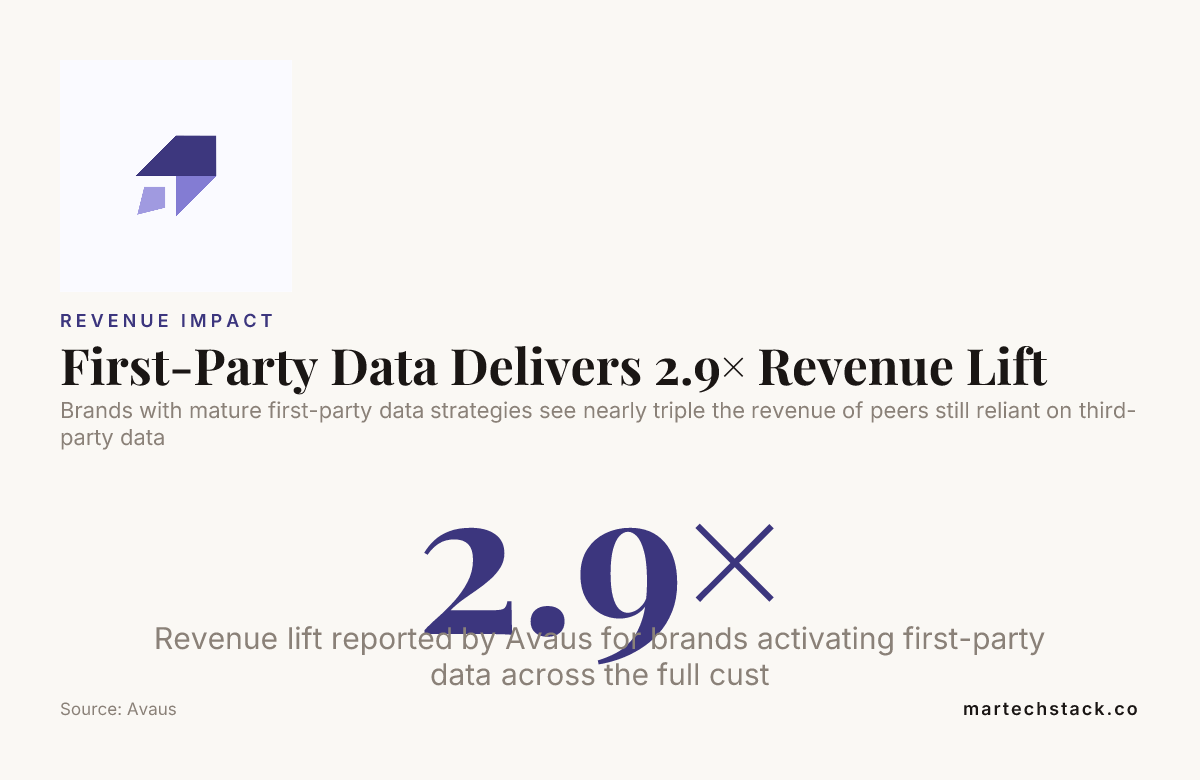
Brands with mature first-party data strategies see nearly triple the revenue of peers still reliant on third-party data

Building Your First-Party Data Strategy: A Practical Roadmap
Here’s the honest truth: over half of marketing teams don’t actually own their data strategy internally. That’s the real barrier, more than any tool or budget line.
Fix that ownership gap first, then work through this roadmap.
- Audit what you already collect. Most companies have more first-party data than they realize, scattered across a CRM, an email platform, and a web analytics tool that never talk to each other.
- Fix consent infrastructure. Make sure every collection point is legally sound and clearly communicated.
- Unify with a CDP. Pick a platform that matches your data volume and technical capacity, not the flashiest vendor demo.
- Move to server-side tagging. This future-proofs your measurement against browser-level restrictions.
- Establish data quality standards. Governance rules should exist before your dataset grows large enough to make cleanup painful.
- Test clean rooms for partnerships. If you rely on co-marketing or media partnerships, this is how you activate first-party data without violating anyone’s privacy.
- Feed AI models with clean, owned data. Whatever predictive or generative tools you adopt, owned data should be the training input, not third-party approximations.
None of this happens overnight, and it shouldn’t. This is a multi-quarter commitment, not a checkbox project.
We start every engagement the same way: with an honest conversation about where your data actually stands today. From there, we build a tailored roadmap instead of a generic template.
If you want a partner who treats this as a shared growth journey rather than a one-off audit, reach out to our team and we’ll walk through where your first-party data stands right now.
Conclusion
First-party data isn’t a trend to react to. It’s the permanent foundation of measurement, personalization, and AI-driven decision-making in 2026 and beyond.
The brands pulling ahead right now aren’t the ones with the biggest ad budgets. They’re the ones who committed early to owning their data, governing it properly, and activating it responsibly.
We’re passionate about helping B2B marketing and analytics leaders make that commitment real. Whether you need SEO consulting that’s grounded in owned data, or a full partnership approach to your data strategy, first-party data is where tangible success starts.
Frequently Asked Questions
What is first-party data in simple terms?
First-party data is information a company collects directly from its own customers or website visitors, such as purchase history, email sign-ups, and on-site behavior. It’s considered the most accurate and trustworthy data type because it comes straight from the source with consent.
Is first-party data worth investing in during 2026?
Yes. With third-party cookies disappearing and over 20 U.S. states enforcing privacy laws, first-party data is now the most reliable and often the only legally sustainable option for targeting and measurement.
What’s the difference between first-party and third-party data?
First-party data is collected directly by your own brand with consent, while third-party data is aggregated from unrelated sources and purchased from a broker. First-party data is more accurate, more compliant, and increasingly the only option as browsers restrict cross-site tracking.
How do data clean rooms help with first-party data activation?
Data clean rooms let two companies match their first-party datasets against each other without exposing raw customer records to one another. This makes partner collaborations and ad measurement possible while staying fully privacy-compliant.
Do I need a CDP to manage first-party data?
Not always, but it helps significantly once you’re collecting data across multiple channels. Nearly 72% of marketers already use a CDP because manually unifying first-party data across a website, CRM, and email platform becomes unmanageable at scale.
Can first-party data actually improve marketing ROI?
Yes, and the numbers back it up. Brands integrating first-party data into ad targeting consistently report stronger return on marketing spend than campaigns relying on third-party sources.
How does first-party data relate to AI and generative search tools?
AI models, including LLMs used in generative search, produce far more accurate and relevant outputs when trained on clean, structured first-party data rather than generic third-party inputs. This makes first-party data collection just as important for AI SEO visibility as it is for traditional personalization and analytics.

Founder of MarTech Stack. SEO, analytics and marketing automation.
LinkedIn